
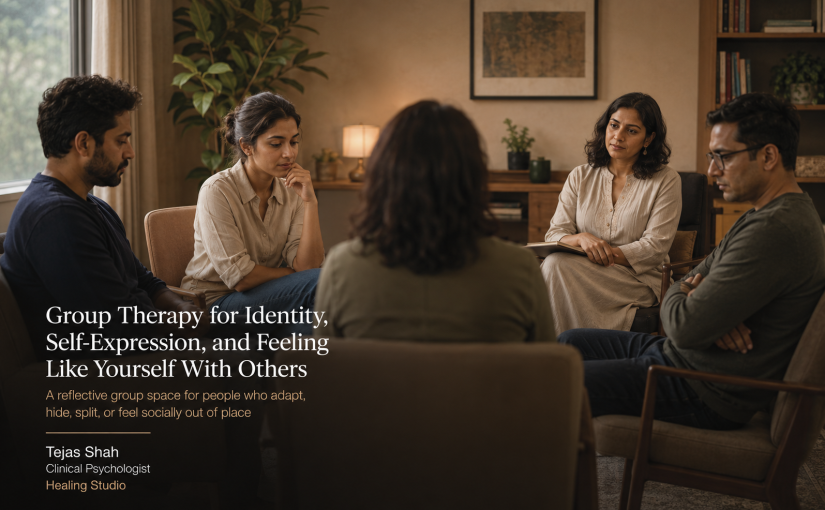
You may look composed around people and still feel strangely absent inside. Group Therapy for Identity, Self-Expression, and Feeling Like Yourself With Others is for people who adapt too much, hide parts of themselves, feel socially out of place, or struggle to remain coherent in relationships.
Some people become fluent in reading the room. They sense what others need, what is acceptable, what should not be said, and which version of themselves will be safest. Over time, this can become exhausting. You may be liked, included, or even admired, while privately feeling unreal.
At Healing Studio, Tejas Shah, Clinical Psychologist, Philosophical Counsellor, and Group Analyst, offers group therapy for adults who want to understand how identity, self-expression, shame, belonging, and social difference come alive in the presence of others.
Tejas Shah
Clinical Psychologist | Philosophical Counsellor | Group Analyst
In-person: Group therapy in Mumbai at our Borivali clinic
Online: Zoom sessions where appropriate
Call / WhatsApp: +917977501648
Email: [email protected]
“Sometimes the problem is not that you do not have a self. It is that your self has learned to disappear in order to stay safe with others.” — Tejas Shah
When You Adapt So Much That You Lose Contact With Yourself
Some people do not enter a group as themselves. They enter as a scanner.
They notice who has power, who may judge, who seems fragile, who must be pleased, who should not be offended, and who needs them to become a certain kind of person. This can happen in families, friendships, workplaces, communities, classrooms, romantic relationships, and therapy groups.
You may find yourself thinking:
- I do not feel fully myself around people.
- I become what the room needs.
- I adapt too much before I even realize it.
- I act confident, agreeable, clever, quiet, useful, or harmless depending on the setting.
- I hide important parts of myself to remain acceptable.
- I feel split between the person I perform and the person I privately feel myself to be.
- I feel socially out of place, even when nobody is openly excluding me.
- I do not know who I am when different people expect different versions of me.
This is not always obvious from the outside. Many people who struggle with identity and self-expression are socially skilled. They may be articulate, polite, competent, sensitive, or emotionally intelligent. However, their social intelligence may have become a kind of self-erasure.
In clinical work, this kind of difficulty often appears not as one dramatic identity crisis, but as a repeating relational pattern. The person slowly begins to notice that they can function with others, but cannot quite feel real with others.
Who This Group Therapy Is For
This work may be useful if you:
- lose your own preferences when you are with stronger personalities
- become agreeable even when you disagree
- feel different in different groups and do not know which version is real
- hide your caste, class background, sexuality, gender experience, family history, emotional need, ambition, anger, or vulnerability
- feel like you are performing normalcy
- feel accepted only when certain parts of you stay invisible
- feel socially “almost included” but not deeply known
- struggle to speak from your own position in a group
- feel shame when your difference becomes visible
- become overly careful, charming, useful, quiet, intellectual, funny, or emotionally unavailable to manage how others see you
This page is also for people who are not looking for a dramatic identity label. You may simply feel that something about your presence with others is constrained. You are there, but not fully there.
Group therapy for identity, self-expression, and feeling like yourself with others in Mumbai may help when identity becomes relationally unsafe
Identity is not only an inner matter. It is also shaped in relationship. You may know who you are when alone, yet lose that clarity when watched, evaluated, desired, judged, depended upon, compared, or placed within hierarchy.
Group therapy gives this difficulty a living context. Instead of only speaking about how you adapt elsewhere, you may begin to notice how you adapt in the group itself.
The Many Ways People Stop Feeling Real With Others
Identity struggles are not always loud. They often look ordinary.
Someone may laugh at things they do not find funny. Someone may soften their intelligence to avoid seeming arrogant. Someone may hide privilege because they feel guilty. Someone may hide disadvantage because they feel exposed. Someone may avoid naming caste, class, sexuality, gender, religion, disability, family structure, divorce, desire, grief, anger, or ambition because the social cost feels too high.
In Indian relational life, identity is often not treated as purely personal. Families, communities, workplaces, caste locations, class codes, gender expectations, marriage norms, educational background, English fluency, skin colour, religion, sexuality, and professional status can all shape whether a person feels permitted to be visible.
This is why “just be yourself” can be a painfully shallow instruction. For many people, being oneself has never been socially neutral.
Psychologically, the issue may involve more than self-confidence. It may involve shame, fear of exclusion, attachment insecurity, defensive adaptation, social hierarchy, internalized judgement, and earlier learning about which parts of the self were welcomed or punished.
Losing Yourself Around Others: When You Become What the Room Needs
When adaptation becomes survival
Some people learned early that belonging required adjustment. They became sensitive to mood, tone, expectation, and unspoken rules. This may have helped them survive family tension, social judgement, academic pressure, caste or class anxiety, gender policing, emotional unpredictability, or environments where difference was unsafe.
As adults, this adaptation can become automatic.
You may enter a room and almost instantly become:
- the responsible one
- the harmless one
- the impressive one
- the agreeable one
- the funny one
- the silent one
- the emotionally available one
- the low-maintenance one
- the one who does not make others uncomfortable
At first, this may look like maturity. However, it can also become a loss of contact with desire, anger, need, spontaneity, and truth.
In group therapy, this pattern can become visible in real time. You may notice when you hold back, when you perform, when you agree too quickly, when you monitor others, or when you disappear into the emotional requirements of the room.
The work is not to become careless or self-absorbed. The work is to become more present without abandoning yourself.
Not Knowing Who You Are With Others: When Every Setting Pulls Out a Different Self
When identity changes from room to room
Some people do not feel like they have one stable social self. They become different in friendships, family, work, romantic relationships, professional groups, and community spaces.
A person may feel bold with one group and mute in another. They may feel intelligent at work but childish with family. They may feel progressive in one context and deeply conservative in another. They may feel emotionally alive with strangers but frozen with people who know them.
This can create a private question: “Which one is me?”
Group therapy can help explore this without rushing to a simple answer. Different parts of the self may have developed for different relational contexts. Some parts may protect you. Some may carry shame. Some may hold longing. Some may be trying to remain loyal to family, community, or earlier survival strategies. Some may be newer, less practiced, and easily frightened.
The aim is not to force one fixed identity. Human beings are multiple. The aim is to develop a more coherent relationship to your own multiplicity.
You may begin to ask:
- What happens to me when I feel watched?
- Which people make me shrink?
- Where do I become false?
- Which version of me feels most alive?
- Which version of me gets punished?
- What do I fear would happen if I spoke more honestly?
- What parts of me have never had a relational home?
Social Difference, Shame, and Belonging: Class, Caste, Gender, Sexuality, and Visibility
When difference becomes emotionally expensive
For many people, the difficulty of feeling like oneself with others is not only personal. It is social and historical.
Class, caste, gender, sexuality, religion, disability, colour, language, education, accent, body, marital status, family background, and migration history can shape whether a person feels seen, misread, exoticized, judged, envied, pitied, erased, or reduced.
Some people carry class shame. Some carry caste silence. Some carry the fear that if they name their background, they will be placed lower or treated differently. Some carry privilege that feels hard to speak about honestly. Some feel that their gender or sexuality is tolerated only if it remains quiet, aesthetic, or non-disruptive. Some belong nowhere cleanly because they live between worlds.
In groups, these issues often become emotionally alive. Who speaks easily? Who hesitates? Who feels entitled to space? Who apologizes before speaking? Who fears being misunderstood? Who becomes the representative of a whole category? Who hides their difference to avoid being reduced to it?
Group therapy can offer a careful space to notice these dynamics. It does not pretend that all people enter the room with equal social ease. It can help people explore how hierarchy, shame, silence, visibility, and belonging affect the capacity to speak as oneself.
This work requires seriousness. Difference should not be turned into a slogan. It must be approached with psychological depth, social awareness, and respect for the person’s lived context.
Hiding Parts of Yourself to Stay Acceptable
When acceptance feels partial
Some people are accepted, but only in edited form.
They may feel welcome as long as they are pleasant, successful, calm, heterosexual enough, masculine enough, feminine enough, caste-neutral enough, modern enough, traditional enough, emotionally contained enough, respectable enough, grateful enough, or not too needy.
This creates a painful split. You may be socially included, yet privately feel unknown.
You may hide:
- anger
- sadness
- ambition
- doubt
- sexuality
- gender experience
- caste location
- class history
- family conflict
- emotional need
- loneliness
- political views
- spiritual doubt
- intellectual difference
- body-related shame
- desire for care
- resentment toward expected roles
The problem is not only secrecy. The deeper problem is that hidden parts of the self often remain emotionally undeveloped. They have no place to be spoken, challenged, understood, mourned, or integrated.
In group therapy, a person may slowly experiment with being known in a less edited way. This does not mean sudden confession. It means discovering whether more of the self can exist in relationship without collapse, rejection, or self-attack.
“Being known is not the same as being exposed. Good therapy helps people discover the difference.” — Tejas Shah
How Group Therapy Can Help With Identity and Self-Expression
The group becomes a live emotional mirror
Individual therapy can help you understand your inner world. Group therapy adds another dimension. It allows you to notice how your identity takes shape in the presence of others.
In a therapy group, you may begin to see:
- how quickly you adapt
- whom you try to please
- whose approval feels important
- when you become quiet
- when you perform intelligence, humour, competence, or indifference
- when you feel excluded, superior, inferior, ashamed, or invisible
- how you respond when someone sees you accurately
- how you respond when someone misunderstands you
- what you hide when the group becomes emotionally real
This is why group therapy can be particularly relevant for identity and self-expression concerns. The struggle itself is relational, so the therapeutic setting also needs to include relationship.
The aim is not to become perfectly authentic in every moment. That would be another performance. The aim is to become more aware, more internally connected, and more able to choose how you relate.
Over time, group therapy may help you:
- recognize your relational roles
- speak from a more honest position
- tolerate being seen without immediately editing yourself
- understand shame and self-censorship
- notice how social difference affects belonging
- become less dependent on approval
- develop a more coherent sense of self with others
- risk small moments of truth in a contained setting
My Approach to Group Therapy for Identity and Self-Expression
My approach to this work is informed by psychodynamic thinking, group analysis, relational psychotherapy, mentalization, narrative sensitivity, queer-affirmative practice, caste-aware and social-justice informed reflection, and philosophical counselling where relevant.
In practical terms, this means we pay attention not only to what you say, but also to what happens between people.
We may explore questions such as:
- What role do you repeatedly take in groups?
- What do you imagine others see when they look at you?
- What parts of yourself feel unsafe to show?
- How do hierarchy, family, caste, class, gender, sexuality, and respectability shape your self-expression?
- When do you feel most false?
- When do you feel most real?
- What happens when someone responds to you differently than expected?
- What kind of belonging are you seeking?
This work is not about pushing people to disclose before they are ready. Nor is it about celebrating authenticity in a simplistic way. Some concealment has history. Some adaptation was once necessary. Some silence protected dignity. Some self-censorship emerged in environments where truth had consequences.
Therapy respects that.
At the same time, therapy also asks whether old protections are now costing too much.
Why Work With Tejas Shah
Tejas Shah is an RCI-Licensed Clinical Psychologist, Philosophical Counsellor, and Group Analyst. He works with adults, couples, families, and groups at Healing Studio, Mumbai.
His work may be especially relevant for this page because identity and self-expression are not only individual issues. They often involve relationships, family systems, group dynamics, social hierarchy, shame, belonging, and the difficulty of becoming visible without being reduced.
Relevant aspects of his background include:
- RCI-Licensed Clinical Psychologist
- Qualified Group Analyst, Institute of Group Analysis, London
- Founder, Institute of Group Analysis India
- M.Phil. in Clinical Psychology, MSc Psychology, and MA Philosophy
- Training in psychodynamic psychotherapy, ISTDP, CBT, RECBT, ACT, MBT, narrative therapy, and queer affirmative counselling practice
- Over 16 years of clinical experience
- Over 16,000 hours of therapeutic experience
- Clinical practice at Healing Studio since 2010
Drawing from my work as an RCI-Licensed Clinical Psychologist and Group Analyst, I often find that people can describe their social discomfort clearly, but need help understanding the deeper emotional position they take in groups. Some become pleasing, some become invisible, some become impressive, some become watchful, and some become split. The therapeutic task is to understand these positions carefully, not shame them, and then create room for a more truthful self to emerge.
This page is meant for education and guidance, not as a substitute for therapy, diagnosis, or personalized clinical advice.
What to Expect in the First Consultation
The first consultation is not a test of whether you are “group-ready.” It is a conversation.
We may discuss:
- what brings you to therapy now
- whether you struggle more with adaptation, hiding, identity confusion, social difference, or self-expression
- how these patterns show up in family, friendships, work, romantic relationships, or communities
- whether group therapy is suitable at this stage
- whether individual therapy, group therapy, or a combination may be more useful
- what concerns you have about joining a group
- what pace would feel clinically appropriate
Many people feel anxious about group therapy. This is understandable. If your difficulty involves being seen by others, then entering a group may feel exposing. The purpose of the consultation is to assess fit carefully, not to push you into a format that does not suit you.
Group therapy may not be appropriate for everyone at every point. Some people may need individual therapy first. Some may benefit from group therapy later. Some may use both formats together.
Practical Details
In-person Location: Providing Group Therapy for Identity, Self-Expression, and Feeling Like Yourself With Others in Mumbai at our Borivali clinic.
Nearby areas: Serving group therapy across Borivali East, Borivali West, Kandivali, Dahisar, Mira Road, Goregaon and the Western Suburbs in Mumbai.
Online: Zoom sessions may be available where clinically appropriate, including for people in India and abroad.
For: Adults dealing with identity, self-expression, social adaptation, hiding parts of themselves, social difference, belonging, shame, and relational selfhood.
Call / WhatsApp: +917977501648
Email: [email protected]
If you are considering Group Therapy for Identity, Self-Expression, and Feeling Like Yourself With Others in Mumbai, you can get in touch to schedule an initial consultation with Tejas Shah.
FAQs
1. How do I know if group therapy for identity and self-expression is right for me?
It may be relevant if you repeatedly feel unlike yourself around others, adapt too much, hide parts of yourself, or feel socially out of place. It may also help if your distress becomes strongest in groups, families, friendships, workplaces, or communities.
2. Is this only for people with a major identity crisis?
No. Many people seeking this work are not in an obvious crisis. They may function well, but feel internally split, socially edited, or unable to feel real with others.
3. What if I am scared to speak in a group?
That fear itself may be clinically meaningful. Group therapy does not require you to reveal everything quickly. The work includes understanding what makes speaking, being seen, or occupying space feel difficult.
4. Can group therapy help if I hide parts of myself because of caste, class, gender, or sexuality?
It may help, especially when the group is held with psychological care and social awareness. These concerns require sensitivity. The work is not to force disclosure, but to understand how social difference, shame, silence, and visibility affect your emotional life.
5. What is the difference between individual therapy and group therapy for this issue?
Individual therapy helps you explore your inner world in depth. Group therapy allows you to notice how your patterns appear with others in real time. For identity and self-expression issues, this live relational setting can be especially useful.
6. Will I be expected to share very personal things?
No. Group therapy should respect pace, safety, and readiness. You may gradually notice what you choose to share, what you hide, and what feelings arise when others see or respond to you.
7. Do you offer online group therapy?
Online group work may be possible where appropriate. Suitability depends on the person, the concern, privacy, group composition, and clinical fit. This can be discussed during the initial consultation.
Book a Consultation
If you feel that you become what others need, hide too much, or lose contact with yourself in relationships, group therapy may offer a serious space to understand that pattern.
You do not need to arrive with a polished explanation. It is enough to say that you are struggling to feel fully yourself with others.
To enquire about Group Therapy for Identity, Self-Expression, and Feeling Like Yourself With Others in Mumbai, contact Healing Studio to schedule an initial consultation with Tejas Shah.
Call / WhatsApp: +917977501648
Email: [email protected]
Tejas Shah is a Clinical Psychologist and Group Analyst at Healing Studio.
He works with adults, couples, families, and groups on emotional, relational, identity, and personality-related difficulties. His group therapy work is informed by psychodynamic psychotherapy, group analysis, relational thinking, philosophical reflection, and sensitivity to Indian social and cultural contexts. At Healing Studio, he offers in-person therapy in Mumbai and online sessions where appropriate.
Tejas Shah’s Healing Studio >> Therapy Clinic in Borivali >> Group Therapy