
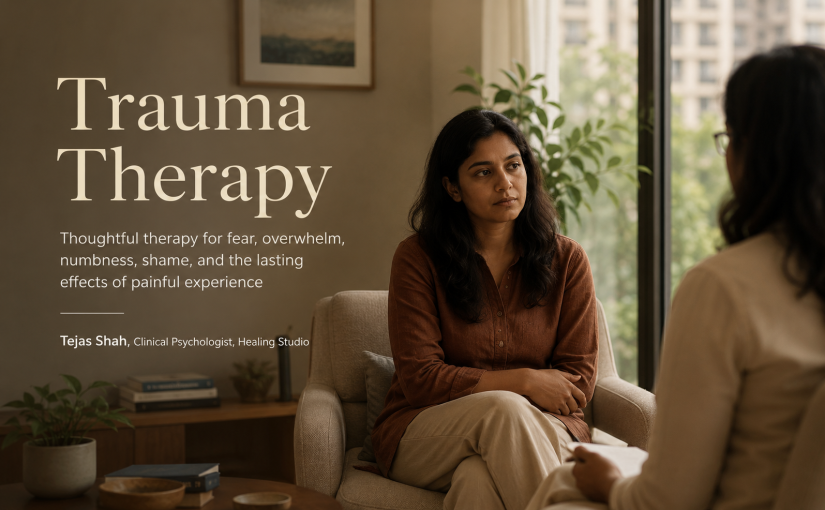
Trauma Therapy can be helpful when a painful experience is over in reality, but still active inside you. You may be dealing with fear, emotional overwhelm, numbness, mistrust, shame, panic, or relationship difficulties, and may find that the past keeps shaping how you respond in the present. If you are looking for trauma therapy in Mumbai or online, the question is often not only what happened, but how deeply it continues to live in the mind, body, and emotional life.
I offer trauma therapy for adults in a paced, respectful, and psychologically in-depth way. The work is not about pushing you to relive what happened. It is about helping you understand its effects, reduce its hold, and gradually build more safety, stability, and emotional freedom.
Tejas Shah
Clinical Psychologist | Philosophical Counsellor | Group Analyst
In-person: Borivali, Mumbai
Online: Zoom sessions for clients in India and abroad
Call / WhatsApp: +91 79775 01648
Email: [email protected]
“Trauma often survives not only as memory, but as a way the mind and body learn to stay braced.” — Tejas Shah
When trauma continues after the event is over
Some people know clearly that they have been through trauma. Others do not use that word, but still feel that something in them remains unsettled, guarded, or deeply affected. Trauma is not limited to one type of event. It may follow childhood neglect, emotional abuse, betrayal, sexual violation, bullying, chronic fear, humiliation, family violence, sudden loss, medical events, accidents, or living for long periods without safety.
Trauma is not always obvious
Trauma does not always look dramatic from the outside. You may appear functional, thoughtful, and composed, while inwardly feeling on edge, disconnected, or unable to trust your own responses. In therapy, this issue often appears less as one isolated event and more as a pattern that keeps returning through fear, self-protection, emotional shutdown, or difficulty feeling safe with oneself or others.
You may relate to trauma therapy if you notice:
- you feel easily overwhelmed, startled, or emotionally flooded
- you go numb, blank, or shut down under stress
- you struggle with trust, closeness, or feeling safe in relationships
- you carry shame, self-blame, or confusion about what happened
- you keep replaying certain memories, feelings, or body reactions
- you avoid situations, conversations, or reminders that feel too activating
- you feel stuck between wanting help and fearing emotional exposure
Trauma may affect the body, emotions, and relationships
Trauma may show up through panic, sleep disturbance, irritability, dissociation, hypervigilance, emotional numbness, guilt, sexual difficulty, people-pleasing, or repeated relational patterns. Sometimes the person is not only remembering the past, but still living from an inner expectation of danger, rejection, invasion, or helplessness.
This is not only a symptom problem. Psychologically, trauma may also affect emotional regulation, defensive style, attachment, bodily safety, and the capacity to trust one’s own mind and feelings. That is why trauma therapy needs care, pacing, and emotional containment, not pressure.
Who trauma therapy may help
Trauma therapy may be useful for:
- adults affected by childhood trauma, neglect, or emotionally unsafe family environments
- people living with the effects of abuse, betrayal, assault, or coercive relationships
- those who feel chronically guarded, numb, ashamed, or mistrustful
- people with panic, hypervigilance, dissociation, or strong body-based fear reactions
- adults who function outwardly but feel inwardly unsafe or fragmented
- those whose relationships are shaped by fear, over-accommodation, withdrawal, or difficulty with closeness
Why people seek trauma therapy
People often seek trauma therapy not at the moment of the event, but later, when its effects start shaping daily life more visibly. A person may notice that they cannot settle, cannot trust, cannot rest, or cannot feel fully present even when life looks “normal” on the surface. Others come because they keep repeating the same relational pattern, and sense that something older is active underneath it.
From clinical work, I have often found that people arrive with a clear account of what keeps happening now, but need help making sense of the deeper emotional structure underneath it. In trauma work, this often means understanding not only the painful experience itself, but also the survival strategies that developed around it. These strategies may once have been necessary. However, later they may begin to limit closeness, spontaneity, self-trust, and freedom.
In an Indian context, trauma can also be difficult to name because many people grow up normalising fear, emotional invalidation, family enmeshment, coercion, or silence around painful experiences. Some have never been given language for what happened to them. They only know that they remain tense, guarded, self-doubting, or unable to feel fully safe.
My approach to trauma therapy
A paced, containing way of working
My approach to trauma therapy is depth-oriented, trauma-informed, and careful about emotional safety. I do not assume that healing comes from forcing disclosure. Depending on the person, therapy may involve understanding triggers, noticing body states, working with emotional overwhelm, making sense of shame and self-blame, identifying protective patterns, and slowly building a more stable inner experience.
I draw from psychodynamic and relational thinking, with relevant use of CBT-informed, ACT-informed, and mentalization-based perspectives where appropriate. The aim is not only symptom relief, although that matters. It is also to help you understand how trauma may have shaped your inner world, relationships, identity, and ways of protecting yourself.
“Good trauma therapy does not push the person past their emotional capacity. It helps them build capacity.” — Tejas Shah
In many cases, trauma is held not only in explicit memory, but in expectation, posture, tone, vigilance, avoidance, and relationship patterns. So therapy may involve working slowly enough that insight does not outrun emotional safety. Where appropriate, the work may include:
- understanding how trauma affects present-day relationships
- recognising fear, shame, anger, helplessness, or numbness without being overtaken by them
- reducing compulsive self-blame or confusion
- working with dissociation, shutdown, or emotional disconnection
- strengthening emotional regulation and reflective capacity
- gradually developing a stronger sense of internal safety and choice
Why work with Tejas Shah for trauma therapy
I offer trauma therapy as an RCI-Licensed Clinical Psychologist with over 16 years of clinical experience and 16,000+ hours of therapeutic experience. I have been in clinical practice at Healing Studio since 2010, working with adults, couples, families, and groups.
Relevant aspects of my background include:
- M.Phil. in Clinical Psychology (RCI), MSc Psychology, and MA Philosophy, which support both clinical grounding and deeper reflective work
- training in Intensive Short Term Dynamic Psychotherapy (ISTDP), which is relevant when trauma is bound up with strong emotion, defence, and relational difficulty
- training in Cognitive Behaviour Therapy (CBT) and Acceptance and Commitment Therapy (ACT), useful where trauma involves anxiety, avoidance, rigid fear patterns, or self-critical thinking
- training in Mentalization Based Therapy (MBT), relevant when trauma affects self-understanding, trust, and emotional regulation
- a serious, integrative practice that remains attentive to both immediate distress and deeper recurring patterns
I am also attentive to how trauma can be shaped by Indian family systems, hierarchy, silence, gendered pressures, caste realities, social shame, and intergenerational emotional patterns. Not every traumatic experience looks the same, and not every person needs the same kind of therapeutic pace. The work is tailored accordingly.
What to expect in the first few sessions
The first session is not an interrogation and not a demand to tell the whole story. It is a space to begin understanding what brings you, what feels difficult now, how long the effects have been present, and what kind of support may be useful.
In early trauma therapy, we may focus on:
- what currently feels most difficult
- how your system responds under stress
- what situations feel activating, disorganising, or shutting down
- what you do to cope, protect yourself, or get through
- whether individual trauma therapy is the right fit at this stage
Some people begin by talking directly about the trauma. Others begin with present symptoms, relationship patterns, or a sense of inner unease. Both are valid. Therapy can move at a pace that respects your capacity.
Trauma therapy in Mumbai and online
In-person Location: Providing Trauma Therapy in Mumbai at our Borivali, clinic.
Nearby areas: Serving Trauma Therapy across Borivali East, Borivali West, Kandivali, Dahisar, Mira Road, Goregaon and the Western Suburbs in Mumbai.
Online: Zoom sessions for clients in India and abroad.
Call / WhatsApp: +91 79775 01648
Email: [email protected]
Online trauma therapy may be helpful if you live outside Mumbai, travel frequently, or prefer the privacy of working from home. I also work with Indians living abroad where relevant, especially when trauma is intertwined with family pressure, migration strain, isolation, or difficulties that are not easily understood outside Indian cultural contexts.
FAQs about trauma therapy
1. How do I know if what I went through counts as trauma?
You do not need to be certain before seeking help. Many people come to therapy unsure whether their experience “qualifies” as trauma. What matters clinically is whether the experience continues affecting your emotional safety, body responses, trust, or daily life.
2. Will trauma therapy make me relive everything?
Not necessarily. Trauma therapy should not force emotional exposure faster than you can manage. The work is usually paced and containing. It may begin with present difficulties, triggers, and patterns before going deeper.
3. Can trauma show up as numbness rather than fear?
Yes. Trauma can involve hyperarousal, but it can also show up as emotional deadness, detachment, shutdown, or a sense of not fully feeling real or connected.
4. Do you work with childhood trauma?
Yes, where appropriate. Childhood trauma may continue affecting adult relationships, self-worth, emotional regulation, shame, trust, and the ability to feel safe. Therapy can help make sense of those longer patterns.
5. Is trauma therapy only for PTSD?
No. Some people meet criteria for PTSD, but many others seek trauma therapy because of unresolved fear, shame, dissociation, emotional instability, or lasting effects of painful experiences that do not fit neatly into one label.
6. Do you offer trauma therapy online?
Yes, apart from trauma therapy in Mumbai, online sessions are available where appropriate. Some people find online work more accessible and private, especially if they are outside Mumbai or living abroad.
7. What if I am not ready to speak about everything yet?
That is completely acceptable. Real trauma therapy respects readiness. You do not need to arrive fully prepared or fully articulate. Therapy can begin with what feels possible to say now.
This page is educational in nature and cannot replace therapy, diagnosis, or an individualized clinical assessment.
Book a consultation for trauma therapy
If you are looking for trauma therapy, you do not need to have everything figured out before reaching out. It is common to feel unsure, cautious, or conflicted about starting. An initial consultation can help clarify what is happening and whether this way of working feels like a fit.
Call / WhatsApp: +91 79775 01648
Email: [email protected]
Tejas Shah is a Clinical Psychologist and Individual Therapist at Healing Studio. He works with adults facing trauma, anxiety, panic, shame, emotional overwhelm, relational difficulty, and deeper repeating patterns that may have roots in painful past experiences. His approach is psychologically in-depth, emotionally careful, and grounded in both clinical seriousness and practical therapeutic work.
Tejas Shah’s Healing Studio >> Therapy Clinic in Borivali >> Individual Therapy