
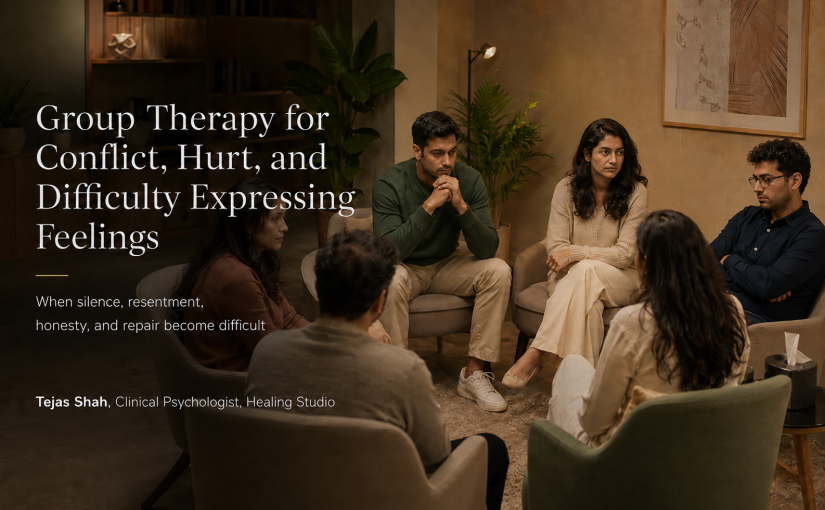
You may be looking for help because conflict has become too costly. Perhaps you stay quiet, avoid saying what you feel, joke instead of being direct, or hold things in until they come out sharply. Group therapy for conflict, hurt, and difficulty expressing feelings can help when relationships are shaped by resentment, silence, mixed signals, emotional rupture, or fear of honesty.
At Healing Studio, Tejas Shah offers group therapy for adults who want to understand how they handle anger, hurt, disagreement, repair, and emotional expression in relationships. This work is not about forcing people to “open up” or become confrontational. It is about learning what happens inside you when feelings become risky to speak.
Tejas Shah
Clinical Psychologist | Philosophical Counsellor | Group Analyst
In-person: Borivali, Mumbai
Online: Zoom sessions where appropriate
Call / WhatsApp: +917977501648
Email: [email protected]
“Some people do not avoid conflict because they lack courage. They avoid it because, somewhere in their emotional history, honesty began to feel dangerous.” — Tejas Shah
When Feelings Stay Unspoken for Too Long
Many people do not experience conflict as a simple disagreement. They experience it as danger.
A small tension may feel like rejection. A direct conversation may feel like an attack. A request may feel selfish. Anger may feel frightening, both in oneself and in others. So the person stays quiet, adjusts, jokes, withdraws, or pretends that nothing is wrong.
However, feelings do not disappear because they are hidden. They often return as irritation, sarcasm, distance, sudden outbursts, emotional shutdown, or the quiet decision to stop trying.
You may recognize yourself in some of these patterns:
- You keep saying “it’s fine” when it is not fine.
- You avoid difficult conversations until resentment builds.
- You become reactive after staying silent for too long.
- You fear that honesty will lead to blame, rejection, or punishment.
- You shut down when someone is disappointed with you.
- You joke, tease, or become sarcastic instead of saying what hurts.
- You cut people off after one painful misunderstanding.
- You want repair, but you do not know how to return after hurt.
- You feel ashamed after expressing anger.
- You often feel misunderstood, but find it hard to explain yourself.
In clinical work, this difficulty often appears not as one dramatic incident, but as a repeating emotional rhythm. A person may seem composed on the outside, while inwardly carrying accumulated hurt, fear, resentment, and unspoken protest.
Who This Group Therapy May Help
This group therapy may be useful for adults who find that conflict, hurt, and emotional expression repeatedly become difficult in their relationships.
It may help people who:
- suppress feelings to keep peace
- fear confrontation or emotional backlash
- become angry only after a long period of silence
- struggle with resentment in close relationships
- avoid disagreement until distance grows
- shut down when tension appears
- feel easily hurt, rejected, or misunderstood
- use humour, sarcasm, or teasing to hide vulnerability
- struggle to repair after emotional rupture
- want to relate more honestly without becoming harsh or defensive
This work may be relevant in friendships, romantic relationships, family relationships, workplace dynamics, therapy groups, and other emotionally significant spaces.
It may also help people who are outwardly functional but inwardly tense. Many people who struggle with emotional expression are not visibly chaotic. They may be responsible, intelligent, caring, and socially skilled. The problem is not that they feel nothing. The problem is that feeling something directly with another person feels too exposed.
The Five Emotional Patterns This Group Therapy Works With
This page belongs to a broader service area: Group Therapy for Conflict, Hurt, and Difficulty Expressing Feelings. Within that, many people recognize one or more specific patterns.
These patterns often overlap. A person may fear honesty, hold things in, joke around pain, avoid conflict, and then feel unable to repair after the relationship becomes strained. Group therapy can help these patterns become visible in real time, because groups naturally bring up differences, misunderstandings, hesitation, care, anger, silence, and repair.
1. The Pressure Cooker Pattern: Holding Things In Until They Burst Out
Some people swallow hurt for too long. They tell themselves that it is not worth bringing up, that the other person will not understand, or that they should be mature enough to manage it alone.
At first, this may look like patience. Over time, it becomes emotional pressure.
You may keep quiet through small disappointments, unmet needs, unfairness, or subtle disrespect. Then, when something minor happens, the reaction feels bigger than the situation. You may explode, collapse, cry, go cold, or lose perspective. Afterward, you may feel guilty or confused.
This pattern often includes themes such as suppressed hurt, sudden outbursts, resentment, unspoken needs, emotional breaking points, and the painful question: “Why do I stay quiet for so long and then react so strongly?”
Group therapy can help you notice the earlier signs of emotional pressure. Instead of discovering your feelings only at the breaking point, you may begin to recognize them while they are still speakable.
2. The Risk Pattern: Fear of Honesty and Backlash
For some people, honesty feels dangerous. It may seem safer to soften the truth, delay it, dilute it, or wrap it in reassurance.
You may say “no hard feelings” before saying something difficult. You may over-explain. You may prepare for retaliation before the other person has even responded. You may fear silence, blame, withdrawal, rejection, punishment, or emotional collapse.
This is not always irrational. Many people have learned, through family, relationships, school, work, or past intimacy, that honesty can invite backlash. In Indian families and close social networks, where emotional boundaries can be blurred, speaking directly may feel like betrayal rather than communication.
This pattern includes fear of speaking honestly, fear of backlash, fear of rejection, fear of being blamed, and the feeling that truth is more dangerous than silence.
Group therapy offers a live but contained space to explore what honesty feels like with others. You can begin to test whether directness always leads to damage, or whether there are ways to speak truth without becoming cruel, defensive, or apologetic for existing.
3. The Collision Pattern: Conflict Avoidance, Escalation, or Shutdown
Some people avoid conflict completely. Some escalate quickly. Some shut down the moment tension appears. Often, the same person may move between all three.
You may stay silent for weeks, then overreact in one conversation. You may want to discuss something calmly, but your body responds as if danger is present. You may become blank, numb, sarcastic, loud, rigid, or suddenly detached.
Small tensions may feel huge because they do not remain small inside you. They may touch older fears: being abandoned, humiliated, controlled, blamed, ignored, or emotionally overpowered.
This pattern includes fear of disagreement, emotional shutdown, overreaction, conflict collapse, and getting hurt too fast in relationships.
In group therapy, disagreement does not have to become destruction. The group can become a place where tension is noticed, slowed down, and understood. That is often where real change begins. Not by avoiding conflict, but by learning to remain psychologically present inside it.
4. The Broken Bridge Pattern: Repair After Hurt, Rupture, or Misunderstanding
Some people can tolerate closeness until there is hurt. After that, something closes.
One misunderstanding may feel final. One disappointment may confirm that the relationship is unsafe. One moment of anger may make return feel impossible. The person may cut off, withdraw, become polite but distant, or silently decide never to need that person again.
This pattern is often misunderstood as coldness. More often, it is self-protection. Repair may feel humiliating, risky, or pointless. The person may fear that returning means surrendering self-respect.
This pattern includes difficulty repairing after hurt, coming back after rupture, cutting people off after one injury, staying connected through anger or disappointment, and the feeling that one misunderstanding changes everything.
Group therapy is especially relevant here because rupture and repair are part of group life. Misunderstandings can happen. Feelings can get stirred. Someone may feel unseen, interrupted, excluded, or misread. The work is not to avoid all rupture. The work is to learn whether repair is possible without losing dignity.
5. The Joke That Carries a Wound: Humour, Sarcasm, and Teasing That Hide Feeling
Humour can create warmth. It can also hide pain.
Some people joke when they want closeness. They tease when they feel vulnerable. They become playful-combative when they are hurt, jealous, ashamed, or afraid of direct emotional contact. The result can be confusing. Others may not know whether the person is joking, attacking, flirting, protesting, or asking for care.
This pattern includes joking instead of saying what one feels, sarcasm that hides hurt, banter as the only safe form of closeness, mixed signals, and fight-play as a disguised wish for contact.
In group therapy, these indirect forms of expression can become visible. A person may begin to notice how humour protects them, how it reaches for others, and how it sometimes prevents others from knowing them more honestly.
Humour does not have to disappear. But it may become freer when it no longer has to carry all the pain alone.
How Group Therapy Helps With Conflict, Hurt, and Emotional Expression
Group therapy is useful for these concerns because conflict and emotional expression are relational problems. They do not only happen inside the mind. They happen between people.
In individual therapy, you may talk about how you avoid conflict, suppress anger, fear honesty, or struggle to repair. In group therapy, some of these patterns may appear in the room itself, in manageable and meaningful ways.
For example:
- You may notice yourself holding back when you disagree.
- You may feel hurt when someone does not respond as expected.
- You may become tense when attention turns toward you.
- You may joke when you feel exposed.
- You may expect criticism before anyone has criticized you.
- You may want to withdraw after a misunderstanding.
- You may discover that others also struggle with directness, anger, shame, and repair.
This does not mean group therapy is chaotic or confrontational. A well-held therapy group is not a place where people attack each other. It is a reflective space where emotional reactions can be slowed down, spoken about, and understood.
The group helps because it gives you more than insight. It gives you experience. You can begin to observe how you relate, how you protect yourself, how others experience you, and what becomes possible when feelings are expressed with more honesty and less fear.
My Approach to Group Therapy for Conflict, Hurt, and Difficulty Expressing Feelings
My approach to group therapy for conflict, hurt, and difficulty expressing feelings in Mumbai is reflective, depth-oriented, and clinically contained. The aim is not to push people into dramatic disclosure. The aim is to help people understand what happens inside them when emotional contact becomes difficult.
The work may involve:
- noticing how you respond to disagreement
- understanding what makes honesty feel unsafe
- identifying resentment before it hardens
- exploring the link between anger, shame, fear, and hurt
- recognizing indirect communication patterns
- understanding silence, withdrawal, sarcasm, and outbursts
- learning how rupture and repair happen in real relationships
- developing more direct emotional language
- staying present when others have feelings that affect you
Psychologically, this is not only a communication problem. It may involve emotional regulation, defensive patterns, attachment insecurity, shame, fear of dependence, and long-standing relational learning.
As a Group Analyst, I pay close attention to the individual and the group. A person’s difficulty with conflict is never only personal. It may also be shaped by family roles, social expectations, gendered emotional rules, caste and class dynamics, hierarchy, authority, community pressure, and the emotional culture in which the person learned to survive.
“Group therapy can show a person not only what they feel, but what they expect others to do with that feeling.” — Tejas Shah
Why Work With Tejas Shah
Tejas Shah is an RCI-Licensed Clinical Psychologist, Philosophical Counsellor, and Group Analyst. He works with adults, couples, families, and groups at Healing Studio, Mumbai.
His clinical work is informed by psychodynamic psychotherapy, group analysis, relational thinking, cognitive and behavioural approaches, couples and family therapy, and philosophical reflection where relevant. For this page, his group analytic training is especially important because the concern is not only emotional expression, but how feeling, silence, hurt, anger, and repair happen between people.
Tejas has over 16 years of clinical experience and has been in practice at Healing Studio since 2010. His training includes Group Analysis from the Institute of Group Analysis, London, ISTDP, CBT, RECBT, ACT, Mentalization Based Therapy, Emotion Focused Therapy, and Couples and Family Therapy.
Drawing from clinical work with individuals, couples, families, and groups, he often finds that visible conflict is only one part of the picture. Beneath it, people may be carrying older emotional positions: the responsible one, the silent one, the explosive one, the joking one, the abandoned one, the one who must never need too much.
Group therapy can help these positions become understandable. Over time, they may also become less rigid.
What to Expect in the First Consultation
The first consultation is not a test of whether you are “ready” for group therapy. It is a space to understand what brings you here and whether this format is suitable.
We may discuss:
- what happens when you feel hurt or angry
- whether you tend to suppress, explode, withdraw, joke, or over-explain
- how conflict has affected your relationships
- whether you struggle more with honesty, repair, resentment, or emotional expression
- whether group therapy, individual therapy, couples therapy, or another format may be most appropriate
- whether in-person or online work is clinically suitable
Some people need individual therapy before entering a group. Some may benefit from group therapy alongside individual therapy. Some may be ready for group therapy because their main difficulties are interpersonal and become clearer in a group setting.
The decision is made carefully.
Practical Details
In-person location: Providing Group Therapy for Conflict, Hurt, and Difficulty Expressing Feelings in Mumbai at our Borivali clinic.
Nearby areas: Serving group therapy across Borivali East, Borivali West, Kandivali, Dahisar, Mira Road, Goregaon, and the Western Suburbs in Mumbai.
Online: Zoom sessions may be available where clinically appropriate.
For: Adults struggling with conflict, emotional suppression, resentment, rupture, honesty, repair, anger, shutdown, sarcasm, or difficulty expressing feelings.
Call / WhatsApp: +917977501648
Email: [email protected]
Appointments: You can get in touch to enquire about an initial consultation with Tejas Shah at Healing Studio.
Reading about a problem can be clarifying, but it cannot replace an individualized assessment or therapeutic process.
FAQs
1. Is group therapy suitable if I avoid conflict?
Yes, group therapy may be useful if you avoid conflict, as long as the group is clinically held and the pace is appropriate. You do not have to become suddenly confrontational. The work often begins with noticing what happens inside you when disagreement, attention, or emotional tension appears.
2. What if I become emotional or reactive in the group?
Strong reactions can become part of the therapeutic work, provided the group is safe and contained. The aim is not to shame emotional reactions, but to understand them. Many people become reactive only after long suppression. Group therapy can help you notice the build-up earlier.
3. Is this the same as anger management?
Not exactly. Anger management often focuses on controlling anger and reducing harmful behaviour. This group therapy looks more deeply at hurt, resentment, fear, shame, avoidance, honesty, repair, and relational patterns. It may include anger, but it is not limited to anger control.
4. Can group therapy help if I find it hard to repair after hurt?
Yes, group therapy can be especially useful for people who struggle with repair. Groups naturally bring up moments of misunderstanding, disappointment, distance, and return. These moments can be worked with carefully, instead of being avoided or treated as failure.
5. Do you offer online group therapy?
Online group therapy may be available where appropriate. Suitability depends on the person, the group, the concern, privacy, stability, and clinical fit. This can be discussed in the initial consultation.
6. How do I know whether I need group therapy or individual therapy?
If your main concern is how you relate with others, group therapy may be useful. If your distress feels too acute, private, overwhelming, or clinically complex, individual therapy may be a better starting point. Sometimes both formats can work together.
7. Will I be forced to share personal things in the group?
No. Group therapy is not about forced disclosure. However, it does invite reflection on what you hold back, why you hold it back, and what happens when you begin to speak more honestly. The pace should remain clinically thoughtful.
Book a Consultation
If you are looking for group therapy for conflict, hurt, and difficulty expressing feelings in Mumbai, you can contact Healing Studio to schedule an initial consultation with Tejas Shah.
This may be useful if you are tired of swallowing feelings, fearing honesty, avoiding conflict, becoming reactive, cutting people off, or using humour to hide hurt. You do not need to have everything clearly figured out before reaching out. The first step is simply to begin understanding the pattern.
Call / WhatsApp: +917977501648
Email: [email protected]
Location: Healing Studio, Borivali, Mumbai
Online: Zoom sessions where appropriate
Tejas Shah is a Clinical Psychologist and Group Analyst at Healing Studio. He works with adults, couples, families, and groups on emotional, relational, and personality-related difficulties. His work with conflict, hurt, silence, anger, rupture, and repair is grounded in psychodynamic, relational, and group analytic thinking. Therapy may help you understand not only what you feel, but how you learned to manage feeling in the presence of others.
Tejas Shah’s Healing Studio >> Therapy Clinic in Borivali >> Group Therapy