
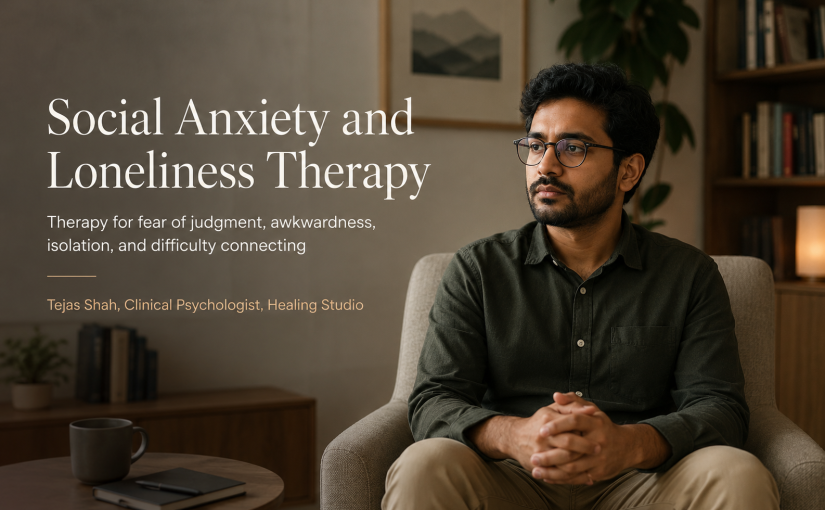
Feeling awkward, watched, or quietly out of place around others can wear a person down over time. If you are looking for Social Anxiety and Loneliness Therapy in Mumbai, you may be struggling with fear of judgment, difficulty speaking freely, avoidance of social situations, or a painful sense of disconnection even when you are not physically alone.
These difficulties are often dismissed as simple shyness or low confidence. In reality, they can affect work, friendships, dating, family life, self-esteem, and your basic sense of belonging. Therapy can help you understand what happens inside you in social situations, why loneliness may have become such a powerful part of your inner life, and how you can begin to relate with more ease and less self-consciousness.
I offer individual therapy for adults facing social anxiety, loneliness, interpersonal discomfort, and difficulty feeling at ease with others. My style is calm, reflective, and depth-oriented. It is not based on pushing you to become socially impressive. It is based on helping you understand your emotional patterns, reduce guardedness, and build a more secure way of relating.
Tejas Shah
Clinical Psychologist | Philosophical Counsellor | Group Analyst
In-person: Borivali, Mumbai
Online: Zoom sessions where appropriate
Call / WhatsApp: +91 7977501648
Email: [email protected]
“Many people do not only fear social situations. They fear what those situations make them feel about themselves.” — Tejas Shah
When social situations feel stressful, exposing, or quietly exhausting
Social anxiety does not always look dramatic. Some people are visibly nervous. Others appear functional, polite, and composed, but remain tense throughout conversations, meetings, gatherings, or even ordinary everyday interactions.
Loneliness can also be more complex than simply being alone. You may have people around you and still feel emotionally cut off, unseen, cautious, or unable to relax into connection. In therapy, this issue often appears less as one isolated problem and more as a recurring emotional pattern that begins shaping confidence, relationships, and daily choices.
Signs this may be more than simple shyness
You may relate to this work if:
- you worry excessively about how you come across to others
- you replay conversations afterward and judge yourself harshly
- you avoid social situations, group settings, calls, meetings, or new interactions
- you struggle to make or keep friends, even when you want closeness
- you feel stiff, awkward, blank, or overly self-aware in conversation
- you hold back your thoughts because you fear sounding foolish, boring, needy, or wrong
- you feel lonely, but also find closeness difficult to trust or sustain
- you often appear fine outwardly, while inwardly feeling tense, excluded, or emotionally alone
Who this therapy can help
This therapy may be useful for:
- adults who feel socially anxious in everyday or professional settings
- people who feel alone even when they are surrounded by others
- those who struggle with awkwardness, inhibition, fear of embarrassment, or chronic self-monitoring
- people who want friendships or relationships, but repeatedly withdraw, hesitate, or overthink
- high-functioning adults whose social anxiety is hidden beneath politeness, competence, or restraint
- those whose loneliness has become tied to self-doubt, shame, or a fragile sense of belonging
Why social anxiety and loneliness often become stuck patterns
Social anxiety is not always only about social skill. Very often, it involves how a person experiences themselves in the presence of others. You may expect criticism, misattunement, dismissal, exposure, or subtle rejection even before anything has actually happened. As a result, you become alert, guarded, careful, and unable to feel spontaneous.
Loneliness can also become self-reinforcing. The more disconnected you feel, the harder it may become to reach outward with confidence. You may start assuming that others are more comfortable, more accepted, or more naturally connected than you are. Over time, this can create a painful cycle: you long for closeness, but feel too tense, doubtful, or defended to move toward it easily.
This is not only a confidence problem. Psychologically, it may also involve shame, attachment insecurity, fear of exposure, defensive withdrawal, and older experiences of not feeling safely received. What looks like quiet awkwardness on the surface may carry a much deeper emotional history underneath it.
For many people in Mumbai, these struggles are intensified by overstimulation, professional pressure, fast-moving social environments, family scrutiny, and the strange isolation that can exist inside crowded urban life. You can be constantly around people and still feel that no one really knows you.
How therapy may help you feel less guarded and more connected
Therapy may help you:
- understand what gets triggered in social situations
- reduce self-consciousness and harsh self-judgment
- explore older emotional patterns linked to shame, exclusion, or fear of being seen
- become less avoidant and more psychologically flexible in relationships
- develop greater ease in speaking, responding, and being present with others
- build a stronger inner sense of belonging, not just better performance in social settings
- form more real, stable, and emotionally satisfying connections
“As a clinician, I often find that people know the pattern well, but not the emotional logic that keeps recreating it.” — Tejas Shah
My approach to Social Anxiety and Loneliness Therapy in Mumbai
My approach is reflective, clinically grounded, and psychologically in-depth. I pay attention not only to the visible problem, but also to the emotional position from which the difficulty keeps repeating. That may include fear of judgment, shame, inhibition, withdrawal, longing for connection, and the ways you protect yourself when closeness feels uncertain.
Depending on the person, therapy may involve understanding present triggers, patterns of avoidance, relational expectations, self-esteem difficulties, and long-standing ways of managing vulnerability. I draw from psychodynamic and relational thinking, while also using structured therapeutic understanding where useful. The aim is not to turn therapy into endless analysis. The aim is to help you become freer, steadier, and less trapped by the same social-emotional pattern.
In my work as an RCI-Licensed Clinical Psychologist, I often see that the stated problem is real, but not always the whole psychological picture. A person may come saying, “I get anxious around people,” but the deeper work may involve how they carry shame, anticipate rejection, or struggle to feel emotionally real in connection.
Why work with Tejas Shah
Choosing a therapist for social anxiety and loneliness is not only about credentials. It is also about whether the therapist can understand guardedness without trivializing it and take loneliness seriously without reducing it to advice about “putting yourself out there.”
I offer work that is serious, calm, and psychologically literate. My aim is to understand the emotional structure of the problem, not just its surface presentation.
Relevant reasons some people choose to work with me include:
- RCI-Licensed Clinical Psychologist, which matters when emotional distress needs careful clinical understanding
- 16+ years of clinical experience and 16,000+ hours of therapeutic work, which supports pattern recognition and depth
- Clinical practice at Healing Studio since 2010, with long-term work across a wide range of emotional and relational concerns
- Training in CBT, ACT, ISTDP, and psychodynamic approaches, which allows the therapy to be thoughtful, flexible, and not one-dimensional
- Work with adults, couples, families, and groups, which helps when loneliness and social discomfort are tied to deeper interpersonal patterns
- Sensitivity to Indian family structures, social pressure, and high-functioning distress, which is often highly relevant in this area
I do not treat loneliness as a minor issue, and I do not treat social anxiety as a personality flaw. Both can be deeply painful. Both deserve serious attention.
What happens in the first session
The first session is a space to understand what brings you, how long the difficulty has been present, what situations tend to trigger it, and what kind of help may be most useful. We may explore not only current symptoms, but also how relationships, self-image, and earlier emotional experiences may connect to the present problem.
You do not need to arrive with a perfect explanation of yourself. You also do not need to prove that your suffering is severe enough. Many people seek help while still functioning outwardly, but no longer feeling at ease inside their own life.
Depending on your situation, the work may focus on:
- current triggers and patterns of avoidance
- shame, self-criticism, and harsh internal narratives
- difficulty initiating or sustaining closeness
- loneliness linked to life transitions, relocation, or emotional isolation
- long-standing relational patterns that make connection feel risky
Sessions are usually held weekly, although this can vary depending on the person and the concern. Therapy may be short-term or longer-term depending on the concern, your goals, and the nature of the pattern. Some people want help with specific social anxiety triggers. Others want to work more deeply on loneliness, self-esteem, belonging, and relational difficulty.
Social Anxiety and Loneliness Therapy in Mumbai, Practical details
In-person Location: Providing Social Anxiety and Loneliness Therapy in Mumbai at the Borivali clinic.
Nearby areas: Serving clients across Borivali East, Borivali West, Kandivali, Dahisar, Mira Road, Goregaon, and the Western Suburbs in Mumbai.
Format: In-person and online, where appropriate
For: Adults
Call / WhatsApp: +91 7977501648
Email: [email protected]
Frequently asked questions
1. How do I know if I need therapy for social anxiety or loneliness?
You may benefit from therapy if fear of judgment, awkwardness, avoidance, or isolation has become repetitive, emotionally costly, or limiting. You do not need to be in crisis. Many people seek help when they are still functioning, but feel increasingly constricted inside.
2. Is this only for people who are extremely shy?
No. Some people are shy, but many are not. They may be articulate, intelligent, and outwardly capable, yet still feel tense, guarded, or disconnected in social situations. The issue is often deeper than temperament alone.
3. Can therapy help if I feel lonely even though I have people around me?
Yes. Loneliness is not always about lack of company. It can also involve emotional distance, difficulty trusting closeness, feeling unseen, or not being able to relax into connection. Therapy can help explore why that happens.
4. Do you offer this online?
Yes, online sessions are available where appropriate. This can be useful for clients in other parts of India or abroad, or for those who prefer the privacy and convenience of online work.
5. Will therapy force me to become more outgoing?
No. The aim is not to push you into a different personality. The aim is to help you feel less trapped by fear, shame, and inhibition, so you can relate more freely and comfortably in ways that are true to you.
6. Is social anxiety always linked to low self-esteem?
Not always, but the two can overlap. Some people struggle more with self-consciousness, shame, harsh self-judgment, or fear of rejection. Others may have more specific anxiety in social or performance settings. Therapy helps clarify the deeper structure.
7. Is therapy confidential?
Yes. Confidentiality is taken seriously within professional and legal limits. Any relevant boundaries and exceptions are discussed clearly in the therapeutic process.
This page is educational in nature and cannot replace therapy, diagnosis, or an individualized clinical assessment.
Book a consultation for Social Anxiety and Loneliness Therapy in Mumbai
If you are looking for Social Anxiety and Loneliness Therapy in Mumbai or individual therapy, you are welcome to get in touch for an initial consultation. Starting therapy can feel exposing, especially when the difficulty already involves fear of judgment or hesitation around people. That is understood.
The first step does not need to be dramatic. It only needs to be honest enough to begin.
Call / WhatsApp: +91 7977501648
Email: [email protected]
Tejas Shah is a Clinical Psychologist and Therapist at Healing Studio. He works with adults facing anxiety, loneliness, self-esteem difficulties, emotional inhibition, and recurring interpersonal patterns. His work is psychologically in-depth, clinically grounded, and attentive to both present distress and older emotional structures. Depending on the person and the problem, therapy may help with greater emotional clarity, more comfortable relating, and a stronger sense of inner steadiness and belonging.
Tejas Shah’s Healing Studio >> Therapy Clinic in Borivali >> Individual Therapy