
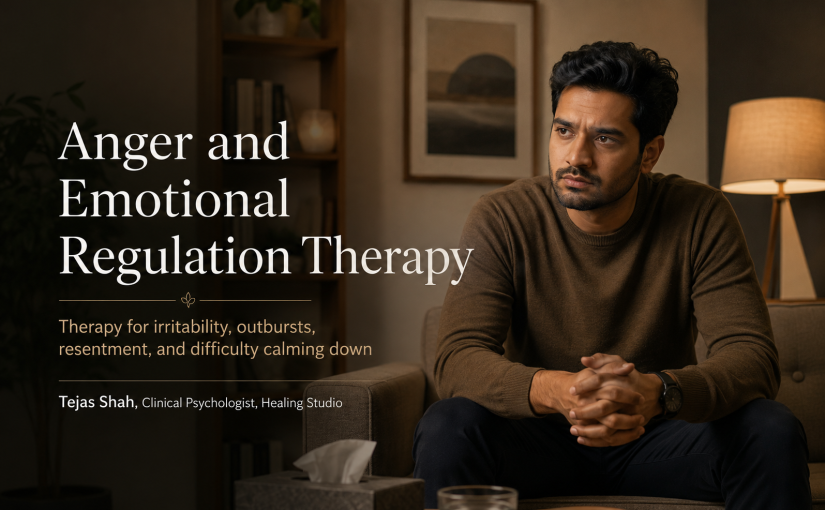
When anger keeps taking over
You may not think of yourself as “an angry person,” yet something keeps happening. Your tone becomes sharp. Small things set you off. You react too fast, say too much, or stay angry long after the moment has passed. If you are looking for anger and emotional regulation therapy in Mumbai, you may already know that the real problem is not just anger. It is what happens inside you before it rises, and what it leaves behind after it spills out.
Anger can involve frustration, hurt, helplessness, jealousy, shame, resentment, or the repeated feeling of being pushed too far. Sometimes it appears as open outbursts. Sometimes it shows up as sarcasm, coldness, irritability, silent punishment, or a constant edge in the body. Therapy can help you understand the pattern more clearly, regulate emotion better, and respond with more steadiness.
I offer anger and emotional regulation therapy for adults in Mumbai, with online sessions also available where appropriate. My work is direct, thoughtful, and emotionally focused. I do not approach anger in a shaming or moralistic way. I try to understand what the anger is doing, what it is protecting, and why it has become difficult to manage.
Tejas Shah
Clinical Psychologist | Philosophical Counsellor | Group Analyst
In-person: Borivali, Mumbai
Online: Zoom sessions where appropriate
Call / WhatsApp: +91 7977501648
Email: [email protected]
“In therapy, anger becomes more workable when it is understood not only as a reaction, but as a signal about what has become difficult to bear.” — Tejas Shah
In clinical work, this difficulty often appears not as one dramatic event, but as a repeating emotional pattern that gradually begins shaping relationships, decisions, and inner life.
How anger may show up
Anger is not always loud. It may look different from person to person. You may recognize yourself here if:
- you become irritable faster than you want to
- your tone becomes harsh with a partner, child, parent, or colleague
- you feel flooded in arguments and cannot calm down easily
- you go from hurt to rage in seconds
- you stay resentful for days and replay the same interaction repeatedly
- you feel guilty after emotional outbursts
- jealousy, suspicion, or feeling disrespected quickly turns into aggression
- you withdraw, become cold, or punish people silently instead of speaking openly
- you know the reaction is too much, but cannot stop it in time
Some people are openly explosive. Others are tightly controlled until they suddenly snap. Some look composed in public but remain chronically tense, reactive, and difficult to soothe in close relationships.
Who this therapy can help
This work may be useful for:
- adults who struggle with irritability, outbursts, or emotional impulsiveness
- people whose anger is affecting marriage, relationships, family life, or work
- people who carry long-standing resentment and find it hard to let things go
- those who become harsh, defensive, controlling, or verbally aggressive under stress
- people who feel ashamed after reacting but still repeat the same pattern
- those whose anger may be linked with hurt, trauma, rejection, insecurity, or chronic stress
This may also be relevant if anger is not the only problem. Sometimes anger sits alongside anxiety, overthinking, relationship strain, depression, burnout, or unresolved hurt.
Why people seek anger and emotional regulation therapy in Mumbai
Most people do not seek therapy simply because they “have anger.” They seek help because the pattern has started costing them something. It may be damaging a relationship, creating distance at home, affecting parenting, escalating conflict at work, or leaving them feeling increasingly out of control.
In a city like Mumbai, anger often gets fed by pressure from several directions at once. Long commutes, emotional crowding, little private space, work strain, family closeness without emotional clarity, and constant overstimulation can all make self-regulation harder. Still, stress alone does not explain everything. Often the anger becomes strongest where a person already feels hurt, unseen, powerless, criticized, or emotionally trapped.
This is not only a behaviour problem. Psychologically, it may also involve emotional regulation, defensive style, shame, fear of vulnerability, old relational wounds, or learned ways of protecting oneself when hurt feels unsafe.
What therapy may help you understand
Therapy for anger is not only about “controlling temper.” That approach is often too shallow. It may help briefly, but it usually misses the deeper structure.
In therapy, we may look at:
- what typically happens just before anger escalates
- the triggers that seem small outside but feel loaded inside
- whether anger is covering hurt, humiliation, fear, shame, or helplessness
- your body’s speed of activation and difficulty calming down
- recurring relationship patterns around criticism, disrespect, control, or abandonment
- family or developmental histories in which anger became the only available defence
- the difference between assertiveness and aggression
- how to respond more clearly without suppressing everything until it explodes
People often think the problem is only what they said or did. However, the more useful question is often: What became unbearable in that moment?
My approach to anger and emotional regulation therapy in Mumbai
My approach is emotionally focused, psychologically informed, and practical. I try to understand the inner sequence of the reaction rather than only giving surface advice. Depending on the person, the work may involve emotional awareness, reflection on triggers, pattern recognition, better communication, and greater capacity to stay with difficult feeling without becoming overwhelmed by it.
I draw from psychodynamic and relational thinking, along with relevant structured approaches where useful. This means we may work both with immediate regulation and with the deeper emotional pattern. For some people, the priority is slowing down reactivity. For others, it is understanding why anger has become the main emotional language available to them.
I do not believe that all anger is wrong. Anger can sometimes point to something real: injury, injustice, boundary violation, accumulated hurt, or exhaustion. But when anger becomes your main mode of expression, it starts distorting judgment, intimacy, and self-respect.
“Anger often makes sense before it becomes destructive. Therapy helps a person see both parts clearly.” — Tejas Shah
Why work with Tejas Shah
Drawing from my work as an RCI-Licensed Clinical Psychologist, I often find that people can describe the outburst clearly, but need help understanding the deeper emotional position they have been living from. When that deeper position becomes more visible, anger often becomes less mysterious and more workable.
You may consider working with me if you are looking for a therapist who is not casual, formulaic, or moralistic about anger.
Relevant credentials and experience include:
- RCI-Licensed Clinical Psychologist, which matters when the issue involves serious emotional distress, long-standing patterns, and the need for clinical depth
- 16+ years of clinical experience and 16,000+ hours of therapeutic work, which matters because anger problems are rarely solved by generic advice alone
- Clinical practice at Healing Studio since 2010, with ongoing work with adults, couples, families, and emotionally complex situations
- Training in Intensive Short-Term Dynamic Psychotherapy (ISTDP), relevant for working with strong feelings, defensiveness, and blocked emotional processes
- Training in RECBT and CBT, useful where anger is intensified by rigid beliefs, impulsive interpretations, and escalating thought patterns
- Training in Emotion Focused Therapy and Mentalization Based Therapy, helpful for understanding emotional states more clearly and responding with less impulsive misreading
My style is serious, reflective, and engaged. I am interested not only in symptom control, but in helping people understand the emotional logic of what keeps happening.
What to expect in the first session
The first session is not an interrogation and not a lecture on how to behave. It is a consultation to understand what happens, when it happens, how long it has been a problem, and what effect it is having on your life and relationships.
We may explore questions such as:
- What usually triggers the reaction?
- Does the anger come quickly, or build over time?
- What do you feel underneath it, before it, and after it?
- What have you already tried?
- Is this mainly an individual difficulty, or is it closely tied to a relationship pattern?
- Would individual therapy be the right fit, or would couples therapy also need consideration?
Depending on the person, therapy may be brief and focused, or longer and more exploratory. Uncertainty about starting therapy is normal. You do not need to arrive with a perfect explanation.
Practical details
In-person and online options
In-person Location: Providing anger and emotional regulation therapy in Mumbai at our Borivali clinic.
Nearby areas: Serving Borivali East, Borivali West, Kandivali, Dahisar, Mira Road, Goregaon, and the Western Suburbs in Mumbai.
Online: Zoom sessions for clients in India and abroad
Format: In-person and online
For: Adults
Call / WhatsApp: +91 7977501648
Email: [email protected]
Frequently asked questions
1. How do I know if I need therapy for anger?
You may need therapy when anger is no longer occasional or manageable, and is affecting your relationships, work, family life, or self-respect. Repeated guilt, harshness, emotional outbursts, chronic irritability, or inability to calm down are all relevant signs.
2. Is this only for people with severe anger problems?
No. Therapy may also help people who are not explosive but remain chronically reactive, resentful, cold, controlling, or emotionally tense. Anger does not have to look dramatic to be damaging.
3. Is anger management the same as anger therapy?
Not quite. Anger management often focuses on control strategies. Anger therapy may go deeper into triggers, underlying emotions, relationship patterns, shame, hurt, and the meaning of the reaction. Many people need both practical regulation and deeper understanding.
4. What if my anger is connected to my relationship?
That is common. Sometimes the anger is mainly individual. Sometimes it is tied to a repeated couple pattern. In such cases, individual therapy may still help, but couples therapy may also be worth considering depending on the situation.
5. Do you offer anger and emotional regulation therapy online?
Yes, where appropriate. Online sessions can work well for many adults, especially when in-person attendance is difficult or privacy and convenience matter.
6. Will therapy teach me to suppress my anger?
No. The aim is not emotional suppression. The aim is to help you understand your anger, regulate it better, express yourself more clearly, and reduce destructive reactivity.
7. How often are sessions held?
This depends on the person and the difficulty. In many cases, weekly sessions are a useful starting point. That can be discussed in the initial consultation.
This page is meant for education and guidance, not as a substitute for therapy, diagnosis, or personalized clinical advice.
Book a consultation
If you are looking for anger and emotional regulation therapy in Mumbai, you can get in touch to schedule an initial consultation for Individual Therapy. Therapy may help you become less reactive, understand what drives the anger, communicate with more clarity, and respond with more steadiness under pressure.
Call / WhatsApp: +91 7977501648
Email: [email protected]
Tejas Shah is a Clinical Psychologist and Individual Therapist at Healing Studio. He works with adults facing anger, emotional reactivity, anxiety, relationship strain, shame, burnout, and recurring inner conflict. His approach is thoughtful, depth-oriented, and practical. Depending on the person, therapy may help clarify the emotional pattern beneath the symptom, improve regulation, and support more grounded ways of responding to self and others.
Tejas Shah’s Healing Studio >> Therapy Clinic in Borivali >> Individual Therapy