
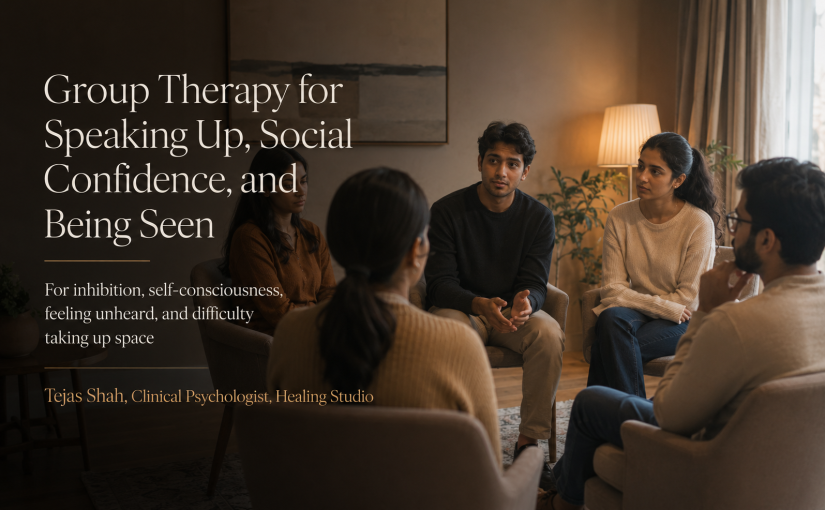
Some people do not struggle because they have nothing to say. They struggle because the moment other people are present, something in them tightens, retreats, blanks out, or waits too long. If you are looking for group therapy for speaking up, social confidence, and being seen in Mumbai, you may be dealing with inhibition, self-consciousness, fear of attention, or the painful sense of not fully occupying your place with others.
This kind of difficulty can affect friendships, family conversations, work meetings, intimate relationships, and group settings of every kind. You may speak well one-to-one, but lose your voice in a room. You may have thoughts and feelings, yet find they do not arrive in time. Or you may speak, but still leave with the feeling that you were not really received.
I offer group therapy in Mumbai for adults who want help with these patterns in a serious, psychologically informed, and relationally alive setting. The work is not about forcing performance. It is about understanding what happens to you with others, and gradually developing more freedom, presence, and confidence in real human situations.
Tejas Shah
Clinical Psychologist | Philosophical Counsellor | Group Analyst
In-person: Borivali, Mumbai
Online: Available where appropriate
Call / WhatsApp: +91 79775 01648
Email: [email protected]
“In therapy, the problem is often not that a person has no voice, but that their voice has learned to withdraw when it feels exposed.” — Tejas Shah
In clinical work, this difficulty often appears not as one dramatic event, but as a repeating emotional pattern that gradually begins shaping relationships, decisions, and inner life.
When this kind of group work may help
You may relate to this page if:
- you go quiet in groups even when you have something to say
- you speak more freely one-to-one than in a room full of people
- you hesitate, lose words, or think of what you wanted to say only afterwards
- attention from others makes you feel exposed, blank, or uncomfortable
- you feel overlooked, not taken in, or emotionally unregistered
- stronger personalities dominate space around you
- you struggle to ask directly for what you need
- you hint, joke, wait, or hope others will notice instead of saying things clearly
- you feel guilty, self-conscious, or “too much” when you take up space
- you want more social ease, but do not want to become performative or fake
The deeper pattern is not always “lack of confidence”
What looks like a confidence issue is often more layered than that. Sometimes the person fears judgment. Sometimes they fear conflict. Sometimes they fear being too visible, too needy, too assertive, too emotional, or too exposed. In other cases, they have learned to stay small around dominant people, critical family systems, or emotionally crowded relationships.
This is not only a social skill problem. Psychologically, it may also involve shame, attachment insecurity, inhibition, defensive self-withdrawal, fear of taking up room, or old experiences of not being responded to well.
Drawing from my work as an RCI-Licensed Clinical Psychologist and Group Analyst, I often find that people can describe the immediate difficulty clearly, but need help understanding the deeper emotional position they have been living from.
A group can become the place where your voice changes
Group therapy can be especially useful for these concerns because the difficulty itself usually happens with other people. A group does not only provide support. It creates a live space where patterns of hesitation, withdrawal, invisibility, indirectness, fear of attention, and struggles around being heard can actually be noticed and worked with.
In a good therapy group, you do not have to become loud, bold, or socially polished. The aim is not performance. The aim is greater freedom. That may mean being able to speak sooner, ask more directly, tolerate being seen, stay present when attention turns toward you, and understand what happens internally when you begin to disappear.
“Confidence often grows not from acting bigger, but from becoming less divided against your own presence.” — Tejas Shah
How these struggles often show up
When your voice disappears, even when you know what you mean
Some people can think clearly in private and speak well one-to-one, yet become inhibited in groups, families, meetings, or emotionally charged conversations. They may go blank, lose timing, second-guess themselves, or feel that by the time they are ready, the moment has passed. Over time, this creates frustration, self-criticism, and the familiar pain of leaving situations with words stuck inside.
Speaking but not feeling received
Others do speak, but still feel unseen. They may be interrupted, overshadowed by stronger personalities, or emotionally missed in subtle ways. The problem is not only silence. It is the experience of not landing, not registering, or not feeling fully recognized by others. This can leave a person feeling strangely invisible even in company.
The problem of taking up space
For some people, visibility itself feels difficult. Attention can feel exposing. Being looked at, listened to, or emotionally noticed may bring discomfort instead of ease. They may shrink, self-monitor, soften their presence, or become highly self-conscious when the room turns toward them. Sometimes guilt is involved too. They may feel that taking up space is selfish, risky, or likely to provoke disapproval.
Indirect asking, hinting, and hoping others will notice
Another common pattern involves indirect communication. The person wants care, recognition, inclusion, or response, but finds direct asking difficult. So they hint, joke, withdraw, wait, or hope others will somehow understand without being told plainly. This can lead to disappointment, resentment, misunderstanding, and the repeated feeling that one is not noticed properly.
Group therapy for speaking up, social confidence, and being seen in Mumbai can help with
- difficulty speaking up in groups, relationships, or family settings
- feeling unheard, overlooked, or invisible
- fear of attention, visibility, or being emotionally exposed
- discomfort taking up space without guilt or fear
- indirect communication and difficulty asking directly
- self-consciousness in real-time social situations
- hesitation, freezing, or delayed expression
- recurring patterns of shrinking around stronger personalities
Why people often seek this help
People usually seek this work after a point of repetition. The problem may not look dramatic from outside, but internally it becomes costly. A person may start avoiding group settings, pulling back in important conversations, speaking less at work, staying too polite in relationships, or carrying resentment because they do not know how to ask directly.
In practice, this kind of difficulty often shows up as a recurring pattern that affects not only mood, but also relationships, self-esteem, and everyday decisions. It can influence career growth, intimate communication, family boundaries, friendship patterns, and the basic feeling of being allowed to exist fully with other people.
In an Indian context, these struggles may also be shaped by family hierarchies, deference to authority, pressure to stay “well-behaved,” fear of seeming disrespectful, gendered expectations, chronic comparison, or the subtle shaming of emotional and interpersonal needs. Sometimes the result is a person who appears functional and thoughtful, but finds it difficult to act from their own centre in the presence of others.
My approach
My approach to this work is reflective, relational, and psychologically in-depth. I do not treat the issue as a simple matter of public speaking or surface confidence training. We look at what happens in live relational space: what you fear, what you expect, what you suppress, how you read others, what makes you disappear, and what makes direct expression feel risky.
The group becomes one place where these patterns can be observed with care rather than judgment. Depending on the person and the group process, the work may involve noticing shame, fear of criticism, difficulty with anger, problems asserting need, defensive withdrawal, self-monitoring, old relational learning, and how all of this shapes present behaviour.
What appears to be a practical communication problem may also involve shame, defensive patterns, insecure attachment, and learned ways of managing vulnerability.
My broader psychotherapy practice is informed by psychodynamic and relational thinking, group analytic understanding, CBT and REBT where relevant, and attention to emotional patterns within family and social life. The work is serious but human. It aims for both insight and change.
Why work with Tejas Shah
I offer this work as an RCI-Licensed Clinical Psychologist, Group Analyst, and therapist with over 16 years of clinical experience and 16,000+ hours of therapeutic work.
Relevant reasons people may choose to work with me include:
- I have been in clinical practice at Healing Studio since 2010
- I am a Qualified Group Analyst trained through the Institute of Group Analysis, London
- I work with adults, couples, families, and groups, which helps me understand how personal difficulties and relational dynamics affect each other
- My training includes Intensive Short Term Dynamic Psychotherapy, CBT, ACT, and Couples and Family Therapy, allowing me to work both deeply and practically
- I am Chief Clinical Psychologist and Clinical Director at Healing Studio, Mumbai
- My work tends to suit people looking for reflective, clinically grounded, non-performative therapy rather than motivational advice or formulaic confidence coaching
From clinical work, I have often found that people arrive with a clear account of the immediate difficulty, but need help making sense of the deeper pattern beneath it.
What to expect in group therapy for speaking up, social confidence, and being seen
What happens in a first consultation
The first consultation helps us understand what brings you, how these patterns show up, how long they have been present, and whether group therapy is the right fit. Not everyone who struggles to speak up needs the same format. In some cases, individual therapy may be useful first or alongside group work.
If group therapy is suitable, we discuss the nature of the group, your concerns about joining, and what to expect. It is normal to feel unsure. In fact, hesitation around entering a group is often part of the very difficulty that needs understanding.
Over time, group therapy may help you:
- become more aware of what happens internally when you retreat or freeze
- speak earlier instead of only afterwards in your head
- feel less dominated by stronger personalities
- ask more directly for what you need
- tolerate attention without collapsing into self-consciousness
- feel more present, more visible, and more emotionally real with others
Practical details
In-person Location: Providing Group Therapy for Speaking Up Social Confidence in Mumbai at our Borivali clinic.
Nearby areas: Serving group therapy across Borivali East, Borivali West, Kandivali, Dahisar, Mira Road, Goregaon, and the Western Suburbs in Mumbai.
Online: Zoom sessions for clients in India and abroad, where appropriate
Call / WhatsApp: +91 79775 01648
Email: [email protected]
FAQs
1. How do I know if this group therapy is for me?
This work may be useful if your difficulty shows up mainly around other people: in groups, families, work settings, conversations, visibility, or being heard. It is especially relevant if you often go quiet, feel overlooked, hesitate to speak, or find direct asking difficult.
2. Is this only for people with social anxiety?
No. Some people do have social anxiety, but others are dealing more with inhibition, shame, family conditioning, fear of attention, indirect communication, or long-standing patterns of shrinking around others. The issue is broader than one label.
3. What if I am uncomfortable speaking in front of a group?
That is common. You do not need to arrive already confident. Group therapy is not a performance space. The discomfort itself is part of what can be understood and worked with.
4. Can group therapy help if I feel unheard rather than silent?
Yes. Some people are not silent at all. They speak, but do not feel received. Group therapy can help explore how this pattern happens, how others experience you, and what makes recognition difficult to take in or secure.
5. What if I hint instead of asking directly?
That is a meaningful pattern, not a trivial habit. Indirect communication often carries fear, disappointment, and hope all at once. Therapy can help you understand why direct asking feels risky and develop more freedom around expression.
6. Do you also offer individual therapy?
Yes. Depending on your situation, individual therapy may be useful before group work, alongside it, or instead of it. This is something we can think through in the first consultation.
7. Is therapy confidential?
Yes, confidentiality is taken seriously within professional and legal limits. Any relevant boundaries are discussed clearly as part of the therapeutic process.
This page is meant for education and guidance, not as a substitute for therapy, diagnosis, or personalized clinical advice.
Book an initial consultation
If you have been looking for group therapy for speaking up, social confidence, and being seen in Mumbai, you do not need to wait until the problem becomes dramatic. Often the real burden is quieter: holding back, staying small, missing moments, and not feeling fully present in your own voice.
You can get in touch to schedule an initial consultation and discuss whether this form of group therapy may be right for you.
Call / WhatsApp: +91 79775 01648
Email: [email protected]
Tejas Shah is a Clinical Psychologist and Group Analyst at Healing Studio. He works with adults who struggle with inhibition, self-consciousness, relational discomfort, loneliness, and repeated interpersonal patterns. His approach is reflective, clinically grounded, and attentive to the deeper emotional structure beneath visible difficulties. Depending on the person, the work may help with greater self-understanding, more direct expression, and a stronger sense of presence with others.
Tejas Shah’s Healing Studio >> Therapy Clinic in Borivali >> Group Therapy