
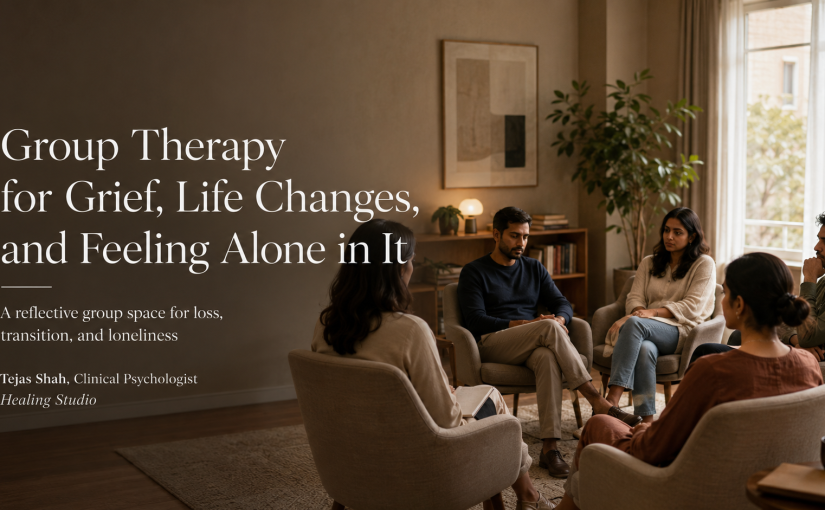
Life can change in a way that others notice for a few days, then quietly forget. You may still be living inside the loss, shock, breakup, illness, role change, or uncertainty long after the world expects you to move on. Group Therapy for Grief, Life Changes, and Feeling Alone in It is for people who are carrying a major change that has made them feel more alone, displaced, or difficult to reach.
This group is not only for visible grief. It is also for the grief that comes when life is interrupted, when a relationship ends, when illness changes the body, when work or legal trouble takes over the mind, when ageing alters identity, or when a person begins asking harder questions about meaning, mortality, and belonging.
I offer group therapy for adults at Healing Studio, Mumbai, with online sessions available where appropriate. The work is facilitated by Tejas Shah, RCI-Licensed Clinical Psychologist, Philosophical Counsellor, and Group Analyst.
Tejas Shah
Clinical Psychologist | Philosophical Counsellor | Group Analyst
In-person: Healing Studio, Borivali, Mumbai
Online: Zoom sessions where clinically appropriate
Call / WhatsApp: +917977501648
Email: [email protected]
“Some losses do not only take something away. They change the room in which you meet other people.” — Tejas Shah
Group Therapy for Grief, Life Changes, and Feeling Alone in It in Mumbai
Group therapy can be useful when the pain is not only private, but relational. You may have people around you and still feel alone. You may receive sympathy, advice, or practical support, yet feel that something essential remains unseen.
After grief or major change, ordinary social life can become strange. People may not know what to say. Some avoid the subject. Some offer quick reassurance. Some expect you to be strong. Others disappear because your pain makes them uncomfortable.
In a group therapy setting, this loneliness can be explored with others who are also carrying something difficult. The group becomes a place where grief, interruption, uncertainty, and vulnerability are not treated as problems to be quickly fixed. They are understood as experiences that may need time, language, and human contact.
When Grief Has Nowhere to Go
Some grief is obvious. A death, a diagnosis, a separation, a divorce, or a major loss may clearly mark a before and after.
However, some grief is harder to name. You may grieve a future that will not happen. You may grieve a version of yourself that felt more certain. You may grieve your old work identity, your health, your family role, your sense of safety, or the ease with which you once belonged.
In clinical work, grief often appears not only as sadness. It may show up as irritability, numbness, fatigue, withdrawal, guilt, loss of confidence, envy of people whose lives seem normal, or a quiet resentment toward a world that keeps moving.
Group therapy can help because grief often needs witnesses. Not spectators. Not advice-givers. Witnesses.
The Many Forms of Loss This Group Can Help With
This group may be useful for people dealing with:
- death of a loved one
- bereavement that feels hard to share
- illness, diagnosis, medical uncertainty, or body-related change
- breakup, separation, divorce, betrayal, or relationship rupture
- legal, financial, or work crisis
- career disruption, role loss, or professional identity collapse
- relocation, migration, or feeling emotionally displaced
- ageing, midlife change, retirement, or changing family roles
- loneliness after a major life event
- existential questions about meaning, mortality, fragility, and human vulnerability
This is not a crisis support group or a motivational sharing circle. It is a reflective psychotherapy group for people who want to understand how grief and change affect their inner life, relationships, identity, and ability to feel connected.
A Map of This Group Therapy Pathway
Grief and life change rarely arrive in neat categories. One loss often touches another. A breakup may bring grief, social displacement, identity confusion, and fear about the future. An illness may bring questions about dependency, mortality, work, family roles, and the body. A death may change how you relate to friends, relatives, rituals, and ordinary time.
This group therapy pathway includes four overlapping areas.
Primary Theme: When Life Changes and You Feel Alone Inside It
Some life changes create a private weather system. From the outside, you may seem functional. You may go to work, reply to messages, attend family events, and do what is required. Inside, however, something may feel altered.
You may notice that people cannot fully see what you are carrying. Their lives continue. Their concerns seem ordinary. You may feel impatient with small talk, irritated by cheerful advice, or guilty for not being able to return to your previous self.
Group Therapy for Grief, Life Changes, and Feeling Alone in It in Mumbai may be useful if
You feel that a loss, crisis, or transition has changed how you relate to people. You may not need others to solve the situation. You may need a space where the impact of the change can be understood without being rushed.
Grief, Bereavement, and Carrying Loss With Others
When death changes your relationship with the living
Bereavement can make the world feel divided. There are those who know what happened, those who mention it awkwardly, those who avoid it, and those who expect you to resume normal life.
You may find yourself carrying the dead person internally while trying to remain socially present. You may feel lonely in family rituals, irritated by spiritual explanations, or exhausted by having to manage other people’s discomfort around your grief.
Group therapy for grief and bereavement offers a place to speak about death without reducing it to closure. It may help you explore the difficulty of continuing to live among others while carrying someone who is no longer physically present.
The themes often include feeling alone with grief, loss that changes how you relate to people, grieving while surrounded by others, carrying death or shock in a social world, and the way grief can make belonging harder.
Life on Hold: Breakup, Divorce, Illness, Legal or Work Crisis
When one event takes over the whole inner room
Some events do not only hurt. They hijack life.
A breakup may make ordinary routines feel meaningless. A divorce may alter family identity, social standing, finances, friendships, and the future you imagined. Illness may interrupt confidence in the body. A legal or work crisis may create shame, fear, helplessness, and constant mental preoccupation.
In these situations, people often describe life as being on hold. They may not feel fully available to themselves or to others. Conversations become difficult because one ordeal occupies the inner room.
Group therapy can help people slowly think with others while living through uncertainty. It can also help with the loss of role, identity, confidence, and relational ease after disruption.
This part of the work may involve themes such as life on hold after a difficult event, crisis and the sense of self, living through uncertainty with people around you, role loss after disruption, and the experience of one ordeal taking over your life.
Life Transitions and Loss of Place
When the old place no longer fits and the new one has not arrived
Not all loss is dramatic. Some loss happens through transition.
You may move cities, change work roles, leave a relationship, enter midlife, become a parent, stop being needed in the same way, retire, separate from a family structure, or realise that an old identity no longer fits.
This can create emotional displacement. You may not feel exactly depressed, but you may feel unplaced. You may wonder where you belong now, who you are becoming, and whether others can recognise this changed version of you.
In Indian contexts, transitions often carry family, social, and cultural pressure. A person may not only be changing internally. They may also be negotiating expectations around duty, marriage, parenting, career, ageing, caregiving, caste, class, gender, sexuality, and respectability.
Group therapy can help because transition is not only a practical adjustment. It is also a relational and identity shift.
This area brings together themes such as feeling emotionally displaced after change, transition and loss of place, losses that make belonging harder, starting again after major disruption, and the question: who am I after this change?
Existential Loneliness, Meaning, and Human Vulnerability
When loneliness is not only social, but existential
There is a kind of loneliness that does not disappear just because people are present. It may arise after loss, illness, ageing, failure, separation, or a confrontation with death. It may also appear quietly, even when life looks stable.
This loneliness can feel difficult to explain. You may not only want company. You may be struggling with the fact that life is fragile, time is limited, people cannot fully protect each other, and every person finally has to face certain realities alone.
Philosophical questions may appear in deeply personal form:
What is the point now?
How do I live after this?
Why does life continue so normally for everyone else?
What does it mean to be human and vulnerable?
Can I belong while knowing how alone I sometimes feel?
Group therapy does not remove existential loneliness. However, it may help a person relate to it differently. In a group, the loneliness of being human can become less shameful, less hidden, and more thinkable.
This part of the work includes existential loneliness in the presence of others, the feeling that life goes on for everyone else, meaning and mortality in groups, disconnection from life and people, and the deeper loneliness of being human.
How Group Therapy May Help With Grief and Life Changes
Group therapy is not useful because everyone has the same story. It is useful because different stories can still touch similar emotional truths.
In a reflective group, you may begin to notice:
- how you speak or remain silent about loss
- what kind of support you can receive, and what feels intrusive
- how grief affects trust, anger, dependency, envy, and shame
- why ordinary social life may feel harder after disruption
- how you protect yourself from being misunderstood
- how you respond when others are also vulnerable
- what it feels like to be witnessed without being fixed
- how your identity is changing after loss or transition
The group allows grief and life change to enter relationship. That matters because isolation often makes pain more rigid. When pain is spoken and received carefully, it may begin to move.
This does not mean the loss disappears. It means the person may become less alone with the loss.
My Approach to Group Therapy for Grief and Life Changes
My approach to group therapy is informed by group analysis, psychodynamic psychotherapy, relational thinking, clinical psychology, and philosophical reflection where relevant.
In practical terms, this means the group does not only discuss events. It also pays attention to what happens between people in the room. Who feels seen? Who withdraws? Who becomes responsible for others? Who feels burdensome? Who fears being too much? Who becomes silent when grief appears? Who feels angry when others seem more supported?
These reactions are not treated as mistakes. They are part of the therapeutic material.
Grief and life transitions often reactivate older emotional patterns. A person may discover that they deal with loss by becoming self-sufficient, pleasing others, intellectualising, collapsing, controlling, disappearing, or becoming angry at dependence. In a group, these patterns can be noticed with care.
This is not only a grief problem. Psychologically, it may involve attachment, shame, emotional regulation, defensive patterns, family roles, cultural expectations, and the person’s long-standing way of managing vulnerability.
Where relevant, philosophical counselling may also support people facing questions of mortality, meaning, identity, freedom, responsibility, ageing, and the limits of control. These questions are not abstract when life has broken open. They are often lived in the body, relationships, and daily decisions.
Why Work With Tejas Shah
Tejas Shah is an RCI-Licensed Clinical Psychologist, Group Analyst, and Philosophical Counsellor. He is the Chief Clinical Psychologist and Clinical Director at Healing Studio, Mumbai.
His work with groups is informed by formal group analytic training, psychodynamic thinking, clinical psychology, and long experience with emotional and relational difficulties. He works with adults, couples, families, and groups, which helps him understand how private suffering is often shaped by family systems, social roles, intimate relationships, and wider cultural pressures.
He has over 16+ years of clinical experience and 16,000+ hours of therapeutic experience. His training includes M.Phil. Clinical Psychology, MSc Psychology, MA Philosophy, and advanced psychotherapy training in group analysis, ISTDP, CBT, RECBT, ACT, family and couples therapy, mentalization-based therapy, narrative therapy, and related approaches.
For this page, his group analytic and philosophical background is especially relevant. Grief, transition, and existential loneliness are not only symptoms to be reduced. They are also experiences that change how a person lives with others, understands time, carries absence, and asks what kind of life is still possible.
“Group therapy can help when the private burden has become too sealed off from human contact.” — Tejas Shah
What to Expect in the First Consultation
The first consultation is a space to understand what brings you to therapy and whether this group is the right fit.
You may discuss:
- what kind of grief, loss, disruption, or transition you are carrying
- how long it has been affecting you
- how it has changed your relationships and daily life
- whether you are looking for group therapy, individual therapy, or another format
- whether the group setting feels suitable at this point
- what you may need before joining a group
- practical questions about frequency, confidentiality, and participation
Some people are ready for group therapy. Others may need individual sessions first. Some may benefit from both. The aim is not to push you into a format, but to understand what kind of help is clinically appropriate.
Uncertainty about joining a group is normal. Many people feel hesitant before beginning group therapy, especially when the subject involves grief, vulnerability, or loneliness.
Practical Details
In-person Location: Providing Group Therapy for Grief, Life Changes, and Feeling Alone in Mumbai at the Borivali clinic.
Nearby areas: Serving group therapy across Borivali East, Borivali West, Kandivali, Dahisar, Mira Road, Goregaon, and the Western Suburbs in Mumbai.
Online: Zoom sessions may be available for clients in India and abroad where appropriate.
For: Adults dealing with grief, bereavement, illness, breakup, divorce, work or legal disruption, transition, role loss, existential loneliness, or feeling alone after life change.
Call / WhatsApp: +917977501648
Email: [email protected]
This page is meant for education and guidance. It cannot replace therapy, diagnosis, or an individualized clinical assessment.
FAQs
1. Is this group only for bereavement after death?
No. Bereavement after death is included, but the group is broader. It may also be relevant for people dealing with breakup, divorce, illness, work crisis, legal stress, relocation, ageing, role loss, or existential loneliness after major life change.
2. How is group therapy different from individual grief therapy?
Individual therapy focuses mainly on your personal history, emotional life, and therapeutic relationship with the therapist. Group therapy adds another dimension. It allows you to notice how grief, disruption, or loneliness affects your relationships with others in real time.
3. What if I do not want to talk much in the group?
That is understandable. Many people enter group therapy cautiously. Silence, hesitation, and guardedness can also become part of the work. The aim is not forced disclosure. The aim is thoughtful participation at a pace that can be clinically held.
4. Can group therapy help if I feel alone even though people are around me?
Yes, this is one of the reasons people may seek group therapy. Some loneliness is not caused by a lack of people. It comes from feeling unseen, changed, or unable to share what one is carrying. A group can help this become more understandable.
5. Is this suitable during an active crisis?
It depends on the nature of the crisis. If you are in immediate danger, severely unstable, or need urgent psychiatric or emergency support, group therapy may not be the first step. An initial consultation can help assess what kind of support is appropriate.
6. Do you offer online group therapy?
Online group therapy may be possible where clinically appropriate. Some people in other cities or abroad may benefit from an online group, especially when they want a therapist who understands Indian family, social, cultural, and relational contexts.
7. How do I know if this is the right group for me?
This group may be right for you if grief, disruption, transition, or existential loneliness has changed how you relate to yourself and others. The first consultation helps clarify whether group therapy, individual therapy, or another form of help would be most useful.
Book a Consultation
If you are looking for Group Therapy for Grief, Life Changes, and Feeling Alone in It in Mumbai, you can get in touch to schedule an initial consultation with Tejas Shah.
You do not need to have the perfect words for what you are carrying. It is enough to say that something has changed, and that you do not want to carry it entirely alone.
Call / WhatsApp: +917977501648
Email: [email protected]
Tejas Shah is a Clinical Psychologist and Group Analyst at Healing Studio. He works with adults, couples, families, and groups dealing with grief, loneliness, relationship difficulties, emotional distress, life transitions, and deeper questions of meaning and belonging. His work is clinically grounded, reflective, and attentive to both personal history and the relational worlds people live in.
Tejas Shah’s Healing Studio >> Therapy Clinic in Borivali >> Group Therapy