
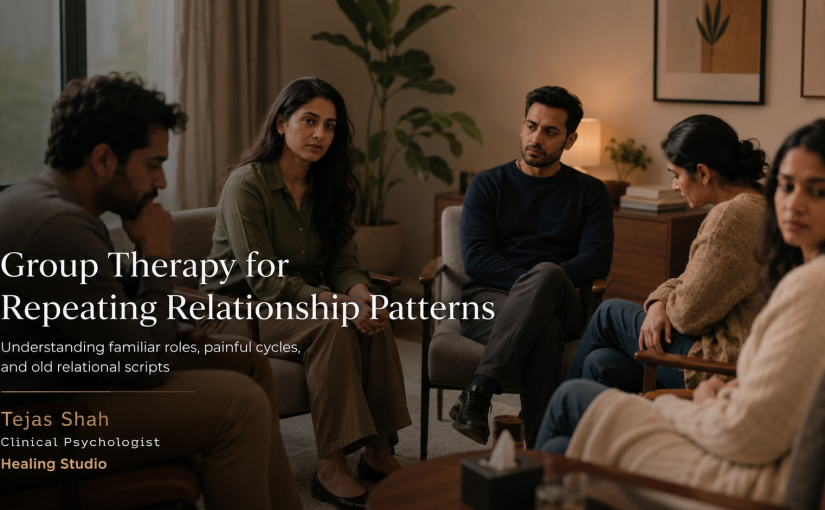
You may not call it a “pattern” at first. You may simply notice that different relationships keep leaving you with the same emotional pain. Group Therapy for Repeating the Same Relationship Patterns in Mumbai is for people who feel caught in familiar roles, repeated disappointments, and relational cycles that return across friendships, dating, marriage, family, work, or group life.
You may keep choosing unavailable people. You may become the caretaker everywhere. You may feel like the outsider in every group. You may adapt so much that you lose your own shape with others. At some point, the question changes from “Why is this person like this?” to “Why does this keep happening to me?”
I offer group therapy for adults who want to understand these repeated relational patterns in a serious, reflective, and clinically grounded way. The work is not about blaming you for what happened. It is about studying the emotional position you keep finding yourself in, and how it may be possible to relate differently.
Tejas Shah
Clinical Psychologist | Philosophical Counsellor | Group Analyst
In-person: Group Therapy for Repeating the Same Relationship Patterns in Mumbai at our Borivali clinic
Online: Zoom sessions where appropriate
Call / WhatsApp: +91 7977501648
Email: [email protected]
“Some patterns do not repeat because people are foolish. They repeat because the emotional role feels familiar before it feels painful.” — Tejas Shah
When the Same Relationship Story Keeps Returning
Repeated relationship patterns are often confusing because each situation looks different on the surface.
One friendship may leave you feeling used. One romantic relationship may leave you chasing closeness. One family interaction may make you feel small. One workplace group may make you quiet, defensive, or over-responsible. Yet underneath these different situations, the emotional position may feel strangely similar.
You may recognize this if:
- you keep feeling drawn to unavailable, critical, intense, or difficult people
- you often give more than you receive
- you become the listener, fixer, rescuer, or emotional shock absorber
- you feel invisible in groups, even when you are physically present
- you often feel blamed, misunderstood, or made into “the problem”
- you adapt to people so quickly that you later feel resentful or empty
- you feel that current relationships carry an emotional weight that belongs to an older time
- you keep promising yourself that the next relationship will be different, but the same pain returns
In therapy, this issue often appears less as one dramatic incident and more as a familiar emotional pattern that keeps returning in slightly different forms. People may be high-functioning, thoughtful, and self-aware, yet still feel unable to shift the relational position they repeatedly occupy.
This can be painful. It can also be embarrassing. Many people think, “I should know better by now.” However, repeated emotional patterns are not usually changed by insight alone. They need to be observed in real relational life.
That is where group therapy can become useful.
Who This Group Therapy May Help
This group therapy may be useful for adults who feel that the same relational difficulty keeps appearing with different people.
It may help if you:
- feel stuck in repeated friendship, dating, or marriage patterns
- keep becoming the caretaker, overgiver, outsider, quiet one, or difficult one
- notice old family roles returning in adult relationships
- lose yourself around different people and become whoever the relationship seems to require
- feel confused by why different people evoke the same emotional pain
- want to understand your relational patterns in a live group setting, not only by talking about them privately
- are willing to reflect on how you experience others and how others may experience you
This work is not only for people in crisis. It may also be for people who are externally composed but internally tired of repeating the same emotional script.
Some people come because individual therapy helped them understand the pattern intellectually, but they still feel caught in it with real people. Others come because their friendships, romantic relationships, family dynamics, or professional groups keep showing them something they can no longer ignore.
The Four Main Patterns
These are not rigid boxes. Many people will recognize themselves in more than one.
1. Familiar Cycles in Friendship, Dating, and Marriage
When the person changes, but the emotional pain does not
Some people keep entering similar relationship cycles despite wanting something different. The names change. The setting changes. The intensity may change. Yet the emotional ending feels familiar.
You may keep choosing unavailable, emotionally complicated, critical, dependent, chaotic, or difficult people. You may repeatedly feel that you have to work hard for love, prove your worth, win attention, manage someone’s moods, or tolerate too much before you are allowed to ask for anything.
In friendships, this may look like being the dependable one who is called during crisis but forgotten during joy. In dating, it may look like pursuing people who cannot fully meet you. In marriage, it may look like repeating the same argument in different forms for years.
This work explores questions such as: Why do I keep repeating the same relationship pattern? Why do I choose people who are unavailable or difficult? Why does the same emotional pain return with different people? Why does nothing seem to change even when the person changes?
The aim is not to give you a simplistic rule like “choose better people.” That advice is usually too thin. The deeper work is to understand what feels familiar, what feels threatening, and what emotional position you keep returning to before you even realize it.
2. Becoming the Same Role Everywhere
The caretaker, outsider, quiet one, fixer, overgiver, invisible one, or “problem” one
Some people do not only repeat relationships. They repeat roles.
You may become the caretaker everywhere. You may become the useful one, the quiet one, the invisible one, the responsible one, the outsider, or the person who gets treated as difficult when you finally protest. You may enter a new friendship, workplace, family system, or group with hope, only to discover that the same role finds you again.
This can feel like an invisible assignment. No one officially gives it to you, but somehow you end up carrying it.
The caretaker may feel needed but unseen. The overgiver may feel generous at first, then resentful. The outsider may protect themselves by staying distant, while also longing to belong. The quiet one may avoid conflict but later feel unknown. The “problem” one may carry the tension that others do not want to name.
Group therapy can help because roles become visible in a group. A person may notice how quickly they take responsibility for others, how difficult it is to receive attention, how they disappear when conflict appears, or how they expect rejection before anyone has rejected them.
The group does not simply talk about roles. It gives people a chance to notice them as they begin to emerge.
3. Carrying Family Roles Into Adult Relationships
When present relationships feel older than they are
Many adult relationship patterns have roots in earlier family roles. This does not mean every current difficulty is “because of childhood.” That would be too crude. However, old emotional positions often return in adult life.
A person who was the responsible child may become the responsible adult everywhere. A child who learned not to need much may become an adult who struggles to ask for care. A person who was ignored may expect invisibility. Someone who was blamed may enter relationships ready to defend themselves. Someone who had to manage a parent’s emotions may become skilled at reading others and poor at knowing themselves.
Current relationships can then feel older than they are. A friend’s delayed reply may feel like abandonment. A partner’s criticism may feel like humiliation. A group’s silence may feel like exclusion. A disagreement at work may feel like being back inside a family drama.
Psychologically, this kind of difficulty may involve long-standing relational learning, fear of dependence, shame, emotional regulation, and internalized expectations about closeness or conflict. The problem is not only what is happening now. It is also how the present awakens earlier emotional maps.
Group therapy can act as a mirror. It allows people to see how old roles, expectations, and defensive patterns may become active with new people.
4. Losing Yourself With Different People
Shape-shifting, adapting, and not knowing who you are in relation
Some people do not feel fixed in one role. Instead, they become different versions of themselves with different people.
With one person, you may become agreeable. With another, you may become witty and detached. With someone else, you may become careful, useful, seductive, intellectual, silent, rebellious, or emotionally unavailable. You may be skilled at reading the room, but less able to know what you feel.
This can look like social intelligence from the outside. Internally, it may feel unstable. You may ask, “Who am I when I am not adjusting?” You may feel that your identity changes depending on who is in front of you.
This pattern often develops for good reasons. Adapting may once have protected you from criticism, rejection, conflict, punishment, or emotional abandonment. However, when adaptation becomes automatic, it can make real relating difficult. You may be liked, needed, or accepted, yet still feel unknown.
Group therapy can help because the group creates a living field of different responses. You may notice who you become with authority, with warmth, with silence, with conflict, with attention, with admiration, or with disappointment. Slowly, the work may help you stay more stable in yourself while remaining connected to others.
Why Group Therapy Can Help With Repeating Relationship Patterns
Repeated relationship patterns are difficult to change because they often happen automatically. They are not only ideas in the mind. They are lived through the body, tone, expectation, silence, humour, withdrawal, compliance, irritation, and longing.
Individual therapy can be very useful for understanding these patterns. However, group therapy adds something specific: other people.
In a therapy group, you are not only describing relationships. You are participating in one. You may notice how you enter the group, how you wait, how you hide, how you compete, how you caretake, how you feel excluded, how you respond to being seen, and how you imagine others are experiencing you.
This makes group therapy especially relevant for repeating relational patterns. The group becomes a careful, reflective space where familiar emotional positions can be studied as they appear.
Group therapy may help you:
- recognize your recurring emotional role more clearly
- understand how old relational learning affects present relationships
- notice how you respond to closeness, conflict, silence, attention, or difference
- receive feedback in a contained therapeutic setting
- experiment with speaking, needing, disagreeing, asking, receiving, and setting limits
- understand how others experience you without reducing you to a label
- develop more freedom in how you relate
This is not quick advice. It is not a social skills workshop. It is a serious therapeutic process where the group itself becomes part of the work.
My Approach to Group Therapy for Repeated Relationship Patterns
My work with repeated relationship patterns is informed by psychodynamic, relational, family systems, and group analytic thinking. I pay attention not only to what happened, but to how a person becomes positioned in relationships, and how that position may repeat.
In group therapy, this means we may explore questions such as:
- What role do you tend to take in groups?
- What do you expect others to do to you?
- What feelings do you avoid showing?
- What do you do when you want closeness?
- What do you do when you feel hurt, ignored, criticized, or needed?
- How do you protect yourself?
- What kind of feedback feels unbearable?
- What kind of care feels difficult to receive?
The work is reflective, but not abstract. It connects emotional history with present experience. It also respects the complexity of Indian relational life, where family roles, marriage expectations, caste, class, gender, sexuality, social performance, professional pressure, and intergenerational obligations can shape how people relate.
A person may not simply be “overgiving.” They may be carrying a learned moral duty. A person may not simply be “avoidant.” They may have learned that needing others is dangerous. A person may not simply be “quiet.” They may have spent years surviving by not taking up emotional space.
Good therapy has to be precise about these differences.
“Group therapy can show a person the role they keep living from, not as an accusation, but as an opening for change.” — Tejas Shah
Why Work With Tejas Shah
Tejas Shah is an RCI-Licensed Clinical Psychologist, Philosophical Counsellor, and Group Analyst at Healing Studio, Mumbai. He works with adults, couples, families, and groups, with attention to emotional, relational, and personality difficulties.
His clinical work is informed by psychodynamic psychotherapy, group analysis, cognitive and rational-emotive approaches, couples and family therapy, mentalization-based ideas, emotion-focused work, and philosophical reflection where relevant. His group analytic and relational training are especially important because repeated relationship patterns often become visible in the live field of a group.
Tejas is the Founder of the Institute of Group Analysis India and has trained as a Qualified Group Analyst with the Institute of Group Analysis, London. His background also includes Couples and Family Therapy training through TISS, Mumbai and NIMHANS, Bangalore, along with formal clinical psychology training and long-term psychotherapy practice.
Drawing from work with individuals, couples, families, and groups, he often finds that the visible difficulty makes more sense when placed in the context of deeper recurring patterns. People usually know what keeps happening. The harder task is understanding why it keeps happening in the same emotional form.
This page is meant for education and guidance, not as a substitute for therapy, diagnosis, or personalized clinical advice. A real therapeutic process depends on the person’s history, context, emotional structure, and present circumstances.
What to Expect in the First Consultation
The first consultation is not a performance test. You do not need to arrive with a perfect explanation of your pattern.
We may begin by understanding what brings you to therapy now. This may include your relationship history, repeated emotional roles, current friendships or romantic patterns, family background, work or group experiences, and what you hope may change.
We may also discuss whether group therapy is the right fit at this stage. For some people, group therapy may be useful immediately. For others, individual therapy, couples therapy, family therapy, or a different format may be more appropriate first.
The first step is to understand the problem carefully. The goal is not to push you into a group, but to assess what kind of therapeutic setting may help you work with the pattern most honestly.
Group Therapy for Repeating the Same Relationship Patterns in Mumbai: Is This Right for Me?
This service may be a good fit if you are ready to look beyond one relationship and study the wider emotional pattern. It may be especially relevant if you are curious about how you relate in real time, how others experience you, and how old roles may repeat in new settings.
It may not be the right fit if you want quick advice, immediate reassurance, or a space where the focus remains only on what other people have done wrong. Group therapy requires some willingness to reflect on your own participation, without turning that into self-blame.
Practical Details
In-person Location: Providing Group Therapy for Repeating the Same Relationship Patterns in Mumbai at our Borivali clinic.
Nearby areas: Serving group therapy across Borivali East, Borivali West, Kandivali, Dahisar, Mira Road, Goregaon, and the Western Suburbs in Mumbai.
Online: Zoom sessions may be available where appropriate for clients in India and abroad.
Format: Group therapy, with initial consultation before joining.
For: Adults dealing with repeated relationship patterns, emotional roles, family-role carryover, overgiving, outsider feelings, identity confusion, and relational repetition.
Call / WhatsApp: +91 7977501648
Email: [email protected]
FAQs
1. How do I know if I need group therapy for repeating relationship patterns?
You may consider group therapy if the same emotional struggle keeps returning with different people. For example, you may repeatedly feel unseen, overburdened, rejected, responsible, controlled, or unable to be yourself. If the pattern appears across friendships, dating, marriage, family, work, or groups, group therapy may help you observe it more clearly.
2. Is this different from individual therapy for relationship issues?
Yes. Individual therapy helps you explore your patterns in a one-to-one setting. Group therapy allows some of those patterns to become visible with other people present. This can be especially useful when the difficulty involves belonging, roles, closeness, resentment, exclusion, overgiving, or fear of being seen.
3. What if I am afraid of speaking in a group?
That fear itself may be clinically meaningful. Many people who enter group therapy feel hesitant, guarded, or unsure about speaking. You are not expected to disclose everything immediately. The pace of participation can be discussed carefully, and the group is meant to be a reflective therapeutic space, not a public-speaking exercise.
4. Will people in the group give me advice?
Group therapy is not primarily advice-giving. The focus is on reflection, emotional understanding, and noticing relational patterns. Members may share their experience of each other, but the process is held clinically so that feedback does not become casual opinion, judgement, or instruction.
5. Can this help if my patterns come from my family?
It may help. Many people carry family roles into adult relationships. Group therapy can make these roles more visible, especially when you notice how you respond to care, authority, conflict, silence, attention, exclusion, or difference within the group.
6. Do you offer online group therapy?
Online sessions may be available where appropriate. Suitability depends on the person, the concern, the group format, privacy, and clinical fit. This can be discussed during the initial consultation.
7. Is group therapy confidential?
Confidentiality is an important part of group therapy. Members are expected to respect the privacy of others. However, confidentiality in a group also depends on the responsibility of each participant, so this is discussed clearly before joining.
Book a Consultation
If you are looking for Group Therapy for Repeating the Same Relationship Patterns in Mumbai, you can contact Healing Studio to schedule an initial consultation with Tejas Shah.
You do not need to know exactly why the pattern repeats before reaching out. It is enough to know that something familiar keeps returning, and that you want to understand it more seriously.
Call / WhatsApp: +91 7977501648
Email: [email protected]
Tejas Shah is a Clinical Psychologist and Group Analyst at Healing Studio. He works with adults, couples, families, and groups on emotional and relational difficulties, including repeated relationship patterns, family roles, overgiving, outsider feelings, conflict, and difficulty being oneself with others. His work is reflective, depth-oriented, and clinically grounded, with attention to both present distress and deeper recurring patterns.
Tejas Shah’s Healing Studio >> Therapy Clinic in Borivali >> Group Therapy