
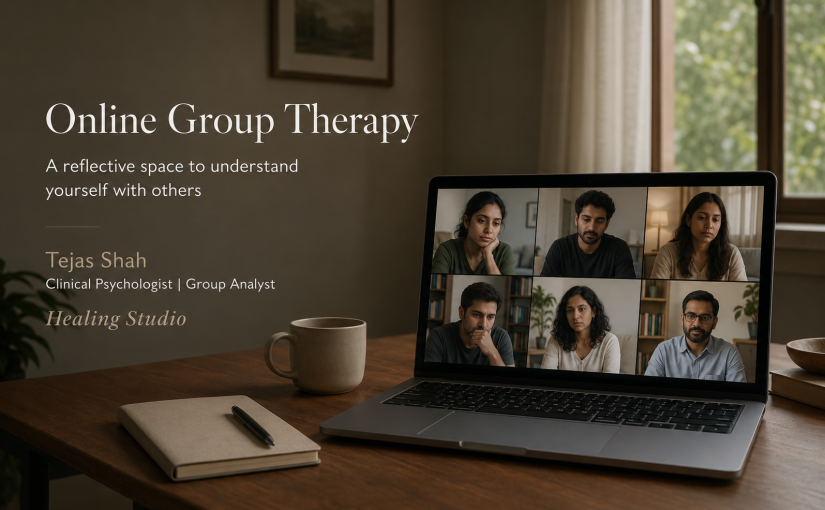
Online group therapy in India may be helpful when your difficulties do not only live inside you, but also appear in how you relate, withdraw, adapt, protect yourself, or feel with other people. Many adults look for online group therapy in India when they feel alone in repeating emotional patterns, even when they seem functional from the outside.
I offer online group therapy in India for adults who want a serious, reflective, and clinically grounded space to understand themselves in relation to others. The work is not about forced sharing or quick advice. It is about noticing what happens between people, how familiar roles repeat, and how emotional life becomes more visible in a group.
Tejas Shah
Clinical Psychologist | Philosophical Counsellor | Group Analyst
Online: Zoom sessions for clients in India and abroad
Call / WhatsApp: +91 7977501648
Email: [email protected]
Online Group Therapy in India for Adults Seeking Real Psychological Work
Group therapy can feel unfamiliar at first. Many people wonder, “How can speaking with a group help me?” Others worry that they may feel exposed, judged, or unable to speak honestly.
These concerns are understandable. A therapy group is not a casual discussion group. It is also not a motivational circle where everyone gives advice. In a well-held therapy group, people begin to notice how they experience themselves with others.
You may discover that you become quiet when attention turns toward you. You may feel responsible for everyone’s comfort. You may fear being misunderstood. You may feel irritated when others seem needy. You may want closeness, but become tense when it is available.
These moments are not distractions from therapy. They are often the material of therapy.
“Group therapy helps because the group does not only talk about relationships. It becomes a living space where relational patterns can be noticed carefully.” — Tejas Shah
What Online Group Therapy in India Can Help With
Online group therapy may be useful for adults dealing with emotional or relational difficulties that keep returning in different forms.
It may help with:
- loneliness, isolation, or feeling unseen
- difficulty trusting people
- repeated conflict in relationships
- shame, self-consciousness, or feeling not good enough
- fear of being judged, rejected, or exposed
- difficulty expressing anger, hurt, need, or disagreement
- over-responsibility for others
- people-pleasing and fear of disappointing others
- emotional guardedness or withdrawal
- difficulty belonging in groups, families, workplaces, or communities
- feeling different from others, even when surrounded by people
- repeated patterns in friendships, intimate relationships, family roles, or work dynamics
In clinical work, these difficulties often appear not as one dramatic problem, but as recurring emotional patterns. They may shape how a person speaks, stays silent, adapts, defends, avoids, or longs to be understood.
Online group therapy may be useful if you feel alone in patterns that repeat with people
Some people come to group therapy because they are tired of carrying everything privately. Others come because individual insight has helped, but something still repeats in actual relationships.
You may know your history. You may understand your patterns intellectually. Yet, when you are with other people, the old emotional position returns.
You may again feel invisible, inferior, responsible, suspicious, needy, excluded, angry, or afraid of taking up space. Group therapy gives these patterns a setting where they can be understood as they happen, not only remembered after the fact.
Who May Benefit from Online Group Therapy
This work may be useful for adults who want to understand themselves more deeply through a relational process.
Online group therapy may suit people who:
- feel lonely despite having people around them
- struggle to feel real, spontaneous, or emotionally honest with others
- want to understand repeated relationship patterns
- feel anxious, inhibited, or self-conscious in groups
- find themselves taking care of others while hiding their own needs
- feel hurt easily, but struggle to speak directly
- become guarded, detached, or watchful around people
- want to work on shame, trust, boundaries, anger, closeness, or belonging
- are interested in depth-oriented psychotherapy rather than surface-level advice
It may also be useful for Indians living abroad who feel caught between cultures, family expectations, migration-related loneliness, and the difficulty of finding emotionally familiar therapeutic spaces.
Why Group Therapy Feels Different from Individual Therapy
Individual therapy offers a private space to speak with a therapist. Group therapy adds something different. It brings other people into the therapeutic field.
This does not mean the work becomes less personal. In many cases, it becomes more immediate.
In a group, you may notice how you listen, how you wait, how you compare, how you hide, how you seek approval, or how you expect criticism. These patterns are often difficult to see alone because they feel normal from the inside.
Group therapy may help you understand:
- how you position yourself with others
- what you expect from people before they respond
- how you manage closeness, conflict, attention, or difference
- what feelings become difficult to express in real time
- how old relational learning appears in current interactions
- how others experience you, often with more nuance than your self-criticism allows
This is not only a communication issue. Psychologically, it may involve shame, attachment insecurity, defensive style, fear of dependence, emotional regulation, and long-standing ways of managing vulnerability.
Group therapy can help because it allows these themes to be explored in a living relational setting.
My Approach to Online Group Therapy
My approach to online group therapy is informed by group analysis, psychodynamic thinking, relational psychotherapy, and clinical psychology. The focus is not only on symptom relief, although symptoms matter. The work also attends to the deeper emotional and relational patterns that organize a person’s life.
In an online therapy group, we pay attention to both content and process. Content is what people talk about. Process is what happens between people as they speak, listen, react, withdraw, feel moved, feel irritated, feel excluded, or feel understood.
Both matter.
For example, a person may speak about feeling ignored in life, while also finding it hard to take space in the group. Another person may describe fear of rejection, while quietly expecting the group to judge them. Someone else may say they want closeness, but become uneasy when the group responds with warmth.
The group gives these patterns a place to be seen with care.
As an RCI-Licensed Clinical Psychologist and Group Analyst, I am interested in how emotional life takes shape not only within the individual, but also between people. Online group therapy can become a serious setting for understanding that between-space, especially when the group is held with clinical attention and psychological depth.
Why Work with Tejas Shah
Tejas Shah is an RCI-Licensed Clinical Psychologist, Philosophical Counsellor, and Group Analyst. His work is informed by psychodynamic psychotherapy, group analysis, cognitive and relational approaches, family and systemic thinking, and philosophical reflection where relevant.
For online group therapy, the group analytic frame is especially important. Group therapy is not simply individual therapy with more people present. It requires attention to group dynamics, silence, authority, belonging, exclusion, dependency, rivalry, shame, care, anger, and the many ways people locate themselves in relation to others.
Relevant experience and training include:
- RCI-Licensed Clinical Psychologist
- Qualified Group Analyst, Institute of Group Analysis, London
- Founder at Institute of Group Analysis India
- Over 16 years of clinical experience
- Over 16,000 hours of therapeutic experience
- Clinical practice at Healing Studio since 2010
- Training in psychodynamic, cognitive, relational, systemic, and group-based approaches
- Work with adults, couples, families, and groups
The work is serious, reflective, and clinically contained. It does not rely on forced positivity, advice-giving, or public emotional performance.
“Many people do not only suffer from being alone. They suffer from not knowing how to be themselves with others.” — Tejas Shah
What to Expect in an Online Therapy Group
The first step is usually an initial consultation. This helps us understand what brings you to therapy, what you are hoping for, and whether online group therapy is the right fit.
Not every person is immediately suited for group therapy. Sometimes individual therapy may be more appropriate first. In some cases, couples therapy, family therapy, or another format may be a better match. The consultation helps clarify this.
If group therapy seems suitable, we may discuss:
- the nature of the group
- session frequency
- confidentiality
- expectations from members
- how participation works
- what concerns may arise for you in a group setting
- whether the group’s focus matches your needs
In the sessions, you do not have to perform openness. You do not have to speak before you are ready. However, the group will gently invite attention to what happens when you speak, stay silent, feel affected, or respond to others.
The work develops over time. Trust usually grows gradually. That slowness is not a defect. It is often part of the therapy.
Practical Details
Format: Online therapy session for group therapy over Zoom
For: Adults
Suitable for: People seeking reflective, depth-oriented group psychotherapy
Online availability: Clients in India and abroad
Call / WhatsApp: +91 7977501648
Email: [email protected]
If you are unsure whether online group therapy is suitable, you can enquire for an initial consultation. The purpose of the first conversation is not to pressure you into joining a group. It is to understand what kind of therapeutic help may actually fit.
This page is meant for education and guidance. It cannot replace therapy, diagnosis, or an individualized clinical assessment.
FAQs About Online Group Therapy
1. Is online group therapy the same as a support group?
No. A support group often focuses on shared encouragement, common experiences, and mutual support. Online group therapy is a clinical psychotherapy process. It looks not only at what people discuss, but also at how people relate, respond, withdraw, protect themselves, and experience others in the group.
2. How do I know if online group therapy is right for me?
Online group therapy may be suitable if your difficulties involve relationships, loneliness, shame, trust, conflict, self-expression, or repeated emotional patterns with people. An initial consultation can help decide whether group therapy, individual therapy, or another format would be more appropriate.
3. Can online group therapy work if I feel shy or guarded?
Yes, guardedness can itself become part of the work. You do not have to arrive as someone who speaks easily. Many people join group therapy because they struggle to be open, visible, or spontaneous with others. The group can help you understand that pattern gradually.
4. Is online group therapy confidential?
Confidentiality is essential. Group members are expected to keep the identities and personal material of other members private. However, because a group includes more than one person, confidentiality is discussed clearly before joining.
5. Do I need individual therapy before joining a group?
Not always. Some people begin with group therapy. Others benefit from individual therapy first, especially if they are in acute crisis, severely overwhelmed, or need more private stabilization before entering a group. This can be discussed during the initial consultation.
6. Can Indians living abroad join online group therapy?
Yes, where timing and clinical suitability allow. Online group therapy may be especially meaningful for Indians abroad who are dealing with loneliness, migration stress, cultural dislocation, family expectations, relationship concerns, or difficulty finding a psychologically familiar therapeutic space.
7. How often are online group therapy sessions held?
The frequency depends on the group structure. Many therapy groups meet weekly, because regularity helps trust and continuity develop. Session timing and frequency can be clarified during the enquiry or consultation process.
Book an Initial Consultation
If you are considering online group therapy, you can get in touch to enquire about suitability and availability and book an initial consultation. You do not need to be certain before reaching out. Uncertainty is often part of beginning therapy.
Call / WhatsApp: +91 7977501648
Email: [email protected]
Tejas Shah is a Clinical Psychologist and Group Analyst at Healing Studio. He works with adults dealing with emotional distress, relationship patterns, loneliness, shame, conflict, identity questions, and difficulties with belonging. His group therapy work is informed by clinical psychology, group analysis, psychodynamic thinking, and a serious interest in how people come to understand themselves with others.
Tejas Shah’s Healing Studio >> Therapy Clinic in Borivali >> Online Therapy India