
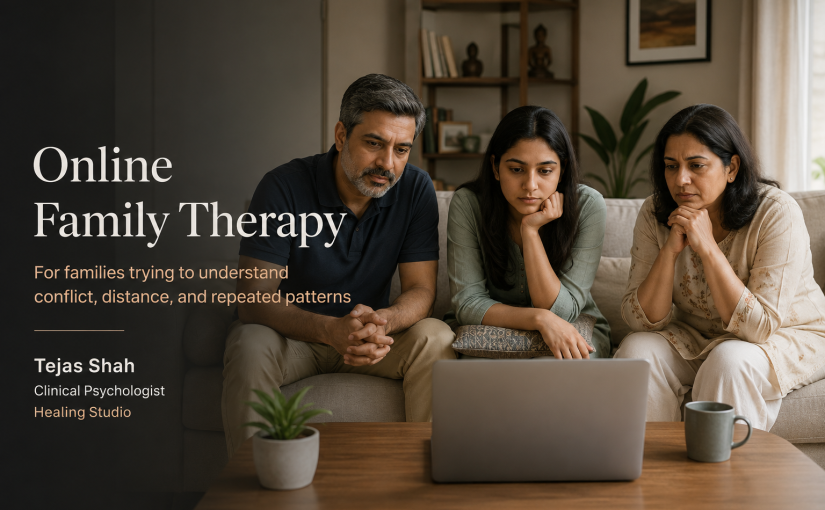
Family problems can become painful when everyone has a different version of what is happening. Online family therapy in India offers a structured space where family members can speak, listen, and understand the pattern they are caught in, especially when conversations at home keep turning into silence, blame, anger, or emotional withdrawal.
I offer online family therapy in India for families who are dealing with conflict, distance, parenting stress, intergenerational tension, family transitions, or repeated emotional patterns that are difficult to resolve alone. The work is calm, reflective, and clinically grounded. It is not about deciding who is right. It is about understanding what keeps happening between people.
Tejas Shah
Clinical Psychologist | Couples & Family Therapist | Group Analyst
Online: Zoom sessions for clients in India and abroad
Call / WhatsApp: +917977501648
Email: [email protected]
“Families often come to therapy hoping one person will change. The deeper work begins when the family can see the pattern that has been holding everyone.” — Tejas Shah
Online Family Therapy in India for Families Who Feel Stuck
Families do not usually seek therapy because of one argument. They seek help when the same issue returns again and again.
One person may feel unheard. Another may feel blamed. A parent may feel disrespected. An adult child may feel controlled. A couple may disagree about parenting. Siblings may carry old hurt. Sometimes the whole family appears functional from the outside, but inside the home there is tension, avoidance, or emotional exhaustion.
Online family therapy in India may be useful when family members want help, but cannot easily come to the same clinic or live in different cities or countries. It can also help families who prefer the privacy and convenience of meeting from home.
In clinical work with families, the visible conflict is often only one part of the picture. Beneath it there may be loyalty, hurt, fear, shame, dependency, guilt, resentment, or old roles that no one knows how to leave.
When Family Problems Become Difficult to Handle Alone
You may be looking for family therapy if:
- conversations quickly become arguments
- family members avoid difficult topics
- one person is repeatedly blamed for the family’s distress
- parents and children struggle to understand each other
- adult children feel controlled, guilty, or emotionally trapped
- family members feel distant despite living together
- caregiving, illness, marriage, divorce, relocation, or loss has changed the family balance
- decisions about money, marriage, career, education, or responsibility create repeated conflict
- everyone is tired of the same cycle, but no one knows how to change it
Family distress is rarely simple. In many Indian families, emotional life is shaped by closeness, duty, hierarchy, dependence, sacrifice, silence, and unspoken expectations. These can offer support, but they can also create pressure.
Sometimes the problem is not lack of love. The problem is that love, guilt, anger, loyalty, and fear have become tangled.
Who Online Family Therapy in India Can Help
Online family therapy in India may be useful for:
- parents and adult children
- parents and teenagers or young adults
- siblings dealing with resentment, inheritance stress, caregiving, or family responsibility
- couples whose conflict is affecting the wider family
- families dealing with illness, grief, separation, relocation, or major life changes
- Indian families living across different cities or countries
- families where one member feels identified as “the problem”
- families trying to repair distance after years of avoidance or conflict
Online family therapy in India may help when the problem involves the relationship system, not only one person
Sometimes one family member is anxious, angry, withdrawn, depressed, rebellious, or overwhelmed. However, their distress may also be connected to the wider family atmosphere. Family therapy does not deny individual responsibility. It looks at how everyone is participating in the emotional system.
This can reduce blame. It can also make change more possible.
Why Families Seek Therapy Online
Families often seek online family counselling when private conversations are no longer working. They may have tried advice, silence, anger, emotional appeals, or repeated explanations. Still, the same pattern continues.
Common reasons include:
- parent-child conflict
- adult child and parent tension
- marital conflict affecting children or extended family
- sibling conflict
- caregiving stress
- family business stress
- conflict around marriage, divorce, separation, or remarriage
- emotional cutoff between family members
- difficulty setting boundaries
- intergenerational differences in values
- family pressure around career, lifestyle, identity, or relationships
Online work may be especially useful when family members are not in the same place. A parent may be in one city, an adult child abroad, and another sibling elsewhere. Zoom sessions allow the family to enter the same therapeutic conversation without needing to be physically present in the same room.
At the same time, online family therapy requires seriousness. The family needs privacy, a stable internet connection, and a willingness to speak with some degree of restraint and honesty.
My Approach to Online Family Therapy
My approach to family therapy is relational, systemic, and depth-oriented. This means I do not look only at one person’s symptoms or behaviour. I pay attention to the family pattern: how people speak, withdraw, protect themselves, blame, rescue, avoid, control, or become silent.
The work may involve understanding:
- repeated family roles
- emotional triangles
- parent-child dynamics
- marital strain affecting the family
- guilt and obligation
- unspoken anger or grief
- boundary difficulties
- loyalty conflicts
- intergenerational expectations
- the pressure to appear “normal” while suffering privately
Family therapy is not a courtroom. It is not a place where the therapist becomes judge, parent, or referee. The aim is to slow the conversation down enough so that the family can hear what usually gets lost under defensiveness.
Depending on the situation, I may also draw from psychodynamic psychotherapy, systemic family therapy, mentalization-based thinking, emotion-focused work, cognitive and behavioural approaches, and philosophical reflection where relevant.
In family work, the question is often not, “Who is wrong?” A more useful question is, “What keeps happening between us, and what does each person do when they feel hurt, afraid, ignored, or powerless?”
Why Work With Tejas Shah
Tejas Shah is an RCI-Licensed Clinical Psychologist, Couples and Family Therapist, Philosophical Counsellor, and Group Analyst. He works with adults, couples, families, and groups, with attention to both immediate distress and deeper relational patterns.
His clinical background includes over 16 years of experience and 16,000+ hours of therapeutic work. He has been in clinical practice at Healing Studio since 2010. His training includes Couples and Family Therapy from TISS and NIMHANS, psychodynamic and group analytic training, CBT and RECBT training, Acceptance and Commitment Therapy, Mentalization Based Therapy, and Emotion Focused Therapy.
This matters because family problems are rarely solved by generic communication tips. Families need a therapist who can understand emotional systems, individual vulnerability, cultural context, and the hidden loyalties that shape behaviour.
Drawing from my work with individuals, couples, families, and groups, I often find that the visible family conflict makes more sense when placed in the context of deeper recurring patterns. People usually know what happened. Therapy helps them understand why it keeps happening in the same emotional form.
What to Expect in the First Session
The first session is usually an initial consultation. It is a space to understand what brings the family to therapy, who is involved, what has been tried before, and what each person hopes will change.
In the first session, we may discuss:
- the main concern
- who should attend sessions
- whether family therapy is suitable
- whether individual, couple, or parent-focused work may also be needed
- how online sessions will be structured
- confidentiality and boundaries
- what the family can realistically expect from therapy
Not every family member has to feel equally ready at the beginning. It is common for one person to want therapy more than others. However, the work is usually more useful when participants are willing to engage with some openness.
Therapy does not require perfect cooperation. It does require enough willingness to pause the usual fight and try a different kind of conversation.
Practical Details
Format: Online therapy sessions on Zoom
For: Families, parents and adult children, parents and teenagers, siblings, and families living across different locations
Online: Sessions are available for clients in India and abroad
Call / WhatsApp: +917977501648
Email: [email protected]
Online family therapy may be suitable if your family members live in different cities or countries, prefer the privacy of home, or need a flexible way to begin therapy together.
This page is meant for education and guidance. It cannot replace therapy, diagnosis, or personalized clinical advice.
FAQs About Online Family Therapy
1. Is online family therapy suitable for Indian families?
Yes, online family therapy can be suitable for Indian families when the work is conducted with sensitivity to family hierarchy, duty, guilt, dependence, boundaries, marriage, parenting, and intergenerational expectations. The online format can also help when family members live in different cities or countries.
2. Can all family members join from different cities or countries?
Yes. Family members can join the same Zoom session from different locations. This can be useful for families where adult children live abroad, parents live in India, or siblings are spread across different cities.
3. What if one family member does not want therapy?
This is common. Family therapy can sometimes begin with the members who are willing to attend. In the first consultation, we can discuss whether it makes sense to invite others later or whether another format may be more suitable.
4. Is online family therapy confidential?
Yes, therapy is treated as confidential. However, family therapy has specific limits because more than one person is present. These boundaries are discussed clearly, especially around privacy, shared information, safety, and how communication outside sessions is handled.
5. How many sessions will a family need?
This depends on the concern, the level of conflict, the family’s readiness, and the depth of the pattern. Some families need a few focused sessions. Others benefit from longer work, especially when the difficulty has built up over years.
6. What is the difference between family therapy and individual therapy?
Individual therapy focuses mainly on one person’s inner life, symptoms, history, and relationships. Family therapy focuses on the relationship system between family members. It looks at how people affect each other, repeat roles, and get stuck in patterns together.
7. Can online family therapy help if there is a lot of anger?
It may help if family members can remain safe and reasonably contained during sessions. If there is active violence, severe intimidation, or immediate risk, a different form of support may be needed first. This can be assessed in the initial consultation.
Book an Online Family Therapy Consultation
If your family is caught in repeated conflict, silence, distance, or emotional strain, online family therapy may offer a more structured way to understand what is happening. You do not need to have everything clear before reaching out. The first step can simply be an initial consultation to understand whether this is the right format for your family.
Call / WhatsApp: +917977501648
Email: [email protected]
Tejas Shah is a Clinical Psychologist and Couples and Family Therapist at Healing Studio.
He works with adults, couples, families, and groups dealing with relationship distress, family conflict, emotional patterns, parenting strain, and complex Indian family dynamics. His work is reflective, clinically grounded, and attentive to both present difficulties and deeper relational structures.
Tejas Shah’s Healing Studio >> Therapy Clinic in Borivali >> Online Therapy India