
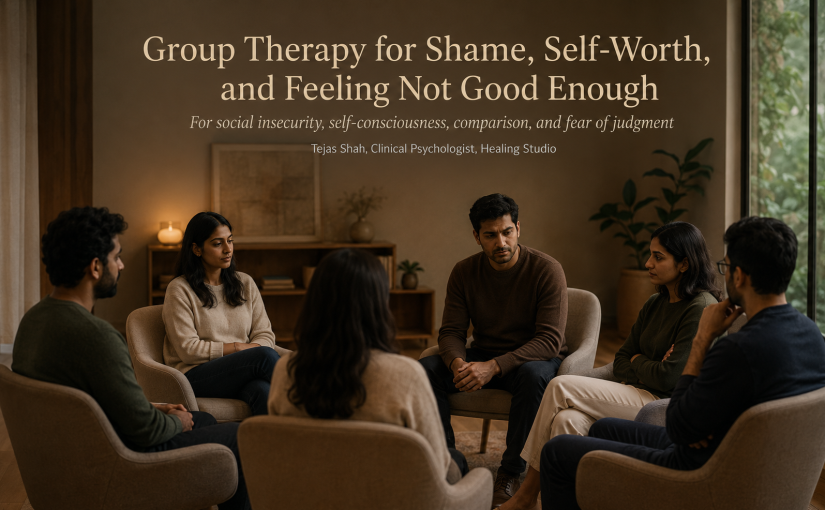
There are people who can function well, speak intelligently, and appear composed, yet feel painfully small around others. They may become awkward in groups, compare themselves constantly, feel inferior in subtle ways, or carry the quiet conviction that something about them is not enough. If you are looking for group therapy for shame, self-worth, and feeling not good enough in Mumbai, the difficulty may not be confidence alone. It may be a deeper emotional pattern that shapes how visible, worthy, and secure you feel with other people.
At Healing Studio, I offer group therapy for adults whose social and relational life is shaped by shame, insecurity, comparison, self-consciousness, and fragile self-worth. This work is not about forcing confidence or teaching people to perform better socially. It is about understanding what happens inside you in the presence of others, and why ordinary contact can feel exposing, diminishing, or harder than it looks.
Tejas Shah
Clinical Psychologist | Philosophical Counsellor | Group Analyst
In-person: Borivali, Mumbai
Online: Zoom sessions where appropriate
Call / WhatsApp: +91 7977501648
Email: [email protected]
“In therapy, shame often hides beneath politeness, withdrawal, comparison, or the effort to never need too much.” — Tejas Shah
When shame quietly shapes your place with other people
You may relate to this page if you often feel:
- awkward, watched, or overly visible around others
- smaller or lesser in the presence of confident people
- embarrassed by your own needs, wishes, or desire for attention
- ashamed after speaking, sharing, or being noticed
- wounded easily by exclusion, misunderstanding, or subtle dismissal
- stuck between wanting connection and wanting to disappear
- preoccupied afterward with what you said, how you came across, or whether others judged you
In practice, this kind of difficulty often shows up as a recurring pattern that affects not only mood, but also relationships, self-esteem, and everyday decisions. A person may appear shy, reserved, avoidant, agreeable, or overly self-controlled. Yet underneath, there is often a painful sensitivity to exposure, comparison, or the fear of being seen as inadequate.
Who this group work may help
This group may be useful for adults who:
- feel not good enough in social or relational settings
- become self-conscious quickly in groups
- compare themselves constantly with others
- feel inferior around stronger, louder, or more at-ease people
- struggle with fear of judgment, embarrassment, or humiliation
- feel ashamed of needing reassurance, care, affection, or attention
- feel emotionally reduced, misunderstood, or diminished in the presence of others
- want depth-oriented help rather than quick confidence tips
This can include people who are outwardly high-functioning. They may manage work, family, and daily responsibilities, yet inwardly remain tense, small, and exposed around other people.
The social world beneath shame: comparison, visibility, and self-doubt
Shame rarely appears as just one feeling. It often shapes the whole emotional atmosphere of being with others. A group can therefore become a very important place to understand it, because the difficulty itself often lives in relation to other people.
Feeling watched, awkward, or judged
Some people enter ordinary social situations already braced. They become aware of themselves too quickly, monitor how they sound, worry about saying the wrong thing, and replay interactions long afterward. Groups may feel harder than one-to-one contact because attention can shift unpredictably, comparison becomes stronger, and there is less control over how one is seen. What looks like social awkwardness may actually be a deep fear of judgment, embarrassment, or emotional exposure.
Living in comparison and inferiority
For others, the struggle is less about speaking and more about where they feel they stand. They compare themselves with almost everyone, shrink around confident or expressive people, and feel lesser in subtle but persistent ways. Someone else’s ease can evoke envy, discouragement, admiration, or collapse. Comparison then stops being an occasional reaction and becomes the person’s whole social lens. In a therapy group, this pattern can be noticed where it happens, rather than only discussed after the fact.
Shame around wanting care, attention, or reassurance
Some people are not only ashamed of weakness, but ashamed of longing itself. They want to be cared for, noticed, valued, missed, included, or chosen, yet feel childish, needy, weak, or exposed for wanting these things. So they hide the need, criticise themselves for having it, or become silently distressed when others receive the warmth or attention they wanted. That conflict, wanting closeness but feeling ashamed of wanting it, often leaves people emotionally hungry and socially guarded at the same time.
Feeling exposed, misunderstood, or emotionally reduced
There are also people for whom visibility itself feels unsafe. Being noticed can feel unbearable, even when nothing openly bad is happening. They may feel exposed when they speak, humiliated by small misunderstandings, or reduced by the sense that others do not really grasp them. In close relationships and in groups, vulnerability and danger can get mixed together. The result is often emotional shrinking, cautiousness, withdrawal, or a lingering sense of being too much and not enough at the same time.
Group therapy for shame, self-worth, and feeling not good enough in Mumbai
Group therapy can be especially relevant for this kind of difficulty because the problem is often not only inside the person. It unfolds between people. Shame, inferiority, self-consciousness, envy, fear of judgment, and the wish to belong all become more visible in a group setting, which means they can also be understood more directly.
This is not only a confidence problem. Psychologically, it may also involve shame, attachment insecurity, defensive withdrawal, fear of dependence, emotional inhibition, and old relational expectations about what happens when one becomes visible. A person may expect criticism, comparison, indifference, exclusion, or subtle humiliation long before any of that has actually happened.
In group therapy, these patterns are approached with care and seriousness. The aim is not forced exposure. The aim is to help you notice what happens in real time, understand the emotional logic beneath it, and gradually develop a more stable, less shamed place in relation to others.
“What hurts in groups is often not the group itself, but the older emotional meanings that get activated inside it.” — Tejas Shah
A map of the struggle, from primary difficulty to lived experience
The deeper core: shame, low self-worth, and not feeling enough
At the centre of this work is a painful sense of insufficiency. You may feel inferior, easily judged, awkward, ashamed, or chronically lesser in the presence of others. You may want connection but not feel secure enough to occupy space within it. The problem is often not dramatic on the surface. It may appear as inhibition, overthinking, deference, restraint, or the habit of disappearing emotionally before anyone has clearly rejected you.
How it often branches out in daily life
Social anxiety, awkwardness, and fear of judgment
For some, the struggle is immediate and situational. Ordinary social contact can feel charged with self-consciousness. You may feel watched, embarrassed, stiff, or unsure of how to enter conversation naturally. Afterwards, the mind replays everything. Small moments begin to feel bigger than they were. The emotional burden is not just anxiety, but the fear of being seen badly.
Comparison, inferiority, and feeling lesser than others
For others, the difficulty turns into a ranking system. You may compare yourself constantly, feel diminished around people who seem more confident or socially fluid, and begin to experience the social world as a place where everyone else belongs more easily than you do. Envy may become painful. Admiration may turn into self-rejection. Over time, comparison can become the main way you relate to people.
Shame around need, attention, or visibility
Some people feel deeply conflicted about wanting care, appreciation, affection, attention, or reassurance. They long to matter, yet feel embarrassed for wanting to matter. They want to be noticed, yet feel exposed when they are. They need closeness, yet fear appearing needy, weak, ordinary, or desperate. This often leads to painful inner splits, wanting contact while also resenting oneself for needing it.
Feeling exposed, misunderstood, or emotionally small
Others are especially sensitive to moments of visibility, misunderstanding, or emotional diminishment. Even without open criticism, they may feel exposed, reduced, or quietly humiliated. They may leave interactions feeling smaller than before, especially in groups or close relationships. The mind then tries to protect them by making them more cautious, less expressive, and less willing to take up space.
What the group can begin to change
When these themes are worked through in a serious group setting, people often begin to recognise patterns that previously felt like fixed personality traits. Social awkwardness may start to make sense. Comparison may become more understandable. Shame around need may soften. Visibility may begin to feel less dangerous. The goal is not performance, but a more grounded sense of self with other people.
My Approach to Group Therapy for Shame, Self-Worth, and Feeling Not Good Enough
My way of working in groups is reflective, psychologically in-depth, and relational. I do not treat shame as a superficial self-esteem issue. I am interested in how the person experiences themselves with others, what they fear will happen if they become more visible, and what older emotional expectations may be getting repeated in present relationships.
Drawing from my work with adults, couples, families, and groups, I often find that the visible difficulty makes more sense when placed in the context of deeper recurring patterns. Someone may say they are shy, awkward, inferior, or too sensitive. Over time, however, we may see a more complex structure involving shame, vigilance, dependency fears, envy, fear of exclusion, or an old expectation of being diminished by others.
Depending on the group and the person, this work may involve:
- noticing real-time reactions to being seen, included, ignored, compared, or responded to
- understanding self-consciousness, withdrawal, compliance, or inhibition as meaningful emotional responses
- making space for dependency needs, rivalry, envy, longing, resentment, and fear without shaming them
- developing greater tolerance for visibility, difference, and emotional presence
- helping the person find a less diminished internal position with others
Why work with Tejas Shah
I am an RCI-Licensed Clinical Psychologist, Group Analyst, and Philosophical Counsellor. My work is suited to people who want serious, thoughtful help with emotional and relational patterns rather than generic advice.
Relevant aspects of my background include:
- over 16+ years of clinical experience
- over 16,000+ hours of therapeutic experience
- clinical practice at Healing Studio since 2010
- training as a Qualified Group Analyst from the Institute of Group Analysis, London
- experience working with adults, couples, families, and groups
- psychodynamic, relational, and depth-oriented understanding of emotional difficulties
- sensitivity to Indian family structures, social pressures, shame dynamics, and high-functioning distress in urban life
As an RCI-Licensed Clinical Psychologist, I often find that what people seek first is relief, but what helps more deeply is understanding the emotional position from which the problem has been repeating. This matters especially in shame-based difficulties, where the person may blame themselves for patterns that actually need careful understanding.
What the process is like
The first step is usually an initial consultation. We look at what brings you, how long these difficulties have been present, how they affect your relationships and daily life, and whether group therapy is currently the right fit.
If group work is appropriate, I will explain the structure of the group, what participation generally involves, and what kind of work the space is designed for. Not everyone needs to speak immediately or force themselves into visibility on day one. The point is not to perform courage. The point is to begin entering the work honestly.
Over time, group therapy may help you:
- feel less ashamed of ordinary emotional needs
- reduce self-consciousness and fear of judgment
- understand comparison, inferiority, and social shrinking more clearly
- take up more emotional space without feeling fraudulent or exposed
- relate to others with greater steadiness and less inner collapse
Practical details
In-person Location: Providing Group Therapy for Shame, Self-Worth, and Feeling Not Good Enough in Mumbai at our Borivali clinic.
Nearby areas: Serving group therapy across Borivali East, Borivali West, Kandivali, Dahisar, Mira Road, Goregaon and the Western Suburbs in Mumbai.
Online: Zoom sessions for clients in India and abroad, where appropriate.
Call / WhatsApp: +91 7977501648
Email: [email protected]
Frequently asked questions
1. How do I know if this group may be relevant for me?
This group may be relevant if your social and relational life is shaped by shame, self-consciousness, inferiority, comparison, fear of judgment, or the feeling of not being enough around others. You do not need to be in crisis. Many people seek help because the same emotional pattern keeps repeating in quieter ways.
2. Is this only for people with social anxiety?
No. Social anxiety may be one part of the picture, but this group is also relevant for people struggling with shame, fragile self-worth, comparison, inferiority, embarrassment about needs, and the pain of feeling emotionally small with others.
3. Will I be forced to speak in the group?
No. Group therapy is not about pushing people into exposure for its own sake. Participation grows over time. The work is more thoughtful than performative, and the aim is to understand what makes speaking, being seen, or taking up space difficult in the first place.
4. How is group therapy different from individual therapy for these issues?
Individual therapy can help you understand your inner world in depth. Group therapy adds something important: it allows shame, comparison, fear of judgment, longing, rivalry, and self-consciousness to be noticed in a live relational setting. That can make the work especially meaningful for people whose difficulty is organised around other people.
5. What if I feel inferior or intimidated by other group members?
That is often part of the very material the therapy is meant to help with. Feeling lesser, intimidated, excluded, or overly affected by others can be worked with in the group rather than hidden outside it.
6. Do you offer this online?
Where appropriate, some sessions may be available online over Zoom. Suitability depends on the person, the group format, and the nature of the concern.
7. What happens in the first consultation?
The first consultation is a space to understand your difficulty, ask questions, and consider whether this form of group therapy is a good fit. If another format, such as individual therapy, seems more suitable, that can also be discussed.
This page is meant for education and guidance, not as a substitute for therapy, diagnosis, or personalized clinical advice.
Book an initial consultation
If you have been living with shame, self-consciousness, comparison, or the persistent feeling of not being enough, group therapy may offer a meaningful place to understand the pattern and begin relating differently to others.
If you are looking for group therapy for shame, self-worth, and feeling not good enough in Mumbai, you can get in touch to ask about suitability and the next available consultation.
Call / WhatsApp: +91 7977501648
Email: [email protected]
Tejas Shah is a Clinical Psychologist and Group Analyst at Healing Studio. He works with adults struggling with shame, self-worth difficulties, social insecurity, relational pain, and repeating emotional patterns that affect how they experience themselves with others. His approach is depth-oriented, clinically grounded, and attentive to both present distress and the deeper structures that keep it going.
Tejas Shah’s Healing Studio >> Therapy Clinic in Borivali >> Group Therapy