
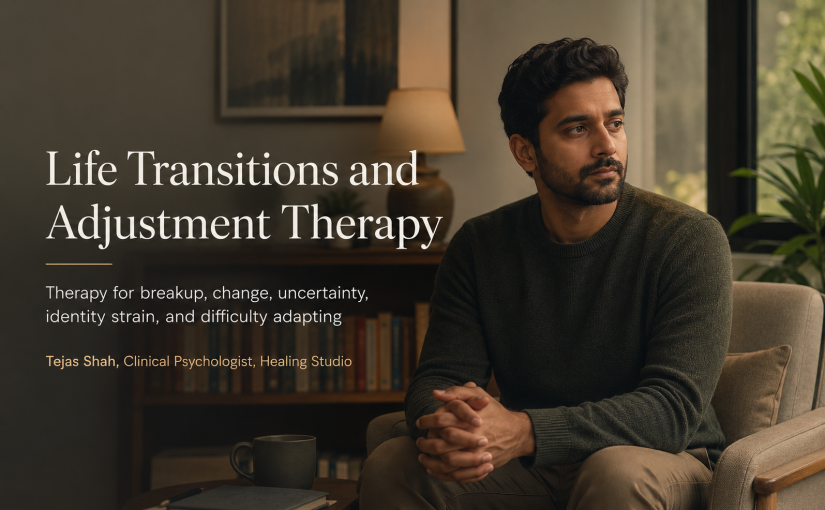
When change leaves you feeling emotionally off balance
A life change does not have to look dramatic from the outside to feel deeply unsettling within. You may be going through a breakup, marriage, relocation, career shift, parenthood, illness, loss, or a major decision, and still find yourself more distressed than you expected. Life Transitions and Adjustment Therapy in Mumbai can help when change brings anxiety, confusion, grief, self-doubt, or the sense that your inner life has not caught up with what is happening around you.
Sometimes the problem is not only the event itself. It is what the change stirs up emotionally. A transition may unsettle old fears, relational patterns, identity conflicts, or long-standing uncertainty about who you are and how you want to live. Therapy offers a space to understand both the visible transition and the deeper emotional pressure underneath it.
Tejas Shah
Clinical Psychologist | Philosophical Counsellor | Group Analyst
In-person: Borivali, Mumbai
Online: Zoom sessions where appropriate
Call / WhatsApp: +91 7977501648
Email: [email protected]
“Change does not only ask what is happening in your life. It often asks who you are becoming in response to it.” — Tejas Shah
In clinical work, this kind of difficulty often appears less as one dramatic event and more as a wider emotional reorganization. A person may be functioning outwardly, but internally feel disoriented, suspended, or strangely unlike themselves. That inner shift deserves careful attention, not casual advice.
Life transitions and adjustment therapy in Mumbai can help when
You may be looking for this kind of therapy if:
- a recent life change has left you emotionally unsettled
- you feel anxious, stuck, flat, or unable to move forward
- you are grieving not only what happened, but what might have been
- you are functioning on the outside but feel inwardly disorganized
- you keep second-guessing a major decision
- you feel pressure to “adjust” faster than you actually can
- a transition has activated older fears, insecurity, or self-doubt
- you are unsure who you are in this new phase of life
Sometimes people come because they cannot name one neat problem. They only know that something feels off. Their relationships may feel strained, their concentration poor, or their confidence reduced. They may feel emotionally crowded by expectation, especially in Indian family and social contexts where major life changes often carry pressure, scrutiny, or unspoken duty.
Who this therapy may help
This work may be useful for adults who are dealing with:
- breakup, separation, divorce, or relationship change
- marriage or uncertainty about marriage
- relocation, migration, or moving away from family
- career shift, job loss, burnout, or role change
- parenthood, fertility strain, or changing family responsibilities
- illness, caregiving, or a change in physical functioning
- bereavement or another form of personal loss
- identity change, value conflict, or uncertainty about direction
It may also help people who appear high-functioning but feel emotionally overwhelmed by change. Some people are not falling apart, but they are no longer steady. That is often reason enough to seek help.
Why life transitions can feel more difficult than they look
A transition is rarely only practical. Even when the external change is expected or socially accepted, it may still involve loss, ambivalence, fear, or a collapse of familiar structure. You may have wanted the change and still struggle with it. That contradiction is more common than people admit.
Common transitions that bring people to therapy
- A breakup may not only mean heartbreak. It may reopen old wounds around rejection, dependency, trust, or self-worth.
- Marriage may not only bring happiness. It may also bring anxiety, family pressure, role confusion, or fear of permanence.
- A relocation may not only involve logistics. It may stir loneliness, identity strain, and the loss of emotional anchoring.
- Parenthood may not only bring love. It may also bring exhaustion, fear, resentment, guilt, and a major change in selfhood.
- Career change may not only be about work. It may expose deeper questions about meaning, status, ambition, or failure.
This work is not only about coping better
On the surface, the difficulty may look practical. Psychologically, it can involve grief, shame, defensive patterns, attachment insecurity, fear of dependence, or uncertainty about how to live in a more authentic way. The distress is often not irrational. It usually has a logic, even if that logic is not yet fully clear.
In my work as an RCI-Licensed Clinical Psychologist, I often see that people can describe the external change very clearly, but need help understanding the deeper emotional position they have been living from. This is often where therapy becomes useful. Not as a pep talk, and not as a forced “fresh start,” but as a way of thinking and feeling more honestly through what is happening.
My approach to life transitions and adjustment therapy in Mumbai
My work is reflective, emotionally attentive, and depth-oriented, while staying grounded in practical realities. Depending on your situation, therapy may involve understanding grief, conflict, indecision, fear, emotional overload, identity strain, or repeating relational patterns that become more visible during times of change.
I draw from psychodynamic and relational thinking, along with broader psychotherapy approaches where relevant. This means we do not only focus on symptom relief in a narrow sense. We also look at what the transition means to you, what it is activating, and how you have been trying to manage it emotionally.
For some people, the work involves slowing down rushed decisions. For others, it involves grieving properly, tolerating uncertainty, or rebuilding an inner sense of steadiness. In many cases, therapy helps a person make better contact with their own emotional truth, rather than simply adapting on the surface.
“Adjustment is not always about becoming comfortable quickly. Sometimes it is about becoming more honest, more stable, and more internally clear.” — Tejas Shah
Why work with Tejas Shah
Tejas Shah is an RCI-Licensed Clinical Psychologist with over 16 years of clinical experience and 16,000+ hours of therapeutic work. He has been in clinical practice at Healing Studio since 2010. His work is serious, thoughtful, and psychologically in-depth.
For people going through major life changes, this matters because transition pain is often not only about stress management. It may involve grief, identity, relationships, dependency, inner conflict, and long-standing emotional patterns. A therapist needs to be able to work at both levels, what is happening now, and what the change has exposed.
His background includes M.Phil. in Clinical Psychology (RCI), MSc Psychology, and MA Philosophy. His psychotherapy training includes work relevant to emotional conflict, anxiety, decision-making, and relational strain, including ISTDP, CBT, ACT, and Couples and Family Therapy. He works with adults, couples, families, and groups, which can be especially important when a transition involves relationship, family, or household pressure rather than only individual distress.
He offers in-person sessions in Mumbai and online sessions where appropriate.
What to expect in therapy
The first consultation is a space to understand what has changed, how you have been affected, what feels most difficult right now, and what kind of help may be useful.
How the first few sessions usually work
In the early phase of therapy, we usually explore:
- the transition itself and why it feels difficult now
- what emotions are most active, such as fear, grief, anger, guilt, or confusion
- what pressures or expectations are shaping your response
- whether this change is activating older patterns or unresolved conflicts
- what kind of support, reflection, and direction may help you move forward
The aim is not to force quick answers. It is to help you think more clearly, feel more steadily, and respond to change with greater awareness and less inner chaos. Depending on the concern, therapy may be brief and focused, or it may open into deeper work.
If you are unsure whether therapy is necessary, that uncertainty itself can be discussed. You do not need to arrive fully certain or fully articulate. Frankly, most people do not.
Practical details
In-person Location: Providing Life Transitions and Adjustment Therapy in Mumbai at our Borivali clinic.
Nearby areas: Serving clients across Borivali East, Borivali West, Kandivali, Dahisar, Mira Road, Goregaon and the Western Suburbs in Mumbai.
Online: Zoom sessions for clients in India and abroad, where appropriate
Call / WhatsApp: +91 7977501648
Email: [email protected]
FAQs
1. How do I know if I need therapy for a life transition?
You may benefit from therapy if a change in your life has left you persistently anxious, emotionally overwhelmed, confused, stuck, or unlike yourself. You do not need to be in crisis. Many people seek help when they are still functioning, but no longer feeling steady inside.
2. What kinds of life changes bring people to therapy?
Common reasons include breakup, marriage, relocation, parenthood, job loss, career shift, illness, caregiving, grief, and difficult decisions. Sometimes the external event is obvious. Sometimes the deeper issue is the emotional meaning of the change.
3. Is this therapy only for negative life events?
No. Even wanted or positive changes can be emotionally disruptive. Marriage, promotion, parenthood, or moving abroad may bring pressure, identity strain, fear, or grief alongside excitement.
4. Do you offer Life Transitions and Adjustment Therapy in Mumbai online as well?
Yes, online sessions are available where appropriate. This may be useful if you are outside Mumbai, travelling, living abroad, or prefer the privacy and convenience of online therapy.
5. What happens in the first session?
The first session is an initial consultation. We look at what has changed, what feels difficult, how long it has been affecting you, and what kind of therapeutic work may help. It is also a chance to see whether the fit feels right.
6. Can therapy help if I am confused about a major decision?
Yes. Therapy can be useful when you feel stuck between options, emotionally pulled in different directions, or pressured by family, relationship, or career expectations. The goal is not to make the decision for you, but to help you think and feel through it more clearly.
7. Is therapy confidential?
Yes. Confidentiality is taken seriously within professional and legal limits. Any relevant boundaries or exceptions are discussed clearly in the therapeutic process.
This page is educational in nature and cannot replace therapy, diagnosis, or an individualized clinical assessment.
Book a consultation for life transitions and adjustment therapy in Mumbai
If you are going through a major change and feel more emotionally unsettled than you expected, individual therapy may help you understand what this transition is stirring up and how to move through it with greater clarity and steadiness.
You can get in touch to schedule an initial consultation with Tejas Shah.
Call / WhatsApp: +91 7977501648
Email: [email protected]
Tejas Shah is a Clinical Psychologist and Individual Therapist at Healing Studio. He works with adults facing anxiety, emotional strain, loss, self-doubt, relationship difficulties, and periods of inner uncertainty. In transition-related work, he helps people think more clearly about change, understand the deeper emotional patterns it activates, and move forward with greater stability, self-understanding, and psychological depth.
Tejas Shah’s Healing Studio >> Therapy Clinic in Borivali >> Individual Therapy