Clinical Psychologist for Individuals, Couples, Families, Groups & Professionals
The Collapse of the Familiar World: When Thought Starts Devouring Reality
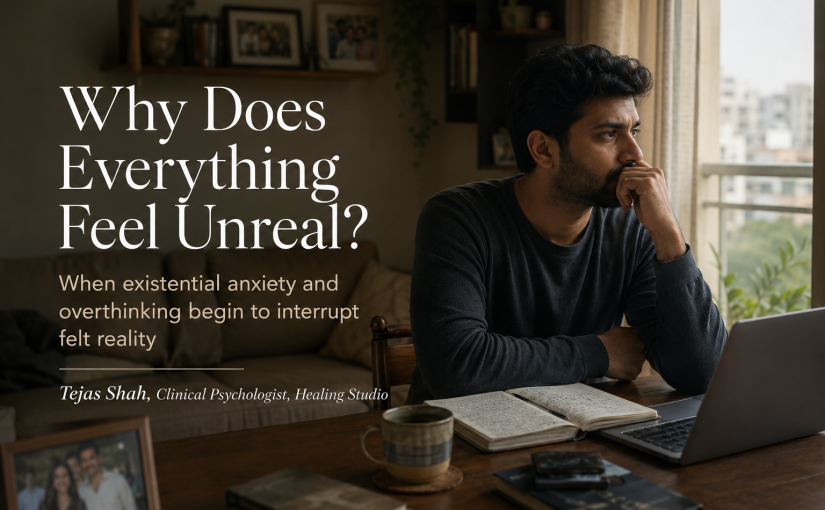
If you have been searching why does everything feel unreal, the experience is often more frightening than ordinary anxiety. It can feel as if family, memory, your own body, or everyday life are still present in a factual sense, but no longer emotionally land as real. The world has not disappeared, yet your felt contact with it seems disturbed.
For some people, this begins after intense overthinking. For others, it arrives through existential anxiety: relentless questioning about reality, selfhood, death, meaning, or whether attachment itself is only a mental construction. Either way, the result can be terrifying. You may start wondering whether you are going mad, becoming detached from human life, or losing something that cannot be restored.
This article is about that collapse of felt reality. It is educational in nature and cannot replace therapy, diagnosis, or an individualized clinical assessment.
When everything feels unreal, the fear is usually bigger than the symptom
People often describe this state in similar ways:
everything feels flat or far away
family feels unreal anxiety becomes the main fear
nothing feels real after overthinking
life feels like a concept rather than an experience
memories seem hollow, as if they belong to somebody else
the body feels present but not fully inhabited
ordinary routines start feeling absurd, thin, or emotionally empty
What makes this especially disturbing is that the content of life may still look intact from the outside. You may still go to work, talk to people, eat meals, and move through the day. Yet inwardly, something essential feels interrupted. The familiar world no longer reaches you in the way it once did.
In clinical work, this issue often appears not as a single dramatic problem, but as a repeating emotional pattern that slowly shapes the person’s relationships, decisions, and inner life.
Why does everything feel unreal in existential anxiety?
Sometimes the problem is not psychosis, loss of intelligence, or lack of insight. Sometimes the mind has become so overactive that it starts interfering with direct experience.
You stop simply seeing your mother and begin noticing that “mother” is a category. You stop feeling love as a lived bond and begin analyzing whether attachment is only biology, memory, projection, or social conditioning. You stop inhabiting the moment and begin examining consciousness itself. The result is not wisdom. Very often, it is estrangement.
This is where derealization existential anxiety can become relevant. Derealization is not the same as “nothing exists.” It is a state in which reality remains there, but your immediate felt connection to it weakens. Things seem distant, dreamlike, flattened, or emotionally unreachable.
The world is still there. What has been disturbed is your trust in it.
When thought starts devouring reality
One useful way to understand this is through a simple psychological idea: sometimes a way of protecting yourself becomes part of the problem.
In plain language, the mind may start using thought to avoid unbearable uncertainty, fear, or emotional vulnerability. Instead of feeling the raw dependency of love, the fragility of being alive, or the terror of losing people, it shifts upward into abstraction. It starts analyzing life instead of participating in it.
This can happen through a form of mental overprotection. Thought becomes a shield. But shields have a cost. When used constantly, they block contact not only with pain, but also with reality, affection, embodiment, and ordinary belonging.
What looks like philosophical depth may, at times, be a desperate attempt not to feel emotional exposure.
“Sometimes the mind does not only think about life. It retreats into thinking so it does not have to feel life.” — Tejas Shah
That is why people in this state often feel trapped in a cruel paradox. The more they think in order to feel certain, the less real life begins to feel.
Family feels unreal anxiety: why this can feel so terrifying
One of the most frightening forms of this state is when loved ones start feeling strangely unreal.
A person may look at parents, spouse, siblings, or children and feel panic because the emotional familiarity is no longer landing in the expected way. Then the mind adds a second layer of terror:
If my family feels unreal, does that mean I do not love them?
If attachment feels mentally constructed, is it hollow?
If I cannot feel closeness properly, am I already cut off?
What if I never come back into ordinary human life?
This becomes clinically important because the person is rarely afraid of an abstract philosophical conclusion alone. Beneath it is usually something far more primitive: terror of disconnection, annihilation, emotional exile, or irreversible estrangement.
So the panic is not coldly intellectual. It is often deeply emotional, even if it appears in a highly mental form.
What keeps the state going
Several things can maintain this pattern:
1. Constant checking
You keep testing whether things feel real yet. Ironically, this pushes you further into self-monitoring.
2. Hyper-reflection
You do not just experience life. You watch yourself experiencing it, then evaluate the quality of that experience.
3. Abstract dismantling
Every feeling gets dissected into theory: attachment, memory, projection, biology, illusion, meaninglessness.
4. Fear of the fear
Once the state becomes frightening, panic about “slipping away from reality” intensifies the state itself.
5. Reduced participation
Routine, work, conversation, exercise, practical tasks, and embodied contact shrink. The mind is left alone with itself for too long.
This is not only a communication problem. Psychologically, it may also involve emotional regulation, defensive style, attachment insecurity, shame, fear of dependence, or long-standing relational learning.
This is why reassurance rarely works for long
People in this condition often ask questions such as:
Is this normal?
Am I going crazy?
Can overthinking cause this?
Is my love fake if it feels mentally constructed?
What if nothing is real?
Reassurance may help briefly. But it often fades because the problem is not just lack of information. The person has become trapped in a pattern where thought is trying to solve a crisis that thought itself is partly maintaining.
So the answer is rarely a better argument.
The task is not to defeat every existential doubt. Human beings can think infinitely. If the goal becomes perfect certainty, the mind will always generate another question.
What helps when nothing feels real after overthinking
The therapeutic task is usually to restore contact, not to win a metaphysical debate.
That means helping the person re-enter lived experience through several channels:
Body
Sleep, eating, movement, breath, posture, sensory grounding, and reducing physiological arousal matter more than they may seem. A disembodied mind gets more abstract.
Time
Re-establishing structure and sequence helps. Wake up, bathe, eat, step outside, work, rest, speak, return. Time makes life feel inhabited again.
Relationship
Not abstractly thinking about family, but sitting with them, talking, helping, eating together, doing ordinary tasks. Reality often returns through shared life before it returns through reflection.
Attention
Less inner checking. More outward contact. What can you smell, hear, touch, carry, cook, clean, notice, finish?
Limits on philosophical spiraling
Some questions are meaningful. Some become compulsive. Learning the difference is part of recovery.
“Reality often returns not through a brilliant answer, but through repeated contact with body, time, work, and relationship.” — Tejas Shah
How therapy may help
In therapy, this kind of experience is approached carefully. It should not be dismissed as “just overthinking.” It should also not be dramatized as proof that you are leaving reality behind.
A serious therapeutic approach usually involves:
understanding what emotional fear sits underneath the hyper-reflection
noticing how abstraction has become a defense against emotional contact
reducing constant inner checking and conceptual dismantling
rebuilding contact with body, routine, and sensory life
restoring ordinary relational participation
making room for existential concerns without letting them become totalizing mental traps
A clinical note from my practice
In my work as a Clinical Psychologist, I have often found that people in this state are not lacking intelligence. In fact, many are highly thoughtful, self-aware, and psychologically observant. The difficulty is that thought has become over-central. It has started colonizing areas of life that usually need to be lived more than solved. Therapy then becomes less about offering clever interpretations and more about helping the person recover emotional immediacy, embodied steadiness, and trust in ordinary reality. This is often delicate work, because the person is not merely anxious; they are frightened that the whole structure of human life is becoming hollow. That fear needs to be understood, not brushed aside.
When to seek professional help
You should consider professional support when:
the sense of unreality is persistent or recurrent
family, work, routine, or sleep are being affected
you are caught in endless existential rumination
daily life feels distant, flat, or emotionally inaccessible
the fear of “slipping out of reality” is becoming consuming
reassurance no longer helps for more than a few minutes
This does not automatically mean something severe or irreversible is happening. But it does mean the pattern deserves careful attention.
A more useful question than “Is reality real?”
When someone is trapped in this state, the mind keeps asking whether reality is real enough. That question can become bottomless.
A more useful question is often this:
What helps me return to contact?
Not perfect certainty. Not total philosophical closure. Contact.
Contact with the body. Contact with time. Contact with work. Contact with affection. Contact with ordinary tasks. Contact with people who are still there, even when your feeling for them has gone dim.
That is often where recovery begins.
Frequently Asked Questions
1. Can anxiety really make everything feel unreal?
Yes. Severe anxiety, especially when mixed with relentless overthinking and self-monitoring, can create derealization-like states in which reality feels distant, flat, or emotionally unreachable.
2. Why does my family feel unreal to me?
This can happen when fear, hyper-reflection, and emotional detachment begin interfering with direct relational experience. It usually does not mean you do not care. More often, your felt access to connection has become disrupted.
3. Is derealization the same as madness?
No. Derealization is a known psychological experience in which reality still exists, but feels altered, distant, or unreal. It can happen in anxiety, panic, trauma, and severe stress. A proper clinical assessment matters when symptoms are severe or unclear.
4. Will this go away if I stop thinking about it?
Usually not by force alone. Telling yourself to “just stop thinking” often fails. Recovery tends to involve reducing compulsive checking, restoring routine and embodiment, and working therapeutically with the fear and overactivity underneath the state.
When this starts affecting daily life
If this article speaks closely to what you are going through, Individual Therapyor Group Therapy may help you understand what is happening beneath the sense of unreality and how to return to a more usable, grounded world. The aim is not to argue you out of your experience, but to help restore contact with life, relationship, and yourself.
Tejas Shah is a Clinical Psychologist and Therapist at Healing Studio. He works with anxiety, overthinking, existential distress, emotional disconnection, relationship pain, and recurring inner patterns that leave people feeling stuck or estranged from themselves. If familiar life has started feeling distant, flattened, or hard to inhabit, therapy may help clarify what is happening and support a steadier return to lived reality.
Explore Therapy at Healing Studio
If this article reflects something important in your life, therapy may offer a space to understand it more clearly and work with it in depth.
Individual Therapy Support for anxiety, depression, trauma, emotional struggles, self-criticism, and deeply rooted personal difficulties.
Couples Therapy Support for conflict, resentment, disconnection, trust difficulties, and repetitive relationship patterns.
Found this article helpful? Follow My WhatsApp Channel for brief reflections on mental health, relationships, emotions, and updates on new articles/workshops:
Related Posts:
Existential Anxiety Symptoms: When Big Questions Cause Panic Sometimes the content of distress sounds philosophical, but the structure of distress is anxious. This article explores existential anxiety symptoms that hide behind questions about life, death, reality, and consciousness.
The Fear Beneath the Thought: What Existential Patients… Many people who feel trapped in existential questioning are not only wrestling with philosophy. Often, they are living through an emotional emergency that has taken the form of thought. This article explores what may actually be behind existential anxiety, why the question feels so frightening, and how therapy can help.
From Metaphysical Panic to Psychological Work When existential questions stop feeling thoughtful and start disrupting sleep, work, relationships, and sanity, the problem is no longer only philosophical. This article explains how therapy can help turn metaphysical panic into something more thinkable, survivable, and workable.
Why Some People Become More Loyal to Questions Than to Life Some people do not just ask difficult questions. They become psychologically organised around asking them. The question starts to feel sacred, identity-giving, and morally superior to ordinary life. This article explores why that happens, why letting go can feel like betrayal, and how therapy can help a person think deeply without sacrificing love, work, rest, and reality.
Published by
Tejas Shah
TEJAS SHAH is a PhD Scholar and has M.Phil in Clinical Psychology (RCI), MSc in Psychology, MA in Philosophy and a Degree in Law (LL.B) from University of Mumbai; he is practicing as Chief Clinical Psychologist at Healing Studio. His research interests are consciousness, phenomenology, positive psychology, philosophical counselling and mindfulness. You can connect with him on [email protected].
View all posts by Tejas Shah