Clinical Psychologist for Individuals, Couples, Families, Groups & Professionals
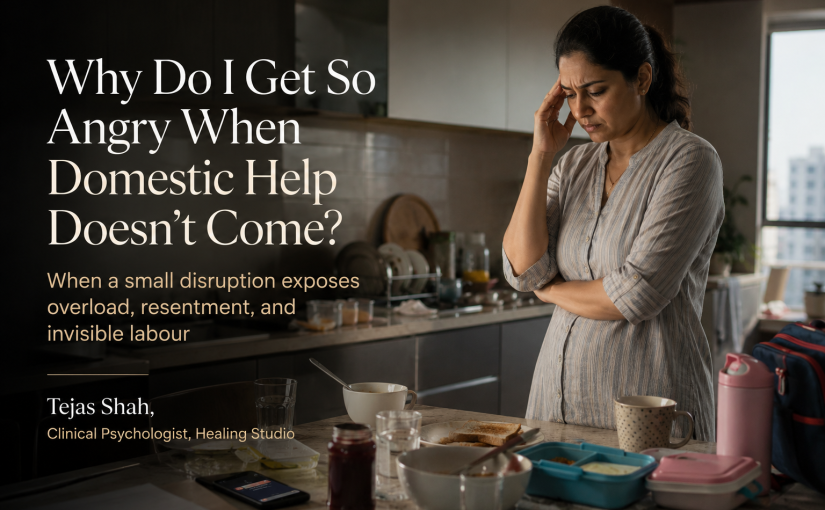
Why Do I Get So Angry When Domestic Help Doesn’t Come?
If you keep asking yourself, why do I get so angry when domestic help doesn’t come, the question usually carries a layer of guilt. You already know the reaction feels bigger than the event. Someone did not show up. The schedule gets disrupted. The work increases. But your internal reaction may be much larger: sharp irritation, pressure in the body, mental flooding, harshness in tone, and resentment that lingers for hours.
That usually means the anger is not being created in that one moment. It is being released there.
In clinical work, this issue often appears not as a single dramatic problem, but as a repeating emotional pattern that slowly shapes the person’s relationships, decisions, and inner life. What looks like a domestic inconvenience on the surface may actually be carrying exhaustion, inequality, unspoken expectation, and a chronic feeling of being over-responsible.
Why do I get so angry when domestic help doesn’t come?
Most people who ask this are not confused about whether the disruption is inconvenient. They already know it is. What troubles them is the intensity of the reaction.
That intensity often comes from the fact that the situation means much more than one unfinished task.
When domestic help doesn’t come, it may immediately affect breakfast, school routines, office timing, cleaning, cooking, elder care, children’s schedules, or the general functioning of the home. If your life is already running with very little margin, one absence can suddenly make the entire day feel fragile.
So the reaction is often not only about cleaning, cooking, or household chores. It is about what those chores represent emotionally: pressure, dependence, being left to manage everything, and the sense that the whole system rests on your shoulders.
Why the reaction feels bigger than the event
A useful question here is not only, what happened this morning? It is also, what has been building for weeks or months?
Sometimes the missed day is simply the point where a much larger burden becomes visible. The emotional build-up may already include:
carrying the mental load of the home
planning meals, school items, and logistics
remembering what needs to be done before anyone asks
managing work alongside caregiving
feeling that others participate only when instructed
having very little space for your own fatigue
If that is the background, then the absence of domestic help does not land on an empty emotional field. It lands on accumulated strain.
This is where one therapeutic concept becomes especially useful: the maintaining dynamic. In simple terms, the problem is not only the visible trigger. It is also the pattern underneath that keeps recreating the emotional pressure. The missed day becomes explosive because the household is already being held together by one person’s invisible labour, high responsibility, and low support.
“Sometimes the real problem is not the missed day itself, but the system that had no spare capacity to absorb it.” — Tejas Shah
The missed day often exposes invisible labour
Many people are not only doing work at home. They are also carrying the mental organization of the home.
Invisible labour includes noticing, anticipating, coordinating, reminding, planning, and tracking. It is the work of remembering school items, arranging meals, checking supplies, making sure routines run, noticing what is running out, and preventing small domestic failures before they happen.
This kind of labour often goes unrecognized because it is easiest to notice only when it breaks down.
When domestic help doesn’t come, the person carrying the invisible labour usually becomes the backup system for the missing visible labour too. That is why the reaction can feel so disproportionate. The mind is not merely thinking, there is extra work today. It may be thinking:
I am already holding too much.
No one fully sees what I do.
There is no slack in this house.
If one thing fails, I become responsible for everything.
That emotional position is exhausting. Over time, it breeds resentment.
Why resentment grows so quickly
Anger is often immediate. Resentment is slower and more cumulative.
If you repeatedly experience the household as something that runs because of your effort, while others remain less burdened, the missed day may touch a deeper wound. The anger is then not only toward the absent worker or the disrupted routine. It may also be linked to the unfairness of the broader arrangement.
What often gets activated is not simply inconvenience, but thoughts such as:
Why does this always fall on me?
Why is no one else anticipating what needs to be done?
Why do I have to think for everyone?
Why does my stress become normal to everyone else?
This is why some people do not calm down even after the immediate work gets managed. The emotional meaning of the event has expanded. It has touched the longer-standing experience of being overburdened, unseen, and taken for granted.
Dependence can also create anger
Many people feel embarrassed by how dependent they are on domestic help. They tell themselves they should be able to manage without it. But in many homes, especially where work, parenting, commuting, and caregiving all coexist, domestic help is not a trivial extra. It is part of the household’s functioning system.
When that support becomes unreliable, two difficult feelings can appear at once: dependence and resentment.
You may need the help, but dislike how much the system relies on it. You may appreciate the support, but also feel frustrated by the vulnerability of depending on someone else’s consistency. That combination is emotionally volatile.
Drawing from my work as an RCI-Licensed Clinical Psychologist, I often find that people describe the surface conflict clearly, but need help noticing the deeper emotional position they have been living from. Here, that position is often one of unsupported responsibility: I am the one expected to absorb the gap whenever something fails.
A note from my practice
In my work as a Clinical Psychologist, I often see that everyday household triggers are rarely only about the household. A missed chore, an untidy kitchen, a late morning, or an absence of help can become the visible doorway into something much larger: chronic overload, unequal responsibility, marital resentment, emotional loneliness, and the pressure of being the person who keeps the home functioning. That is why I do not see such anger only as a temper problem. Often, it is also a signal about the structure of the home, the emotional economy of the relationship, and the invisible burden one person has been carrying for too long.
Why the tone becomes harsh so quickly
Once a person is already stretched, the mind has very little room left between frustration and reaction. Patience narrows. Irritation becomes sharper. Tone becomes harsher.
This does not mean the reaction is justified. But it does mean it is understandable.
Many people then misread the whole issue as simply, I have anger problems. Sometimes anger is indeed the issue. But very often, the harsher tone sits on top of:
emotional exhaustion
low frustration tolerance under strain
silent resentment
lack of shared domestic responsibility
a chronic feeling of being unsupported
This becomes clinically important because if the situation is treated only as a problem of temper, the deeper structure remains untouched. The person may try to suppress the reaction, but the same pressure will keep rebuilding underneath.
“This kind of anger is often less about one event and more about the life-position of being the one who must hold everything together.” — Tejas Shah
What this anger may actually be trying to say
Anger is often a crude form of communication, but it still communicates.
In this situation, it may be expressing:
I need more shared responsibility.
I need practical help, not only sympathy.
I am mentally overloaded.
I feel unseen in the work I do.
I cannot keep being the shock absorber for every disruption.
Something in our household setup needs to change.
When anger is understood this way, the goal is not only to calm it down. The goal is to understand what condition keeps producing it.
What may actually help
The most useful question is often not, How do I stop getting angry? but, What is this anger showing me about the way my life is currently organized?
A few shifts are often more helpful than generic advice to stay calm.
1. Notice the overload earlier
Do not wait until you are already snapping. Try to notice the earlier signs: dread, tightening, rushing, resentment, or the feeling that there is no emotional space left.
2. Separate the trigger from the system
Yes, the immediate issue may be the absence of domestic help. But that does not explain why the whole burden lands where it does. The system question matters just as much as the event question.
3. Revisit division of labour at home
Some households have visible inequity. Others have hidden inequity, where practical tasks may appear divided but mental load is not. If one person is carrying planning, anticipation, and emotional management, the imbalance remains.
4. Reduce crisis dependence where possible
If every disruption becomes a collapse, the system is too brittle. Even partial backup planning can reduce emotional flooding.
5. Speak before resentment turns into bitterness
The later the conversation happens, the more likely it is to happen through sarcasm, harshness, or contempt. Earlier communication is often less dramatic and more useful.
When therapy may help
If you repeatedly find yourself asking why do I get so angry when domestic help doesn’t come, and the pattern leads to ongoing conflict, guilt, harshness, or a persistent sense of being emotionally trapped inside your own home, therapy may help.
The work may not be only about anger management. It may involve understanding resentment, invisible labour, emotional overload, boundaries, relationship expectations, and the household system itself.
Sometimes this is best worked through in individual therapy, especially when the person is carrying private strain, stress, and burnout. Sometimes it is better addressed in couples therapy or family therapy, when the larger pattern involves unequal responsibility, emotional non-cooperation, or a home atmosphere that repeatedly becomes tense and dysregulated.
This article is educational in nature and cannot replace therapy, diagnosis, or an individualized clinical assessment.
A more honest way to ask the question
In the end, the deeper question may not be only, Why do I get so angry when domestic help doesn’t come? It may also be:
Why has my life become so overloaded that one disruption makes me feel abandoned inside my own home?
That question is often harder, but also more truthful.
FAQs
1. Is it normal to get angry when domestic help doesn’t come?
Yes, irritation is completely understandable. But if the reaction becomes intense, repetitive, or affects the whole day, it may point to deeper overload, invisible labour, or household imbalance rather than only inconvenience.
2. Why do I stay angry for hours after a small household disruption?
Because the reaction may not be about that one event alone. It may activate accumulated resentment, mental load, and the feeling that the home depends too heavily on one person.
3. Does this mean I have anger issues?
Not necessarily. Sometimes the problem is not general anger, but anger arising from exhaustion, stress, and an unfair domestic pattern. Still, if the reaction keeps causing damage, it deserves attention.
4. Can therapy help if the problem looks practical rather than psychological?
Yes. Therapy may help you understand the emotional structure underneath the trigger, especially when the issue involves invisible labour, resentment, relationship strain, or repeated overload.
If this pattern keeps repeating
If this article speaks to what you are going through, support may help you understand not only the anger, but also the burden and relational pattern underneath it. Depending on the situation, individual therapy may help with emotional overload and resentment, while couples or family therapy may help when household roles, emotional support, and responsibility have become chronically unequal.
Tejas Shah is a Clinical Psychologist and Couples and Family Therapist at Healing Studio. He works with anger, resentment, family tension, emotional overload, and repeated household or relationship conflicts that begin to affect daily life and peace at home. His approach helps people understand not only the visible trigger, but also the deeper emotional and relational pattern underneath it. If this issue resonates with what you are living through, you may consider reaching out for a consultation.
Explore Therapy at Healing Studio
If this article reflects something important in your life, therapy may offer a space to understand it more clearly and work with it in depth.
Individual Therapy Support for anxiety, depression, trauma, emotional struggles, self-criticism, and deeply rooted personal difficulties.
Couples Therapy Support for conflict, resentment, disconnection, trust difficulties, and repetitive relationship patterns.
Found this article helpful? Follow My WhatsApp Channel for brief reflections on mental health, relationships, emotions, and updates on new articles/workshops:
Related Posts:
Why Do I Feel Like a Loser When Love Doesn’t Work Out? When love does not work out, many people do not just feel sad. They start feeling defective. This article explores why rejection can turn into shame, comparison, and a painful verdict on self-worth.
I Hurt People, But I’m Not a Bad Person You may know you hurt people and still not experience yourself as cruel or malicious. That conflict can create guilt, defensiveness, regret, and repeated damage in relationships. This article explains why intention and impact often split apart under emotional pressure, and how accountability can grow without collapsing into self-hatred.
What is Therapy About? In treatment at times your therapist won't talk very much, he may remain silent as well. There is an equally good reason that the therapist in treatment does not say much. Everyone expects to tell the therapist about his problem and then have him give advice which will solve everything just like that. This isn't true; it just doesn't work…
When Affordable Therapy Is Enough and When You May Need… Affordable therapy can be useful, supportive, and enough in many situations. But when distress is complex, recurring, severe, or affecting daily life, more experienced psychological care may be clinically appropriate.
Published by
Tejas Shah
TEJAS SHAH is a PhD Scholar and has M.Phil in Clinical Psychology (RCI), MSc in Psychology, MA in Philosophy and a Degree in Law (LL.B) from University of Mumbai; he is practicing as Chief Clinical Psychologist at Healing Studio. His research interests are consciousness, phenomenology, positive psychology, philosophical counselling and mindfulness. You can connect with him on [email protected].
View all posts by Tejas Shah