Clinical Psychologist for Individuals, Couples, Families, Groups & Professionals
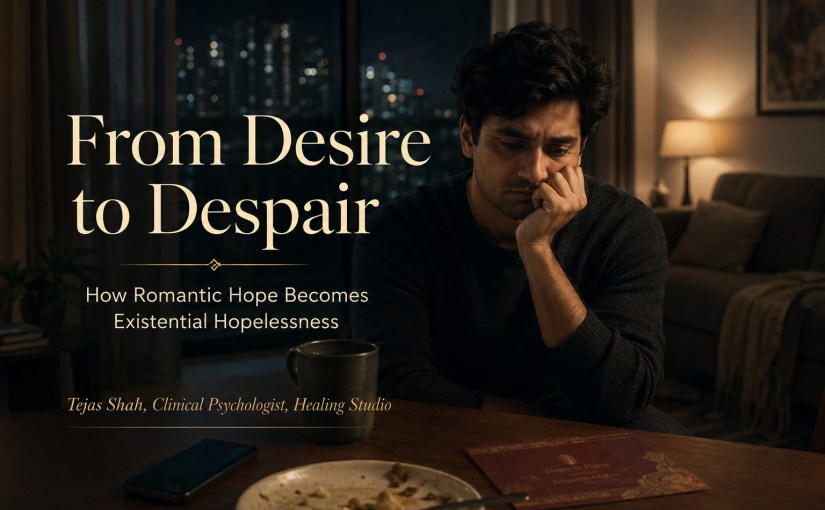
From Desire to Despair: How Romantic Hope Becomes Existential Hopelessness
If you keep finding yourself asking why dating makes me feel hopeless about life, the pain is usually bigger than one rejection, one failed talking stage, or one disappointing relationship. Something about romantic hope has become tied to your sense of worth, future, and aliveness itself.
This is why dating disappointment can feel strangely total. It is not only that someone did not choose you, respond the way you hoped, or stay. It is that the disappointment quickly becomes a verdict: maybe love will not happen for me, maybe I am already behind, maybe life is closing, maybe nothing matters enough without this.
That is a very different emotional experience from ordinary sadness. It is closer to despair.
“When longing becomes a verdict on your worth, heartbreak stops being only about love.” — Tejas Shah
Why dating makes me feel hopeless about life can become more than heartbreak
Most people expect romantic pain to hurt. What surprises them is the scale of it. A dating disappointment can leave someone not only sad, but mentally emptied out, unable to work properly, unable to enjoy anything, and quietly questioning the point of life.
This happens because the mind often does not keep the loss contained. Instead, it generalizes. One disappointment becomes evidence about everything.
You may begin with a specific grief:
This person did not want me.
This relationship did not work.
I am still alone.
I am tired of trying.
But the mind quickly expands it:
I am not lovable.
I am running out of time.
Other people belong to life more easily than I do.
If this does not happen, what exactly am I living for?
That expansion is where romantic pain starts becoming existential pain.
The old inner map underneath romantic despair
One useful way to understand this is through the idea of an old inner map, sometimes called a schema. A schema is not just a thought. It is a deeper emotional template through which you read yourself, other people, and the future.
If someone carries an old inner map such as I will be left, I am not enough, I am not chosen, or good things happen to others, not me, then dating disappointment lands on very loaded ground. The present event hurts, yes. But it also wakes up an older structure already waiting underneath it.
That is why the reaction can feel disproportionate even to you.
You may know, logically, that one person’s disinterest should not define your entire life. But emotionally, it lands as proof of a much older conclusion. The pain is not only about the present. It plugs into an existing map.
This becomes clinically important because many people do not suffer only from the romantic event itself. They suffer from how the event gets interpreted through an old emotional system. The disappointment then starts saying things it was never meant to say.
It starts saying:
you are fundamentally unwanted
your future is closing
your life is becoming second-rate
there is no point hoping anymore
That is why why dating makes me feel hopeless about life is often not a simple question about dating. It is a question about what dating failure awakens inside the self.
How romantic disappointment spreads into the rest of life
Once this collapse begins, it rarely stays confined to love. It starts affecting work, sleep, energy, social confidence, and the ability to imagine a future.
You may notice some of the following:
You lose interest in ordinary life. Work becomes mechanical. Food tastes flat. Messages from friends feel irritating. Weekends become heavy. You stop wanting to go out, but staying in feels deadening too.
You begin comparing yourself constantly. Other people’s engagements, weddings, anniversaries, and family milestones start to feel like personal accusations. You do not merely feel single. You feel excluded from life’s main road.
You become ashamed of your own longing. Instead of saying, I want love, you begin feeling humiliated that you want it so much. Need itself starts to feel degrading.
You start reading your entire future through the current pain. This is how loneliness makes life feel pointless. The mind quietly tells you that tomorrow will only repeat today.
In clinical work, this issue often appears not as a single dramatic problem, but as a repeating emotional pattern that slowly shapes the person’s relationships, decisions, and inner life. What looks like “dating disappointment” on the surface may gradually become withdrawal, loss of vitality, cynicism, compulsive fantasy, self-neglect, or a private despair no one else fully sees.
“A romantic disappointment hurts most when it lands on an older fear: that you may be unwanted in life itself.” — Tejas Shah
Why being single can start to feel like proof of something terrible
Being single is not automatically a crisis. Many single people are lonely at times without collapsing into despair. The deeper problem begins when singleness is no longer experienced as a circumstance, but as evidence.
Evidence that you are failing adulthood. Evidence that other people are more desirable. Evidence that you missed your chance. Evidence that family, society, and time are quietly moving ahead without you.
This is where social pressure becomes psychologically powerful. In many cultures, including Indian urban life, adulthood is still heavily organized around partnership, marriage, and family progression. Even when people appear modern on the surface, the emotional script remains old: by a certain age, you should have someone, you should be settled, you should have entered life properly.
So when romantic hope keeps breaking, the pain is not only private. It becomes social and existential. You do not just feel disappointed. You feel left behind.
And once that happens, the question is no longer, Why did this not work? It becomes, What does it say about me that this still has not happened?
That is a much harsher question. It is also usually the wrong one.
A clinical note from my work
In my clinical work, I often see people arrive saying they are upset about one person, one rejection, or one failed relationship. But as the work deepens, it becomes clear that the visible romantic event is carrying much more than itself. It is carrying older shame, fear of being ordinary or forgettable, grief about time passing, comparison with peers, and a painful uncertainty about one’s place in life. Very often, the person is not only mourning love. They are mourning a lost version of the future. That is why the emotional intensity can look excessive from outside but feel completely life-defining from inside.
What therapy may help you understand here
Therapy is not about talking you out of wanting love. Wanting love is not weakness. Nor is it something to be mocked, minimized, or dressed up as “you should just focus on yourself.”
The work is usually deeper than that.
Therapy may help you separate at least four things that have become fused together:
1. The real romantic grief
What actually happened? What did you lose? What were you hoping for? What is legitimately painful here?
2. The old inner map
What older conclusion got activated? Is the pain saying more than the current situation alone can explain?
3. The social humiliation around longing
Have you started feeling ashamed not only of being alone, but of needing closeness at all?
4. The collapse of meaning
When did love stop being one important part of life and become the condition under which life feels worth living?
This is where therapy can be steadying. It can help the person move from a total verdict to a more truthful picture.
You may still be grieving. You may still feel lonely. You may still deeply want partnership. But those feelings no longer have to mean that your whole existence is failing.
This is not only a communication problem or a dating-skills problem. Psychologically, it may also involve shame, self-worth injury, old schemas of rejection, over-interpretation of disappointment, and a habit of turning emotional pain into global conclusions about the self and future.
When heartbreak starts looking like existential depression
Sometimes people describe this state as heartbreak. Sometimes it is closer to heartbreak and existential depression.
That does not mean every painful dating phase is a depressive disorder. But it does mean the emotional field has widened beyond romance. The person may feel flat, purposeless, detached, chronically heavy, or privately done with life.
A few signs that the issue has become more serious:
you no longer enjoy much outside the romantic issue
you feel increasingly numb, not just sad
daily functioning is declining
you have withdrawn from people and routine
your future feels blank
life keeps feeling pointless because love is not happening
thoughts about not wanting to live have begun appearing
If that last point is present, it deserves to be taken seriously. This article is educational in nature and cannot replace therapy, diagnosis, or an individualized clinical assessment. If life feels unbearable, or you may act on thoughts of harming yourself, seek immediate support from local emergency services, a crisis helpline, or a trusted person near you today.
From desire to despair is not the end of the story
Romantic hope becomes dangerous when it stops being hope and starts becoming identity. Then every disappointment feels like revelation. Every silence feels like proof. Every delay feels like doom.
But that emotional logic is not the whole truth.
It may be the truth of your pain right now. It may be the truth of an old inner map. It may be the truth of shame, loneliness, and longing fused together.
It is not necessarily the truth of your life.
If why dating makes me feel hopeless about life has become a serious question for you, the task is not to suppress longing or pretend you do not care. The task is to understand why hope has become so total, why disappointment becomes so absolute, and how love got tied so tightly to your sense of existence.
That kind of understanding can bring relief. Not instant relief. Not magical relief. But real relief.
And from there, life can begin to widen again.
FAQs
1. Why does romantic rejection affect me so deeply?
Romantic rejection often hurts so deeply because it touches more than the current situation. It can activate older fears of not being chosen, not being enough, or being left behind in life. The present event feels enormous because it lands on older emotional ground.
2. Can loneliness really make life feel pointless?
Yes. When loneliness becomes chronic, it can begin affecting self-worth, motivation, daily functioning, and the ability to imagine a meaningful future. The problem is usually not loneliness alone, but the meanings the mind attaches to it.
3. Is this just dating stress, or could it be depression?
It may be either, or both. Dating stress becomes more serious when it spreads into sleep, work, appetite, motivation, withdrawal, emptiness, and loss of interest in life. If hopelessness is persistent or life starts feeling not worth living, professional help is important.
4. How can therapy help if the real problem is that I am single?
Therapy cannot manufacture a relationship. But it can help you understand why singleness has become so crushing, why romantic setbacks turn into total self-judgments, and how to loosen the link between longing and your sense of worth. That often changes both suffering and choice.
A gentle next step
When romantic hope has begun to define your worth
If longing, rejection, or repeated romantic disappointment has started affecting your mood, confidence, daily functioning, or sense of meaning, Individual Therapyor Group Therapy may offer a place to understand the deeper pattern rather than only manage the latest hurt. The work is not about talking you out of love. It is about helping you suffer less absolutely, understand yourself more clearly, and find a steadier way to live while love remains uncertain.
Tejas Shah is a Clinical Psychologist and Therapist at Healing Studio. He works with people struggling with loneliness, heartbreak, self-worth, shame, emotional overwhelm, and repeated relational pain. His approach goes beyond surface reassurance to help people understand the deeper emotional patterns that keep distress alive. If this issue resonates with what you are going through, reaching out for a consultation may help clarify what kind of support would be useful.
Explore Therapy at Healing Studio
If this article reflects something important in your life, therapy may offer a space to understand it more clearly and work with it in depth.
Individual Therapy Support for anxiety, depression, trauma, emotional struggles, self-criticism, and deeply rooted personal difficulties.
Couples Therapy Support for conflict, resentment, disconnection, trust difficulties, and repetitive relationship patterns.
Found this article helpful? Follow My WhatsApp Channel for brief reflections on mental health, relationships, emotions, and updates on new articles/workshops:
Related Posts:
Why Do I Feel Ashamed of Wanting Love? Longing, Shame,… Wanting love, affection, marriage, or sexual closeness is human. Yet for many people, especially men, longing gets fused with shame. This article explores why desire can start to feel humiliating, needy, or weak, and how therapy may help untangle longing from self-contempt.
When Marriage Becomes the Condition for Life to Feel Worth Living When the desire for marriage stops being one meaningful hope among many and starts carrying the whole weight of dignity, adulthood, and purpose, remaining single can feel far more than lonely. It can begin to feel like personal failure, social defeat, and a life that has somehow missed its real beginning.
Quiet Resignation: The Defense of Giving Up Before Being Hurt Some people do not give up on love because they do not care. They give up because hope has become linked with shame, humiliation, and repeated disappointment. This article explores quiet resignation as a defense against being hurt before life can reject you openly.
Fear of Making the First Move: Why Inaction Protects… The fear of making the first move is often less about lack of desire and more about protecting dignity from shame, rejection, and exposure. But the same inaction that preserves self-respect in the short term can quietly destroy hope over time.
Published by
Tejas Shah
TEJAS SHAH is a PhD Scholar and has M.Phil in Clinical Psychology (RCI), MSc in Psychology, MA in Philosophy and a Degree in Law (LL.B) from University of Mumbai; he is practicing as Chief Clinical Psychologist at Healing Studio. His research interests are consciousness, phenomenology, positive psychology, philosophical counselling and mindfulness. You can connect with him on [email protected].
View all posts by Tejas Shah