
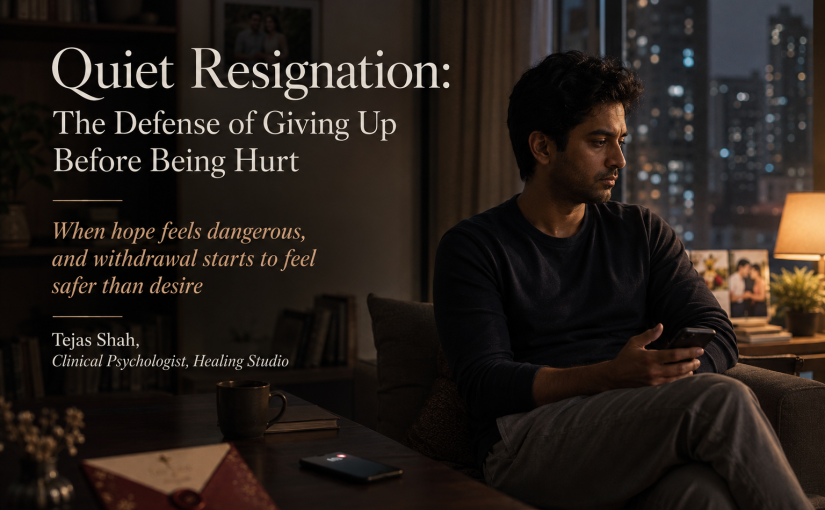
Why do I give up before trying in relationships? For many people, this question does not come from lack of desire. It comes from a painful inner split: one part still wants closeness, companionship, and love, while another part steps in early and says, do not go there, do not hope, do not risk the humiliation.
From the outside, this can look like indifference, laziness, or realism. Inside, it often feels flatter and harsher than that. The person may still want connection, but has entered a dutiful survival mode in which wanting itself begins to feel unsafe.
Why Do I Give Up Before Trying in Relationships?
Some people do not fail because they tried and were rejected. They suffer because they stop themselves before anything fully begins. They do not message. They do not show interest clearly. They do not follow through. They keep feelings private, measured, and controlled. Then they live with the emptiness that follows.
This is one reason the pain can become confusing. If nothing definite happened, why does it hurt so much? Because something did happen internally. Hope was shut down before life could test it.
When this becomes a pattern, it affects more than dating. Confidence starts thinning out. Everyday life becomes flatter. Work may continue, but with less aliveness. Social life narrows. The person may appear composed, sensible, even mature, while privately feeling behind, ashamed, and emotionally cut off.
The conflicts beneath quiet resignation
Longing is alive, but it is being attacked
The first conflict is intrapsychic. A part of the person still wants love, attention, tenderness, sexual closeness, and emotional recognition. Another part attacks that longing before it can gather force.
That inner attack often sounds like this: it will not happen, do not make a fool of yourself, stop wanting so much, be practical, stay in control.
This is not the voice of wisdom as often as it is the voice of frightened self-protection. It tries to prevent pain by preventing investment.
Distance then creates the very loneliness that hurts
The second conflict is interpersonal. The person does not move toward the people they want. They stay ambiguous. They appear detached. They withdraw just before something vulnerable is required. Then they suffer the distance, silence, and non-progress that follow.
This is how someone can say they want a relationship but keep producing a life in which nothing truly develops. Not because desire is fake, but because desire is being interrupted.
Resignation can feel more dignified than wanting
The third conflict is social. In many environments, especially for men, visible longing can feel humiliating. There is pressure to seem self-controlled, unneedy, unfazed, and above all not desperate. Add peer comparison, family timelines, marriage pressure, and social-media evidence that everyone else is moving ahead, and resignation can start to feel more respectable than honest desire.
That is a trap. Dignity matters, yes. But sometimes what is being protected is not dignity. It is the fear of being seen wanting and still not getting chosen.
“Giving up can look like realism when it is actually grief dressed as discipline.” — Tejas Shah
Why giving up on love before getting hurt can feel safer
One useful way to understand this pattern is through the idea of a defense. In plain language, a defense is something the mind does to protect a person from pain, shame, fear, helplessness, or inner conflict.
That protection may once have been necessary. The problem is that what protects us in one phase of life can later begin to imprison us.
So if you find yourself asking why do I give up before trying in relationships, the answer may not be that you do not care enough. It may be that caring has become linked with hurt. Then the mind begins to protect you in advance.
That protection can take different forms. Some people overthink instead of feeling. Some become detached and ironic. Some call their shutdown maturity. Some stay busy and productive so they never have to face loneliness directly. Some keep choosing inaccessible situations because impossible longing feels safer than real vulnerability.
This is why giving up on love before getting hurt can feel strangely relieving in the short term. Once you resign, you no longer have to wait, risk, hope, or expose yourself. But the relief is expensive. It protects you from the sharp pain of rejection while also cutting you off from the living possibility of closeness.
In that sense, quiet resignation is often a form of self-preemptive rejection. You step away before life can do it openly.
How emotional withdrawal after repeated disappointment develops
Usually this pattern does not appear out of nowhere. It builds.
Sometimes there has been one visible heartbreak. Just as often, there has been a long sequence of smaller injuries: being overlooked, being compared, being kept uncertain, not being chosen clearly, being wanted only partially, being led on, feeling invisible, feeling too much, or feeling foolish after hoping.
Over time, the emotional system learns something dangerous: hope is humiliating.
Then even when a new possibility appears, the body and mind do not greet it with simple excitement. They greet it with caution, tension, suspicion, self-criticism, and withdrawal. The person may ask why do I shut down emotionally before rejection, but in a deeper sense the system is already trying to avoid an older emotional memory, not only a present event.
In my clinical work, I often see this pattern in people who still want love quite deeply but have become ashamed of wanting it. Outwardly they may look practical, composed, or resigned. Inwardly there is disappointment, comparison, fear of humiliation, and an inner voice that keeps demanding emotional self-control. Clinically, what matters is that this resignation is rarely just an opinion about love. It is usually a way of managing pain, helplessness, and accumulated emotional learning. Once that becomes visible, therapy can begin working with the protection instead of merely arguing against it.
“When hope repeatedly feels humiliating, the mind may choose numbness over longing.” — Tejas Shah
What therapy begins to work on
Therapy does not help this pattern simply by saying be confident or put yourself out there. That is usually too shallow. The deeper task is to understand what makes hope feel so dangerous.
This often means working on several connected layers at once:
First, the person begins to notice the defensive voice more clearly. Instead of treating it as truth, they start hearing it as protection.
Second, the emotional cost of the pattern becomes clearer. The issue is not only missed relationships. It is also the flattening of desire, reduced confidence, social withdrawal, and a life increasingly organized around safety rather than aliveness.
Third, older disappointment, shame, and comparison can be worked through rather than carried silently into every new situation.
Fourth, therapy can help the person tolerate wanting without immediately collapsing into self-attack. This is crucial. Many people do not need more advice. They need more capacity to stay emotionally present to desire without shaming themselves for having it.
For some, this also includes questioning the social story they have absorbed: that to want visibly is weak, that being chosen determines worth, or that emotional restraint is the only respectable form of masculinity.
Relief begins when resignation is seen for what it is
There is a specific kind of relief that comes when the pattern finally makes sense.
If quiet resignation is a defense, then you are not merely weak-willed, lazy, or incapable of love. You are protecting yourself in a costly way. That is a different picture. It does not excuse the pattern, but it makes it understandable.
And once a pattern becomes understandable, it becomes more workable.
You may still feel afraid. You may still hesitate. You may still lose hope in dating too fast. But you can begin to notice that the part shutting everything down is not the whole of you. It is one strategy. An old one. A tired one. Sometimes an intelligent one. But not the whole truth about what you feel.
If you keep asking why do I give up before trying in relationships, the answer may be less about lack of desire and more about fear of what desire has come to mean.
When to seek help if you stop trying in relationships
It may be time to consider therapy when this pattern is no longer occasional and has become a quiet structure in your life.
That includes situations where:
- you repeatedly stop yourself before expressing interest
- you lose hope in dating unusually fast
- you feel emotionally shut down before any clear rejection has happened
- you are becoming lonelier, flatter, or more cynical over time
- your self-worth now depends heavily on whether you feel chosen
- you are functioning outwardly, but inwardly living in defeat, comparison, or numbness
This article is educational in nature and cannot replace therapy, diagnosis, or an individualized clinical assessment. Still, understanding the pattern is not nothing. It is often the first crack in a structure that once felt solid and final.
Quiet resignation is not peace. It is often pain made quiet.
And that can change.
FAQs
1. Is giving up before trying in relationships always a sign of low self-esteem?
Not always. Low self-esteem may be part of it, but often the deeper issue is defensive self-protection. The person may want closeness, yet shut it down early because hope feels dangerous, exposing, or humiliating.
2. Why do I lose hope in dating so fast even when nothing clearly bad has happened?
Because the nervous system is not only reacting to the present moment. It may also be reacting to accumulated disappointment, comparison, shame, and earlier emotional learning. The mind can treat a new possibility as if an old wound is about to reopen.
3. Is emotional withdrawal after repeated disappointment the same as depression?
Not necessarily. Emotional withdrawal can happen within depression, but it can also be a specific defense against hurt. The difference matters. One person may feel globally low and lifeless, while another may feel especially shut down around love, wanting, and vulnerability.
4. Can therapy help if I already understand this pattern intellectually?
Yes. Insight helps, but insight alone is often insufficient. Many people understand their pattern in theory and still repeat it because the emotional fear underneath it has not yet been worked through deeply enough.
When quiet resignation has become the pattern
If this describes something you have been living with, Individual Therapy or Group Therapy may help you understand what makes hope feel dangerous, why emotional withdrawal keeps taking over, and how this pattern may be affecting confidence, loneliness, and your ability to move toward love more honestly.
A first consultation can help clarify whether the issue is mainly about repeated disappointment, self-worth, fear of rejection, emotional shutdown, or an older pattern that keeps entering present relationships.
Tejas Shah is a Clinical Psychologist and Therapist at Healing Studio. He works with anxiety, shame, self-worth difficulties, loneliness, relationship pain, and repeated emotional patterns that leave people feeling stuck or inwardly defeated. His approach aims to go beyond surface advice toward deeper clarity, emotional understanding, and more workable ways of living and relating.