
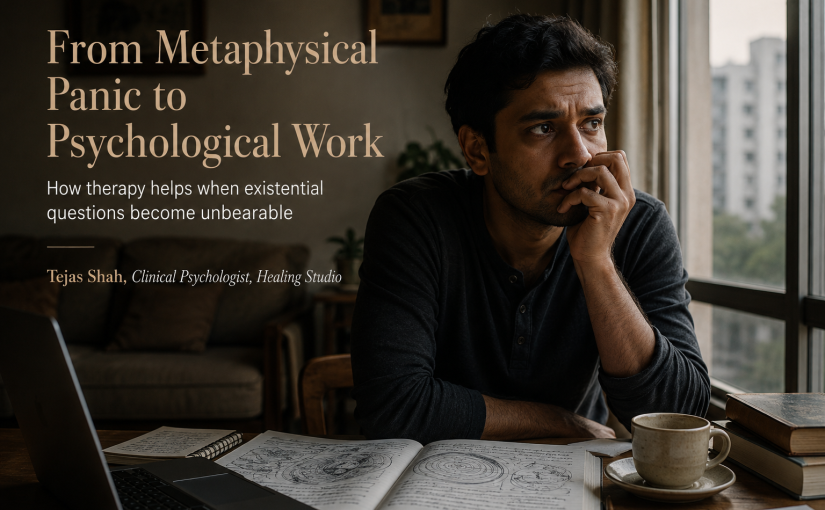
There are times when therapy for existential anxiety becomes relevant not because a person is casually thinking about life, death, meaning, or reality, but because those questions have started behaving like an internal emergency. What may look philosophical from the outside can feel catastrophic from the inside. The mind loops. The body alarms. Sleep becomes uneven. Work starts slipping. Family contact becomes thin. Even ordinary life begins to feel impossible unless some final answer is reached.
At that point, the real problem is not simply that a person has deep questions. The problem is that the question has fused with panic, urgency, and a felt inability to go on living without certainty. Many people in this state are not trying to be intellectual. They are trying to survive something that feels mentally and emotionally unbearable.
When existential anxiety becomes an emergency, not just a question
Existential distress can remain within the range of ordinary human reflection. Most thoughtful people, at some point, wrestle with mortality, meaning, freedom, uncertainty, loneliness, or the fact that life offers no complete guarantees. That is not pathological. It is part of being conscious.
However, an existential crisis changes form when the question no longer opens reflection but narrows life. The person may start checking their mind all day, arguing with thoughts, searching compulsively, reading endlessly, asking for reassurance, or trying to think their way into absolute certainty. What looked like inquiry becomes pressure. What looked like depth becomes siege.
This is usually the point at which people begin searching for therapy for existential anxiety. They are not asking for a clever answer to the meaning of life. They are asking how to function when their own mind has turned against them.
In clinical work, this issue often appears not as one dramatic breakdown but as a repeating emotional pattern that slowly begins shaping concentration, work, relationships, appetite, rest, and self-trust. That matters, because many people delay help by telling themselves, “This is philosophical, not psychological.” Unfortunately, the nervous system does not care about that distinction. Once panic, looping, and collapse enter the picture, the suffering is psychological whether the content is philosophical or not.
What existential crisis therapy notices first: the loop, not only the question
One of the most useful shifts in therapy for existential anxiety is that therapy stops treating the content of the question as the whole story. Instead, it begins asking: what is the process around the question?
This matters because the suffering is often maintained less by the theme itself and more by the loop around it. The question arrives. Alarm rises. The person feels they must solve it now. They think harder. The body becomes more activated. Life gets postponed. Uncertainty feels even more intolerable. Then the question returns with greater force.
That loop is psychologically crucial.
A person may say, “I need to know what is ultimately true.” But what therapy often discovers is that the mind has attached far more to the question than truth-seeking alone. The question may now be carrying fear of collapse, fear of going mad, fear of not being able to work, fear of losing ordinary contact with life, fear of helplessness, or fear of living without guarantees.
“An unanswered question becomes dangerous when the mind turns uncertainty into a condition for survival.” — Tejas Shah
This is where one simple therapeutic idea becomes useful: sometimes the symptom is not the deepest problem. Sometimes the key issue is the pattern that keeps recreating the symptom. In plain language, the question may be real, but the suffering is being intensified by the way panic, certainty-demand, bodily arousal, and avoidance keep feeding each other.
Why therapy for existential anxiety works on the maintaining dynamic
A lot of people arrive hoping therapy for existential anxiety will either answer the question or teach them how to suppress it. Usually, neither approach works for long.
What therapy can do more honestly is identify the maintaining dynamic. That means the inner process that keeps the crisis active: compulsive questioning, catastrophic interpretation, totalizing conclusions, nervous-system escalation, withdrawal from concrete life, and the private rule that life cannot proceed until certainty arrives.
This is not mere semantics. Once that process becomes visible, the person is no longer facing one giant metaphysical wall. They are facing several observable parts of an experience:
- the trigger
- the bodily surge
- the mental demand for an answer
- the absolutist conclusion
- the avoidance of ordinary life
- the return of panic because life has now shrunk around the question
That is a very different situation. It is still painful, but it is more workable.
In therapy, this rarely appears in such a simple form. Some people are terrified of madness. Some are terrified of dependence. Some are frightened by separateness, adulthood, or death. Some fear that if certainty is impossible, then action itself becomes fraudulent. Yet underneath these variations, the same structural issue often appears: an existential thought has become fused with a catastrophic way of relating to uncertainty.
How therapy for existential anxiety turns panic into observation
The early movement in therapy for existential anxiety is not toward final answers. It is toward steadier observation.
That may sound modest. It is not. For someone in metaphysical panic, observation is already a major shift. It means the person is no longer only inside the experience. They are also beginning to notice it.
Therapy may help the person observe questions such as:
What happens in my body when this thought arrives?
What do I immediately demand from myself?
What catastrophe do I imagine if the question remains unresolved?
What parts of life do I postpone while trying to solve it?
What kind of certainty am I insisting on?
What fear becomes visible if I stop thinking for a moment?
This is the beginning of psychological work. The crisis becomes less engulfing because it becomes more describable.
In my own work, I often find that people feel some initial relief not when the existential question disappears, but when they realize they are not dealing with one impossible abstract problem. They are dealing with a pattern that has form. Once the form becomes clearer, intervention becomes possible. Panic can be tracked. Absolutism can be named. Avoidance can be noticed. The body can be taken seriously. Daily life can be brought back into the room.
Therapy for existential overthinking is not forced reassurance
Many intelligent readers resist help because they fear therapy will become patronising. They worry the therapist will say, “Don’t think so much,” or offer a thin version of comfort dressed up as insight. That fear is not foolish. Bad therapy does this.
Good existential crisis therapy does something more respectful. It does not belittle the depth of the question. It also does not collude with the idea that only a final answer can make life possible.
That middle position is clinically important.
Therapy may help a person distinguish between a genuine philosophical concern and a compulsive attempt to eliminate all uncertainty. Those are not the same. One enlarges thought. The other narrows life.
“This is not about lowering the depth of the question. It is about lowering the panic with which you have been forced to carry it.” — Tejas Shah
In practice, this often means moving from demand to wish. Instead of “I must solve this now or life is impossible,” the person may slowly arrive at something more human: “I deeply wish I knew. I may never know fully. But I still need to live, love, choose, work, and remain in contact with reality.”
That shift is not surrender in the cheap sense. It is a more mature relationship to incompleteness.
When therapy for existential anxiety starts helping in real life
Useful therapy for existential anxiety does not only show up as insight in a session. It starts showing up in life.
The person may still have the thoughts, but the body no longer reacts as if the house is on fire. They may still feel uncertainty, but stop treating it as disqualifying. They may read less compulsively. Search less frantically. Sleep a little more steadily. Return to work with less private drama. Re-enter ordinary conversations. Eat without scanning internally the whole time. Feel less need to prove that they have solved existence before they can answer an email.
These shifts matter because existential panic often becomes believable precisely when it destroys ordinary life. The less a person is able to function, the more convincing the crisis feels. So part of therapy is not merely symbolic insight. It is restoration of livability.
Drawing from my work as an RCI-Licensed Clinical Psychologist, I often find that existential suffering becomes more manageable when we stop debating only the content of the question and begin noticing the emotional position from which the question is being asked. A person may sound philosophical while actually feeling terrified, helpless, ashamed, or close to internal collapse. In those moments, therapy needs to respect the depth of the thought, but work first with the alarm around it. Once panic settles, the person can think more honestly, feel more fully, and live with less inner coercion.
What therapy for existential anxiety can and cannot do
It is better to be precise here.
Therapy for existential anxiety cannot give guaranteed metaphysical certainty. It cannot abolish death, erase finitude, remove ambiguity from existence, or hand over a final system that settles human life once and for all.
What it may do is equally important. It may help you:
- understand the loop that turns reflection into panic
- reduce catastrophic urgency
- recognize bodily arousal as part of the crisis
- identify absolutist inner rules
- return to daily functioning
- bear uncertainty with less collapse
- reconnect thought with emotional reality
- live without making final certainty the price of participation in life
That is not a small outcome. For many people, it is the difference between being haunted by a question and being able to carry it.
This article is educational in nature and cannot replace therapy, diagnosis, or an individualized clinical assessment.
A more workable relationship to the unanswered
The aim of therapy for existential anxiety is not to make you shallow, distracted, or falsely reassured. It is to help you become less captive to an emergency state built around the question.
Existential questions may remain. In some lives, they remain for years. But the person can change. Their relation to the question can change. The body can become less terrified. The mind can become less coercive. Life can stop being held hostage by the demand for final certainty.
That is the real movement from metaphysical panic to psychological work: not from depth to superficiality, but from engulfment to form, from collapse to thought, and from inner catastrophe to something more survivable, honest, and human.
FAQs
1. Can therapy help existential anxiety even if the question itself is still unresolved?
Yes. Therapy often helps by changing your relationship to the question rather than pretending to solve philosophy. The question may remain, but panic, compulsion, collapse, and functional impairment can reduce.
2. How do I know if this is existential reflection or existential panic?
Reflection usually leaves room for life. Panic starts narrowing it. If your thoughts are disrupting sleep, work, relationships, routine, or your sense of sanity, the issue is no longer only intellectual.
3. Why do existential thoughts feel physically frightening?
Because the body may begin responding as if uncertainty itself is danger. When that happens, philosophical content gets fused with nervous-system alarm, and the experience becomes much more overwhelming.
4. What does therapy actually do in an existential crisis?
It helps identify the pattern around the question: compulsive thinking, catastrophic interpretation, bodily arousal, certainty-demand, and avoidance of ordinary life. That makes the crisis more thinkable and more workable.
If This Pattern Feels Familiar
If existential questions have stopped feeling thoughtful and started disrupting your ability to live, Individual Therapy or Group Therapy may help you understand the loop, steady the panic, and find a more workable relationship to uncertainty.
Tejas Shah is a Clinical Psychologist and Therapist at Healing Studio. He works with anxiety, overthinking, shame, emotional conflict, existential distress, and patterns that quietly begin taking over daily life. His approach aims to go beyond surface reassurance toward deeper understanding, steadier functioning, and psychologically serious help that remains humane and practical.