
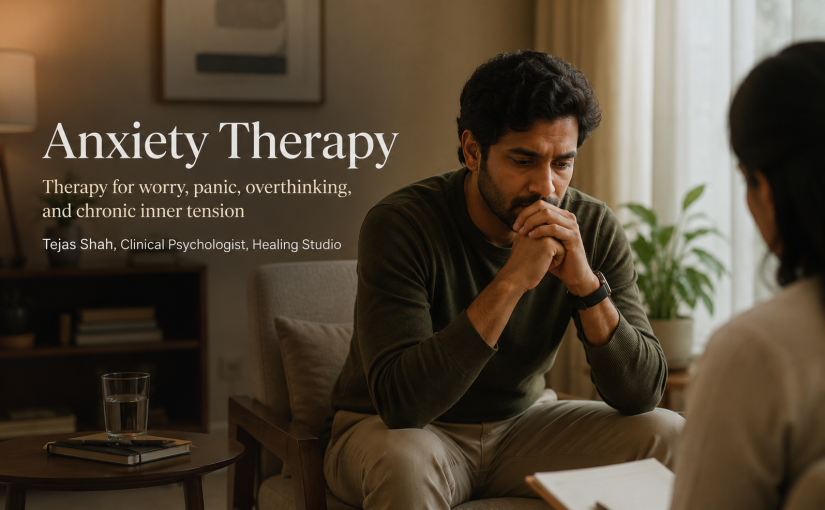
If anxiety is affecting your work, relationships, sleep, or daily functioning, anxiety therapy may help. I offer anxiety therapy in Mumbai and online for adults dealing with overthinking, panic, chronic worry, and stress-related emotional difficulties. Anxiety therapy can be useful when life starts feeling constantly tense, mentally crowded, and difficult to settle into. You may be functioning on the outside, going to work, handling responsibilities, speaking normally, even appearing composed, while internally living with worry, overthinking, panic, dread, physical tension, or the sense that something may go wrong at any moment.
I offer anxiety therapy in Mumbai for adults, with online sessions also available where appropriate. My work is calm, thoughtful, and depth-oriented, while still practical enough to help in daily life. The aim is not only to reduce symptoms, but also to understand the emotional patterns, pressures, and inner conflicts that may be keeping anxiety active.
Tejas Shah
Clinical Psychologist | Philosophical Counsellor | Group Analyst
In-person: Borivali, Mumbai
Online: Zoom sessions for clients in India and abroad
Call / WhatsApp: +91 79775 01648
Email: [email protected]
“Anxiety is often not only fear about the future, but a mind and body that no longer know how to feel safely at rest.”
— Tejas Shah
When anxiety starts taking over daily life
Anxiety does not always look dramatic. Sometimes it looks like a person who is constantly thinking ahead, preparing for problems, rehearsing conversations, checking repeatedly, struggling to sleep, or staying busy because stillness feels unbearable.
Anxiety is not always loud
You may be looking for anxiety therapy if you notice some of the following:
- constant worrying, even when there is no clear crisis
- overthinking decisions, conversations, or future possibilities
- restlessness, irritability, or feeling unable to switch off
- panic symptoms such as racing heart, breathlessness, shakiness, or dread
- disturbed sleep because the mind does not settle
- difficulty relaxing without guilt or unease
- fear of making mistakes, being judged, or losing control
- physical tension, stomach discomfort, headaches, or fatigue linked to stress
- feeling high-functioning on the outside but inwardly exhausted
In therapy, this issue is often less about one incident and more about a familiar pattern that keeps returning in slightly different forms. A person may say, “I know I am overthinking, but I cannot stop,” and that is often where deeper work begins.
Common forms anxiety may take
Anxiety may show up in many ways. For example, it may appear as:
- generalized worry that keeps moving from one topic to another
- panic episodes or sudden surges of fear
- health anxiety and repeated checking
- social anxiety and fear of embarrassment
- work anxiety linked to performance, perfectionism, or self-criticism
- relationship anxiety, reassurance-seeking, or fear of abandonment
- decision paralysis and chronic doubt
- stress that has become so constant it now feels normal
Some people know they are anxious. Others simply say they feel “tense all the time,” “unable to relax,” or “never fully at ease in myself.”
Who anxiety therapy may help
This work may be useful for:
- adults dealing with chronic worry, overthinking, or nervous tension
- people whose anxiety is affecting work, sleep, concentration, or relationships
- those who experience panic, dread, or fear of losing control
- high-functioning professionals who appear capable but feel inwardly overwhelmed
- students and young adults struggling with uncertainty, pressure, or self-doubt
- people carrying family pressure, emotional responsibility, or long-term stress
- those who have tried to cope alone but find the pattern keeps returning
You do not need to be in crisis for therapy to be useful. Many people seek help when they realize that anxiety has quietly started organizing too much of their inner life.
Why anxiety builds and keeps repeating
Anxiety is often treated as if it were just a faulty thought pattern. Sometimes thoughts are part of it, yes. Still, anxiety often has a deeper emotional structure.
A person may become anxious because they live under chronic pressure, conflict, uncertainty, loneliness, or unprocessed emotional strain. In other cases, anxiety develops around anger that cannot be expressed, grief that has not been fully faced, self-worth that depends too heavily on performance, or early emotional environments in which safety felt conditional.
In Indian contexts, anxiety may also be intensified by family expectations, comparison, pressure to remain stable and responsible, fear of disappointing others, marriage-related stress, career uncertainty, or the exhausting requirement to appear fine while carrying too much internally. Many people are taught to be functional before they are taught to be emotionally understood. That arrangement works for a while, then the body starts protesting.
In my clinical work, the immediate problem is often easiest to name, while the deeper emotional structure takes more time and reflection to understand. When therapy helps, it often helps because the person begins to see not only what triggers anxiety, but what emotional position they have been living from.
This is not only a symptom problem. Psychologically, it may also involve shame, fear of dependence, emotional suppression, perfectionism, internalized pressure, attachment insecurity, or long-standing ways of organizing vulnerability.
My approach to anxiety therapy
I do not approach anxiety as something to be fought by force of will. Usually, that only creates another layer of pressure. Instead, I try to understand what the anxiety is doing, what it may be protecting against, what keeps it active, and what kind of help is most useful for the person sitting in front of me.
Anxiety therapy is not only symptom management
Depending on the nature of the problem, anxiety therapy may include:
- understanding the triggers, patterns, and meaning of anxious states
- identifying overthinking loops, catastrophic thinking, or rigid self-pressure
- working with panic, avoidance, reassurance-seeking, or hypervigilance
- exploring emotional conflicts beneath worry, including anger, guilt, dependency, or fear
- improving emotional regulation so the nervous system is less constantly activated
- examining relationship patterns that intensify anxiety
- building a steadier internal position, not just temporary relief
My work is informed by psychodynamic and relational thinking, while also drawing from CBT, ACT, and other approaches where useful. That means the therapy can be practical and psychologically deep at the same time. We may work with present-day symptoms directly, but we may also look at the older emotional patterns that make your mind stay on guard even when danger is not immediate.
“Relief matters, but deeper change usually comes when the emotional pattern beneath anxiety begins to make sense.”
— Tejas Shah
What therapy may focus on
Some anxiety responds well to structured work around thoughts, behaviours, and avoidance. Some anxiety requires deeper attention to conflict, attachment, loss, shame, or long-standing inner pressure. Many people need both. So the work is not mechanical. It is adjusted to the person.
If your anxiety is tied to relationship dynamics, repeated self-doubt, fear of failure, panic, identity conflict, or longstanding emotional strain, therapy may involve a deeper exploration of how you have learned to manage feeling, safety, closeness, and control.
Why work with Tejas Shah
I am an RCI-Licensed Clinical Psychologist with over 16 years of clinical experience and 16,000+ hours of therapeutic work. I have been in clinical practice and providing anxiety therapy in Mumbai at Healing Studio since 2010. For anxiety-related concerns, that matters not as a badge, but because anxiety often needs more than generic reassurance. It needs careful assessment, emotional understanding, and a way of working that fits the person rather than forcing everyone into the same method.
Relevant aspects of my training and background include:
- M.Phil. in Clinical Psychology (RCI), MSc Psychology, and MA Philosophy, which support both clinical depth and reflective understanding
- CBT training from the Beck Institute and ACT training, which are useful for worry, avoidance, rigid thought patterns, and anxiety-linked distress
- ISTDP training, which can help where anxiety is tied to defended emotion, internal conflict, or chronic inner tension
- Mentalization and relationally informed work, which can be useful when anxiety is shaped by relationships, misunderstanding of one’s own feelings, or unstable self-experience
- work with adults, couples, families, and groups, because anxiety often does not exist in isolation from relational life
- a serious, non-performative therapeutic style that values psychological honesty over motivational slogans
From clinical work for anxiety therapy in Mumbai, I have often found that people arrive with a clear account of the immediate difficulty, but need help making sense of the deeper pattern beneath it. That is often where therapy becomes more meaningful.
What to expect in the first few sessions
The first session is not an interrogation and not a test you have to pass. It is a space to understand what has been happening, how long anxiety has been present, what tends to trigger it, how it affects your life, and what you may already have tried.
We may talk about:
- the nature of the anxiety itself
- whether there are panic symptoms, avoidance, sleep problems, or bodily fear
- the pressures currently active in your life
- whether this feels recent, long-standing, or both
- relationship or family patterns that may be relevant
- what kind of therapy may be most suitable
Some people want immediate help with overwhelming anxiety. Others want to understand why they have been living in a state of constant apprehension for years. Both are valid starting points.
Sessions are usually held weekly, though this may vary depending on the difficulty and what seems clinically appropriate. It is also completely acceptable to begin therapy while unsure. Many people come precisely because they are tired of trying to handle everything alone.
Online Anxiety Therapy for Indians in India and abroad
Apart from offering anxiety therapy in Mumbai, I also offer online anxiety therapy for clients in India and abroad. This can be useful if you live in another city, travel often, prefer privacy, or want to work with someone familiar with Indian emotional life and family structures.
Online work may especially help people dealing with anxiety linked to migration, loneliness, professional pressure, family expectations from a distance, or the emotional strain of living between cultures. Sessions are held on Zoom and remain clinically serious, reflective, and focused.
Practical details
In-person Location: Providing Anxiety Therapy in Mumbai at our Borivali clinic.
Nearby areas: Serving anxiety therapy across Borivali East, Borivali West, Kandivali, Dahisar, Mira Road, Goregaon and the Western Suburbs in Mumbai.
Online: Zoom sessions for clients in India and abroad
Call / WhatsApp: +91 79775 01648
Email: [email protected]
This page is meant for education and guidance, not as a substitute for therapy, diagnosis, or personalized clinical advice.
Frequently asked questions about anxiety therapy
1. How do I know if I need anxiety therapy?
You may not need therapy simply because you worry sometimes. However, anxiety therapy may be useful if worry, panic, tension, overthinking, sleep disturbance, avoidance, or chronic fear are affecting daily life, relationships, work, or your sense of inner steadiness.
2. Can anxiety therapy help if I look fine from the outside?
Yes. Many anxious people are high-functioning. They continue meeting responsibilities while internally feeling overworked, tense, afraid, or mentally exhausted. Therapy can be useful even when the struggle is not visible to others.
3. Do you work with panic attacks as well as general anxiety?
Yes, where appropriate. Panic symptoms, chronic worry, overthinking, performance anxiety, health anxiety, and other anxiety patterns can all be explored in therapy. The work depends on the nature and severity of the difficulty.
4. Is anxiety therapy only about changing thoughts?
No. Thoughts matter, but anxiety is often not only a thinking problem. It may also involve emotional conflict, relationship patterns, shame, unresolved stress, fear of uncertainty, or an inner life organized around pressure and vigilance.
5. Do you offer anxiety therapy online?
Yes. Online sessions are available for clients in India and abroad. This can be useful for people outside Mumbai, those who travel, or those who prefer the privacy and convenience of remote sessions.
6. What happens in the first session?
The first session usually focuses on understanding your difficulty in context. We look at what is happening, how long it has been present, how it affects daily functioning, and what kind of therapeutic work may help.
7. Is therapy confidential?
Yes, therapy is confidential within standard professional and ethical limits. If you have specific concerns about privacy, those can be discussed openly at the beginning.
Book an initial consultation
If you are looking for anxiety therapy that is serious, thoughtful, and psychologically in-depth, you are welcome to get in touch for an initial consultation for Individual Therapy.
Call / WhatsApp: +91 79775 01648
Email: [email protected]
Uncertainty about starting is normal. You do not need to arrive with everything already understood.
Tejas Shah is a Clinical Psychologist and Individual Therapist at Healing Studio. He works with adults facing anxiety, overthinking, panic, self-doubt, emotional strain, and recurring inner conflict. His approach is depth-oriented, clinically grounded, and practical enough to help with day-to-day functioning. Depending on the person, the work may focus on symptom relief, emotional regulation, deeper pattern recognition, or all three.
Tejas Shah’s Healing Studio >> Therapy Clinic in Borivali >> Individual Therapy