
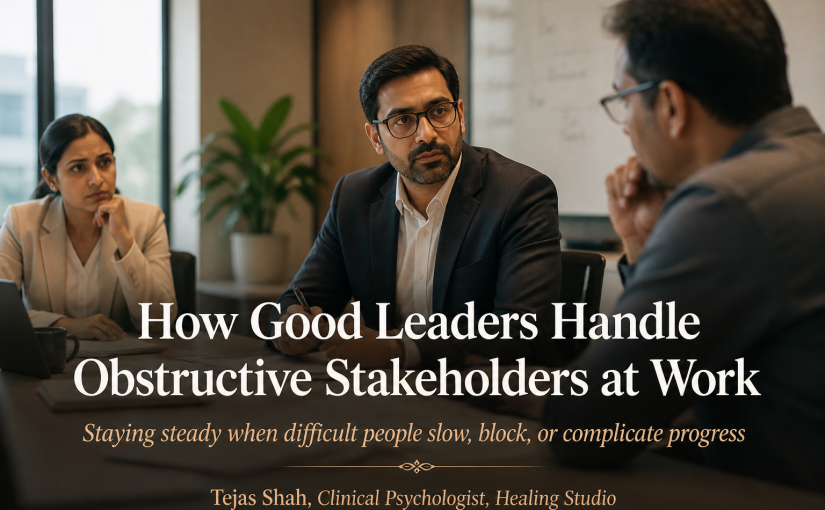
Dealing with difficult stakeholders is one of the quieter tests of leadership. The problem is rarely just that someone disagrees with you. The harder problem is when a stakeholder becomes rigid, slow, overly cautious, emotionally difficult, or quietly obstructive while still holding enough influence to delay progress.
This can make even capable leaders feel trapped. You may have responsibility for delivery, but limited control over approvals. You may need cooperation from someone who keeps raising objections, changing standards, delaying decisions, or insisting on process long after the main issue is clear.
Good leaders do not simply “stay positive” through this. That is conference-room incense. Useful leadership conflict management requires something more adult: emotional containment, strategic communication, and the ability to stay firm without becoming reactive.
“Leadership is often tested not by open opposition, but by the slow emotional pressure of obstruction.” — Tejas Shah
Why Obstructive Stakeholders Are So Draining
An obstructive stakeholder can affect work in ways that are hard to explain from the outside.
Nothing dramatic may happen. No one shouts. No one openly sabotages. Yet progress slows. Meetings become circular. Simple decisions require excessive justification. You begin preparing emotionally before every interaction.
Over time, this can create:
- frustration before meetings
- overthinking after conversations
- loss of confidence in your own judgment
- irritation with the wider team
- pressure to over-explain everything
- resentment at being responsible without real authority
- emotional exhaustion from managing the person, not the work
This is why managing difficult colleagues is not only a communication issue. It is also an emotional regulation issue.
Dealing With Difficult Stakeholders Requires Containment
The central leadership skill here is containment.
Containment does not mean tolerating nonsense indefinitely. It means holding the emotional pressure of the situation without dumping it back into the room.
A contained leader can think while irritated. They can listen without surrendering authority. They can recognize anxiety, defensiveness, ego, or control in the other person without immediately attacking it.
This matters because obstructive stakeholders often pull leaders into one of two traps.
The first trap is escalation. You become sharper, more sarcastic, more forceful, or visibly impatient. The stakeholder then becomes more defensive, and the conflict hardens.
The second trap is appeasement. You keep accommodating the difficult person to avoid friction. The stakeholder learns that slowing, questioning, or resisting will keep giving them more control.
Containment offers a third path: calm firmness.
Understand the Obstruction Before You Respond to It
Not every difficult stakeholder is difficult for the same reason.
Some are anxious and need certainty before moving. Some are perfectionistic and cannot tolerate risk. Some are protecting their territory. Some are afraid of being blamed later. Some enjoy positional power more than actual problem-solving.
The response should depend on the underlying pattern.
A cautious stakeholder may need clearer risk framing.
A controlling stakeholder may need stronger boundaries.
A defensive stakeholder may need face-saving options.
A chronically obstructive stakeholder may need escalation through formal structures.
In clinical work, I often see that workplace conflict becomes more manageable when people stop treating every obstruction as personal disrespect. Sometimes it is disrespect. But often it is anxiety, control, shame, insecurity, or fear of accountability wearing a professional mask. The leader still has to act, but with a more accurate reading of the room.
Do Not Fight the Personality. Structure the Conversation.
Difficult stakeholder communication improves when you shift from personality judgment to process clarity.
Instead of saying, “You are blocking this again,” say: “We seem to be returning to the same concern. Let us separate what is a genuine risk, what needs more data, and what decision is required today.”
Instead of saying, “You are overcomplicating this,” say: “I want to make sure we do not lose momentum. Which of these concerns is a blocker, and which can be handled as we proceed?”
Instead of saying, “You never approve anything,” say: “What would make this decision ready for approval from your side?”
This does not make you soft. It makes you harder to derail.
Separate Valid Concerns From Emotional Fog
Good leaders do not dismiss resistance automatically. Sometimes the difficult stakeholder is seeing a real risk others are avoiding.
However, good leaders also do not let every concern become a veto.
A useful distinction:
- Valid concern: specific, evidence-based, relevant to the decision
- Emotional fog: vague unease, repeated doubt, shifting criteria, personal defensiveness, or endless “not yet”
Once you see the difference, the conversation becomes cleaner.
You can say: “That is a valid risk. Let us build a mitigation plan.”
Or: “That concern has been noted. Unless there is new information, we need to move to a decision.”
This is the spine of work conflict leadership: respect the concern without becoming hostage to the anxiety.
Stay Calm, But Do Not Become Vague
Many leaders confuse calmness with softness.
They become so careful not to escalate that their message loses force. The stakeholder leaves the meeting without knowing what was decided, what is expected, or what happens next.
Calm leadership needs precision.
Use clear statements:
- “The decision needed today is…”
- “The open risk is…”
- “The next step belongs to…”
- “The deadline is…”
- “If this remains unresolved by Friday, we will escalate it to…”
This protects the work from emotional drift.
“Calm leadership is not the absence of pressure. It is pressure held with enough clarity that others can still think.” — Tejas Shah
Manage the Room, Not Just the Difficult Person
An obstructive stakeholder often changes the emotional climate of the whole group.
People stop speaking honestly. Team members look to the leader to see whether the resistance will dominate. Some become passive. Others become quietly angry. The meeting starts revolving around the most difficult person.
Good leaders notice this.
They widen the conversation:
“I want to hear from the implementation side as well.”
“Let us check whether this concern changes the decision for the whole group.”
“We need to avoid spending the entire meeting on one objection unless it is truly a blocker.”
This prevents one stakeholder’s anxiety or rigidity from becoming the team’s operating system.
Use Documentation Without Becoming Bureaucratic
When a stakeholder is repeatedly obstructive, memory becomes political.
They may later say they never agreed, were not informed, or had raised concerns that were ignored. Therefore, documentation becomes protection.
After key conversations, send a brief written summary:
- decision made
- concerns raised
- agreed next steps
- owners
- timelines
- unresolved issues
Keep it neutral. No emotional commentary. No courtroom drama. Just clean records.
This reduces ambiguity and protects you from endless revisionism.
Know When to Escalate
Not every conflict should be handled endlessly through patience.
Escalation becomes appropriate when:
- the stakeholder repeatedly delays agreed decisions
- criteria keep changing
- the project is at risk
- the person uses process to avoid accountability
- informal conversations have failed
- your authority is being undermined
- the emotional cost to the team is becoming too high
Escalation should not be a revenge move. It should be a governance move.
The tone matters: “We have tried to resolve this directly. Since the decision remains blocked and timelines are affected, I think we need a higher-level alignment on ownership, risk, and authority.”
That is clean. Adult. Difficult to dismiss.
What Therapy Can Teach Leaders About Conflict
Drawing from my work as a Clinical Psychologist, I often find that people describe the surface conflict clearly, but need help noticing the deeper emotional position they have been living from. At work, this may look like anger, helplessness, over-responsibility, fear of confrontation, or a need to prove competence to someone who keeps withholding cooperation. Therapy can help leaders understand not only the difficult stakeholder, but their own reaction to being blocked, doubted, controlled, or subtly undermined.
How Good Leaders Handle Obstructive Stakeholders
Good leaders do not need to dominate every difficult person. They need to stay clear enough to lead the work.
That means:
- understanding the obstruction
- separating risk from emotional resistance
- keeping communication structured
- documenting decisions
- protecting the wider team
- escalating when needed
- managing their own anger, urgency, and helplessness
The goal is not to make every stakeholder easy. Some people are not easy. The goal is to prevent their difficulty from taking over your leadership.
When Work Conflict Starts Affecting You Personally
If dealing with difficult stakeholders is affecting your sleep, confidence, emotional steadiness, or ability to function at work, it may be worth taking the impact seriously.
Sometimes the professional issue touches something deeper: fear of authority, anger about unfairness, helplessness when blocked, guilt about being firm, or old patterns of over-responsibility.
Therapy can help you think more clearly about these patterns, respond with more steadiness, and stop carrying workplace conflict as if it is a private failure.
A consultation can help clarify whether the issue is mainly situational, emotional, relational, or part of a repeated professional pattern.
FAQs
1. How do I deal with a difficult stakeholder without escalating the conflict?
Stay calm, but become more structured. Clarify the exact concern, decision, timeline, and next step. Avoid personal attacks. However, do not keep absorbing vague resistance indefinitely.
2. What if a stakeholder keeps delaying decisions?
Ask what specific condition is needed for approval. If the criteria keep shifting, document the pattern and escalate through the proper leadership channel.
3. Is stakeholder obstruction always intentional?
No. Some obstruction comes from anxiety, perfectionism, fear of blame, or unclear authority. However, even unintentional obstruction still needs boundaries.
4. Can therapy help with workplace conflict leadership?
Yes, especially when work conflict triggers anger, helplessness, overthinking, fear of confrontation, or difficulty staying firm under pressure. Therapy can help you understand your reactions and respond more strategically.
This article is educational in nature and cannot replace therapy, diagnosis, or an individualized clinical assessment.
Tejas Shah is a Clinical Psychologist and Therapist at Healing Studio. He works with adults dealing with anxiety, emotional regulation difficulties, work stress, relationship patterns, authority conflict, and professional burnout. His therapeutic work helps people understand the deeper patterns beneath their reactions and respond to life with greater clarity and steadiness.