Clinical Psychologist for Individuals, Couples, Families, Groups & Professionals
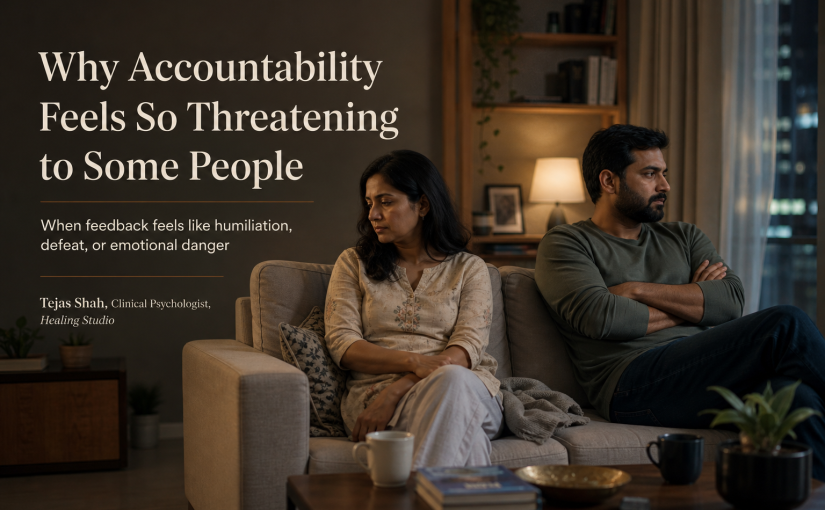
Why Accountability Feels So Threatening to Some People
Why accountability feels threatening to some people even when feedback is mild
If you have ever wondered why accountability feels threatening to some people, the answer is usually deeper than stubbornness. A small concern is raised. Nothing especially harsh is said. Yet the response is immediate and disproportionate: anger, denial, cold silence, counterattack, sarcasm, self-pity, or a long explanation about why the other person is actually the problem.
This is one reason why accountability feels threatening in some relationships. The issue is rarely just logic. On the surface, someone is being asked to reflect, apologize, or take responsibility. Underneath, they may be reacting as if they are being cornered, exposed, or emotionally crushed. That is often why accountability feels threatening, even when the conversation itself is relatively calm.
“In many relationships, the fight is not only about what happened. It is about what responsibility comes to mean inside each person.” — Tejas Shah
A lot of people describe this bluntly as emotional immaturity in a relationship. Sometimes that description is not wrong. But it is also incomplete. It tells you what the person is doing, not what the moment may feel like from the inside.
What this often looks like in real life
When accountability feels unbearable, the person may not say, “I feel ashamed and terrified of being wrong.” That would be too clean. More often, it shows up as:
arguing over tiny details instead of addressing the hurt
focusing on your tone instead of their behaviour
suddenly bringing up your past mistakes
becoming icy and unreachable
apologizing theatrically but not sincerely
collapsing into “I am always the villain”
acting as though one criticism cancels all their good intentions
Living with a defensive partner in a relationship can feel exhausting because the conversation never stays with the actual issue. It keeps turning into a courtroom drama, a character assassination, or a vanishing act.
In clinical work, this issue often appears not as a single dramatic problem, but as a repeating emotional pattern that slowly shapes the person’s relationships, decisions, and inner life.
The hidden experience underneath defensiveness
For some people, accountability does not feel like, I made a mistake. It feels like:
I am being humiliated.
I am losing control.
You are putting me beneath you.
If I admit this, I disappear.
If I am wrong, I am weak.
If I take responsibility, I will be flooded with shame.
That is the deeper fear of accountability psychology often misses when it gets reduced to moral language alone.
Some people grew up in homes where being wrong meant ridicule, contempt, withdrawal, or harsh punishment. Others learned that weakness was dangerous, dependence was humiliating, or mistakes were proof of defectiveness. Some were never allowed an ordinary human margin for error. In such people, feedback does not land in an open mental space. It lands on an old wound. When that wound gets activated, why accountability feels threatening becomes much easier to understand.
So the person defends. Not always because they are calculating. Sometimes because their whole system has interpreted accountability as emotional danger.
The protective pattern underneath it
One useful way to understand this is through a simple idea: what looks like refusal may sometimes be protection.
A protective pattern begins when the mind learns that certain feelings are too painful to bear directly — shame, helplessness, hurt, inadequacy, grief, dependence, or fear. So instead of feeling them openly, the person develops ways to survive them. They attack, argue, shut down, become overly logical, get sarcastic, go numb, or act superior.
At first, these patterns may help. Later, they become costly.
So the issue is not only that the person “cannot take feedback.” The issue may be that feedback instantly activates a deeper emotional state they do not know how to tolerate. This does not excuse hurtful behaviour. But it explains why a partner who cannot take responsibility may look less like someone calmly refusing reason and more like someone defending against collapse.
“This does not make harmful behaviour acceptable. But understanding the protection underneath it can make the pattern more workable.” — Tejas Shah
Why mild feedback can trigger fear of accountability
One of the most clinically important distinctions here is this: not everyone experiences criticism at the same psychological depth.
For one person, “That hurt me” is information.
For another, it becomes:
You have failed.
You are not enough.
You are being reduced.
You are losing status, dignity, or love.
That is why seemingly small feedback can trigger outsized reactions. It is also why accountability feels threatening: the mind is not hearing correction alone, but disgrace.
This is not only a communication problem. Psychologically, it may also involve emotional regulation, defensive style, attachment insecurity, shame, fear of dependence, or long-standing relational learning.
A person who feels secure enough internally can stay in the discomfort of being imperfect. A person whose self-worth is brittle may experience even accurate feedback as annihilating. They do not just hear the complaint. They hear disgrace.
Why this pattern damages relationships
In defensiveness in marriage or long-term partnership, the damage is cumulative.
The injured partner stops bringing things up because every conversation becomes harder than the original issue. Trust erodes. Emotional safety drops. Small hurts go underground. Resentment builds. Over time, the relationship becomes less honest because honesty feels too expensive.
Then a second pattern emerges: loneliness.
One person feels chronically accused. The other feels chronically unseen. Neither feels safe enough to be real. The couple gets trapped between blame and self-protection.
That is often why the conflict repeats. Not because the issue is unsolvable, but because responsibility itself has become emotionally loaded.
A clinical note from practice
As an RCI-Licensed Clinical Psychologist, my work with individuals, couples, and families often involves helping people notice the emotional meaning hidden beneath blame, defensiveness, shutdown, and repeated conflict. With training in psychodynamic work, ISTDP, couples and family therapy, CBT, ACT, and group-analytic thinking, I do not treat accountability as a moral slogan or a mere communication skill. I look at what the person is protecting, what shame is doing to the interaction, and how older emotional learning may be shaping current reactions. That depth matters when advice such as “just apologize” or “just communicate better” has repeatedly failed.
When fear of accountability takes over
The first step is not forcing shame harder. That usually backfires.
What helps more is helping the person separate three things:
1. Responsibility is not the same as worthlessness
A mistake, blind spot, or harmful reaction is not the whole person. If every admission of fault feels like total self-collapse, accountability will keep feeling impossible.
2. Slowing down matters
When people are flooded, they cannot reflect well. They defend first and think later. In those moments, the goal is not perfect communication. It is enough emotional steadiness to remain present without escalating.
3. Curiosity works better than courtroom energy
People often soften more under accurate understanding than under relentless correction. This does not mean walking on eggshells forever. It means that if the nervous system hears only attack, it will respond with protection.
4. The pattern has to become visible
Once someone can say, “When I am confronted, I instantly feel shamed, cornered, and small,” the cycle becomes easier to interrupt. Before that, the person only experiences themselves as justified.
How therapy may help
Therapy can help in at least two directions.
In individual work, the task is often to understand the inner meaning of criticism, the role of shame, the fear of defectiveness, and the protective habits that come up under pressure. Over time, the person may develop more room between feeling exposed and becoming defensive.
In couples work, the task is not only to decide who is right. It is to understand the pattern that keeps turning hurt into attack and feedback into threat. That often means helping one partner speak without contempt and helping the other stay present without collapsing into counterattack, shutdown, or emotional disappearance.
Drawing from my work as an RCI-Licensed Clinical Psychologist, I often find that people describe the surface conflict clearly, but need help noticing the deeper emotional position they have been living from.
This article is educational in nature and cannot replace therapy, diagnosis, or an individualized clinical assessment.
When to consider professional help
It may be time to seek help when:
every difficult conversation ends in escalation, freezing, or stonewalling
apology feels nearly impossible
one partner feels they must suppress reality to keep the peace
blame and defensiveness have started replacing trust
the same conflict keeps returning with new content but the same emotional shape
the issue is affecting children, work, sleep, or the emotional climate of the home
Accountability should feel uncomfortable at times. That is normal. But when you understand why accountability feels threatening, the reaction looks less like simple refusal and more like a shame-based defensive pattern.
If it does, the problem is usually deeper than stubbornness.
FAQs
1. Why does my partner become defensive when accountability is raised gently?
Because the feedback may not be landing as simple information. It may be landing as shame, disrespect, failure, or loss of control. Some people react to accountability as if they are under emotional threat, even when the conversation is relatively mild.
2. Is inability to take responsibility always narcissism?
No. Sometimes it reflects entitlement or manipulativeness, but not always. It can also come from shame sensitivity, brittle self-worth, defensive habits, trauma-related threat responses, or poor emotional regulation. The outer behaviour may look similar while the inner drivers differ.
3. Can someone learn accountability without becoming flooded by shame?
Yes, but usually not through force alone. The person has to build more capacity to tolerate imperfection, regulate emotional surges, and separate “I did something hurtful” from “I am worthless.” That is where deeper therapy can be useful.
4. What kind of therapy helps when accountability keeps turning into conflict?
Individual therapy may help when the issue is rooted in shame, trauma, self-worth, or emotional regulation. Couples therapy may help when the problem is organized inside a repeated relationship cycle of complaint, defensiveness, hurt, and withdrawal. Often, both levels matter.
PS: If this pattern is affecting closeness, trust, or repeated conflict, a visit to the Couples Therapy page would be the most natural next step. It can help readers understand how therapy works when blame, shutdown, and defensiveness have become part of the relationship’s emotional rhythm.
Tejas Shah is a Clinical Psychologist and Couples and Family Therapist at Healing Studio. He works with individuals, couples, and families facing repeated conflict, shame, emotional reactivity, trust rupture, and long-standing relational patterns. His approach aims to bring depth, clarity, and practical movement when conversations keep collapsing into blame, shutdown, or hurt.
Explore Therapy at Healing Studio
If this article reflects something important in your life, therapy may offer a space to understand it more clearly and work with it in depth.
Individual Therapy Support for anxiety, depression, trauma, emotional struggles, self-criticism, and deeply rooted personal difficulties.
Couples Therapy Support for conflict, resentment, disconnection, trust difficulties, and repetitive relationship patterns.
Found this article helpful? Follow My WhatsApp Channel for brief reflections on mental health, relationships, emotions, and updates on new articles/workshops:
Related Posts:
I Hurt People, But I’m Not a Bad Person You may know you hurt people and still not experience yourself as cruel or malicious. That conflict can create guilt, defensiveness, regret, and repeated damage in relationships. This article explains why intention and impact often split apart under emotional pressure, and how accountability can grow without collapsing into self-hatred.
Why Do I Get So Angry When Domestic Help Doesn’t Come? If you keep wondering why you get so angry when domestic help doesn’t come, the reaction may be about more than one disrupted morning. It may reflect invisible labour, mental load, accumulated resentment, and a household system with very little margin for disruption.
When Affordable Therapy Is Enough and When You May Need… Affordable therapy can be useful, supportive, and enough in many situations. But when distress is complex, recurring, severe, or affecting daily life, more experienced psychological care may be clinically appropriate.
Why Do I Feel Like a Loser When Love Doesn’t Work Out? When love does not work out, many people do not just feel sad. They start feeling defective. This article explores why rejection can turn into shame, comparison, and a painful verdict on self-worth.
Published by
Tejas Shah
TEJAS SHAH is a PhD Scholar and has M.Phil in Clinical Psychology (RCI), MSc in Psychology, MA in Philosophy and a Degree in Law (LL.B) from University of Mumbai; he is practicing as Chief Clinical Psychologist at Healing Studio. His research interests are consciousness, phenomenology, positive psychology, philosophical counselling and mindfulness. You can connect with him on [email protected].
View all posts by Tejas Shah