
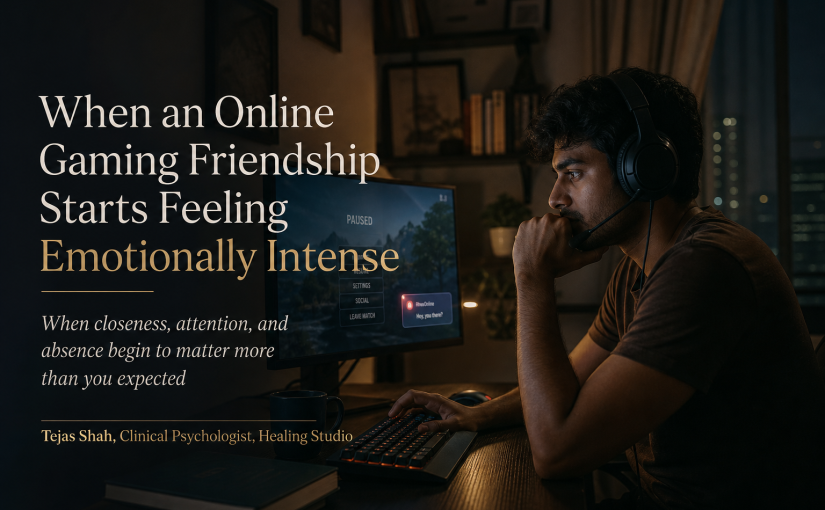
An emotional attachment to online friend dynamics can feel strangely powerful, especially when that friend came into your life through gaming. You may have started with raids, ranked matches, voice chat, jokes, and shared routines. Then one day you notice that their mood affects your mood, their absence unsettles you, and their approval matters more than you expected. If you have been wondering, why am I so attached to an online gaming friend, the question is more understandable than it may seem.
Online friendships can become deeply real. In some cases, they become emotionally central. That does not automatically mean something is wrong. But when an online gaming friendship feels too intense, it is worth asking what the bond has come to mean in your inner life.
A gaming friendship can hold companionship, consistency, excitement, private disclosure, and a sense of being chosen. For some people, it also becomes a place where loneliness softens for a while. That is why online friends matter so much. Not because they are imaginary, but because they can become psychologically important.
Can emotional attachment to an online friend become deep?
Yes. They can become very deep.
I think people still underestimate how intimacy forms. They assume depth comes mainly from physical proximity, shared geography, or conventional social labels. But in psychological life, depth is often built through something more basic: repetition, emotional disclosure, shared rhythm, mutual attention, and the experience of being recognized. Gaming can create all of that more efficiently than many offline spaces do.
You may show up at the same hour each evening. You may hear each other’s voice more often than you hear the voices of people in your physical environment. You may play through boredom, stress, insomnia, frustration, grief, and loneliness together. You may know when the other person is going quiet for emotional reasons and when they are merely tired. You may develop jokes, rituals, loyalty, a sense of being on the same side, and a strange but real dependence on each other’s presence.
That is why online friends matter so much. Not because people are weak, but because repeated emotional contact creates meaning. In many cases, the gaming friendship is not just about the game at all. The game becomes the meeting place, the ritual structure, the safe doorway into companionship.
For people with limited offline support, social anxiety, a strained home environment, loneliness, or a history of not feeling understood, gaming communities can become more than entertainment. They can become one of the few places where the self feels alive, responsive, welcomed, and less guarded. Sociologically, that matters. Online spaces are not merely distractions. They are now one of the real places where belonging, intimacy, and identity get formed.
So yes, can online friendships become deep is not really a debate to me. They can. They often do.
Why a gaming friend can start meaning so much to me
When someone asks me, why does a gaming friend mean so much to me, I usually think the answer has at least three layers.
The first is simple: the friendship may genuinely be good. It may contain warmth, humor, consistency, mutual care, and a kind of ease that is hard to find elsewhere. Not every intense bond is pathological. Sometimes it is just meaningful.
The second layer is structural. Gaming creates repeated contact without the awkwardness of formal intimacy. Many people find it easier to talk while doing something together rather than sitting face-to-face trying to perform closeness. So the bond can deepen almost sideways. You are playing, but you are also revealing yourself. You are collaborating, competing, waiting, chatting, staying up too late, carrying each other through bad moods, and building a rhythm that begins to feel personal.
The third layer is psychological, and this is where I think the issue becomes more interesting. Often, the current friend is not only the current friend. The bond begins to carry older emotional hunger with it. A person may not only be enjoying the friendship; they may also be resting unmet needs inside it. The need to feel chosen. The need to feel important. The need to feel emotionally held without too much risk. The need to matter to someone without having to prove it all the time.
This is where I find the idea of relationship templates useful. I do not mean that in a dry academic sense. I mean that most of us carry older expectations about closeness into new relationships without realizing it. We may expect to be overlooked, replaced, abandoned, criticized, or suddenly dropped. Or we may quietly long for the opposite: to finally feel preferred, safe, remembered, and emotionally wanted.
When that old pattern meets a vivid, repeated, emotionally charged online bond, the attachment can intensify fast. A delayed reply may not feel like a delayed reply. It may feel like rejection. A different tone in voice chat may not feel like a mood shift. It may feel like loss. A gaming session without you may not feel like an ordinary scheduling difference. It may feel like proof that you were less important than you hoped.
This is why I would say, carefully but directly: sometimes the intensity is about the friendship, and sometimes it is also about the older emotional position you have been living from.
“An online friendship can be real and still become emotionally expensive.” — Tejas Shah
When an online gaming friendship feels too intense
The clearest sign that an online gaming friendship feels too intense is not simply that you care a lot. Caring a lot is not the problem. The issue is whether the relationship has started carrying too much of your emotional regulation.
I would become concerned when your internal balance starts rising and falling with one person’s availability. When you keep checking whether they are online. When your mood drops sharply if they seem warmer with someone else. When you replay conversations, try to decode silences, or feel disproportionate relief from small signs of approval. When their absence turns an ordinary evening into a strangely empty one. When you cannot focus on work because a message felt off. When sleep gets affected. When your appetite, concentration, or peace of mind starts depending on how the bond is going.
In clinical work, this issue often appears not as a single dramatic problem, but as a repeating emotional pattern that slowly shapes the person’s relationships, decisions, and inner life. It rarely announces itself as, “I am emotionally dependent.” It appears more quietly. The person says they are distracted. They say they feel foolishly hurt. They say they do not understand why this one online friend has so much power over their day.
That is usually because the friendship is no longer functioning only as friendship. It is functioning as reassurance, structure, belonging, excitement, emotional rescue, self-esteem support, and relief from loneliness all at once. That is a heavy load for any bond to carry.
I also think idealization plays a major role here. Because online closeness can be intense but also partially edited, the mind sometimes fills in what is missing with hope. You may not just care about the person as they are. You may care about what they represent: an emotionally easier world, a safer attachment, a better version of yourself, a place where you do not feel as alone. Then the friendship becomes charged with more than reality alone can hold.
“When one gaming bond starts carrying your loneliness, hope, and self-worth, the intensity is no longer just about the game.” — Tejas Shah
That does not mean the bond is fake. It means the bond is overloaded.
What I would want you to notice before you blame yourself
I would not want you to respond to this by mocking yourself or abruptly cutting the person off just to prove you are not needy. Usually that only drives the pattern underground. What helps more is honest observation.
Notice what exactly hurts when the friend pulls back. Is it disappointment? Jealousy? Shame? Panic? Emptiness? Do you feel left out, replaced, foolish, angry, small? Different feelings point to different meanings.
Notice also what the friendship has become for you. Is it your main source of emotional ease? The place where you feel most seen? The one relationship that breaks your isolation? The part of the day you look forward to most? The only place where your humor, tenderness, or vulnerability come out more freely?
Then notice what has thinned out elsewhere. Have offline friendships weakened? Has routine become narrower? Are you waiting rather than living? Has too much of your emotional life begun clustering around one person’s attention?
These are not accusations. They are orientation points. Many people ask, why do online friends matter so much, when the deeper question is, why has this one bond become so central to my emotional survival? That is a harder question, but it is usually the more useful one.
I would also make one distinction very clear. Intensity does not automatically mean romance. Many people get confused here. A powerful bond may involve dependency, idealization, attachment hunger, loneliness, and fear of loss without fitting neatly into categories like friendship or love. Human attachment is not always tidy. What matters more is not the label, but the cost, the meaning, and the degree of emotional freedom still available to you inside the bond.
How therapy may help without shaming the bond
If someone brought this issue to me, I would not begin by dismissing the friendship as “just online,” and I would not begin by pathologizing the person for caring too much. That would miss the point. I would want to understand what the bond is doing psychologically, what it is protecting against, and what it has come to represent.
Drawing from my work as an RCI-Licensed Clinical Psychologist, I often find that people describe the surface bond clearly, but need help noticing the deeper emotional position they have been living from. The work may involve loneliness, attachment insecurity, idealization, fear of exclusion, old experiences of not feeling chosen, or the painful gap between online connection and offline emotional life.
Therapy may help make the intensity more thinkable. It may help you separate real affection from emotional overinvestment. It may help you understand why uncertainty hits so hard, why one person’s mood has become such a strong regulator, and why absence feels larger than it “should.” It may also help you build a broader emotional life so that one friendship matters without becoming the whole center of gravity.
I do not think the aim is to become detached and superior. The aim is to care without becoming captive. To value the friendship without placing your entire sense of steadiness inside it. To understand what it awakens in you without turning the other person into the sole manager of your inner life.
Online friendships can be deep. Gaming friendships can become genuinely intimate. But if an emotional attachment to an online friend has started affecting your mood, confidence, sleep, work, or peace of mind, that may be the point at which deeper reflection becomes necessary. Not because the bond is ridiculous, but because it matters. And when something matters that much, it deserves to be understood properly.
This article is educational in nature and cannot replace therapy, diagnosis, or an individualized clinical assessment.
FAQs
1. Can an online gaming friendship really become emotionally deep?
Yes. Repeated voice chat, private disclosure, shared routine, and feeling known over time can create very real emotional closeness. Online does not automatically mean shallow.
2. How do I know whether this is friendship or emotional dependency?
The key issue is not the label. It is whether your mood, self-worth, sleep, focus, or daily functioning begin depending too heavily on one person’s availability, tone, or approval.
3. Why does silence from an online friend affect me so much?
Sometimes silence hurts because of the present friendship. Sometimes it also activates older fears of neglect, exclusion, or being replaced. The reaction may be bigger than the current moment alone.
4. Can therapy help even if I feel embarrassed by how much this affects me?
Yes. Therapy can help you understand the intensity without mocking it or trivializing it. The goal is to make the attachment more understandable and less controlling.
When one online bond starts affecting your peace of mind
If this pattern feels uncomfortably familiar, individual therapy may help you understand why this friendship carries so much emotional weight, what older longing or fear may be living inside it, and how to build a steadier life around the bond rather than inside it.
Tejas Shah is a Clinical Psychologist and Group Analyst at Healing Studio.
He works with loneliness, relational repetition, emotional dependency, self-doubt, and the hidden patterns that make certain relationships feel unusually powerful. His approach is psychologically deep, clinically grounded, and attentive to both immediate distress and the older emotional structures that keep repeating.