

You may be studying seriously, attending classes, trying to stay disciplined, and still finding that your mind turns against you when exams come close. Learn how therapy can help with exam anxiety and performance pressure.
Maybe you read the same page three times and nothing goes in. Maybe your sleep gets disturbed before an exam. Maybe you become unusually irritable, tearful, frozen, or mentally scattered. Maybe you know the material, yet panic makes you feel as if you know nothing.
This is one of the frustrating things about exam anxiety: it can make a capable student feel unreliable. It can quietly interfere with concentration, confidence, routine, and performance, even when the student is trying hard.
The problem is not only that exams matter. Of course they matter. The deeper problem is that pressure can start hijacking the mind and body so thoroughly that the student stops functioning at their real level.
What exam anxiety often feels like
Exam anxiety does not always look dramatic from the outside.
Sometimes it looks like:
- constant overthinking about marks, rank, or the future
- fear of blanking out in the exam hall
- comparing yourself with others until your confidence drops
- feeling guilty whenever you rest
- procrastinating because starting feels too loaded
- revising in panic rather than studying with steadiness
- sleeping poorly and waking with dread
- feeling that one exam will decide your entire worth
A student in this state is not simply “lazy,” “careless,” or “not serious enough.” Very often, the mind has become over-activated. Instead of helping performance, it starts interfering with it.
How exam anxiety begins to affect real life
When exam stress grows beyond a certain point, it rarely stays limited to books.
It starts spreading into daily life.
Concentration becomes weaker. Routine gets disrupted. Sleep becomes lighter or broken. Confidence drops. Small setbacks begin to feel huge. The student may become more withdrawn, more reactive at home, or more dependent on reassurance. In some cases, the whole day begins revolving around worry rather than actual study. This matches the intake data closely: academic distress often shows up as fear of failure, scattered attention, overthinking before exams, difficulty absorbing instructions, and anxiety about the future.
This is where many students and families get confused. They assume the answer is only “study more” or “stop thinking so much.” But that usually does not work, because the student is not dealing with a simple lack of effort. They are dealing with a mind that is getting caught in a pressure loop.
The part people often miss: what keeps the exam anxiety going
A useful way to understand exam anxiety is to look beyond the symptom to the maintaining dynamic.
That simply means this: the visible problem is anxiety, but there is usually a process underneath that keeps recreating it. The symptom is what you notice. The loop underneath is what keeps feeding it.
In exam anxiety, that loop often looks something like this:
Pressure rises -> the mind starts predicting disaster -> the body becomes tense and over-alert -> concentration becomes worse -> confidence drops -> more panic and over-studying or avoidance -> performance feels even more threatened -> pressure rises again
Once this becomes a pattern, the student may start believing the problem is simply “I get too anxious.” But that is only the top layer. The more useful question is:
What keeps recreating this state in me?
That question can bring a surprising amount of relief. Because when the problem starts making structural sense, it stops feeling random. It also stops sounding like a character flaw.
Common loops underneath exam anxiety
The exact loop differs from person to person, but a few patterns show up often.
1. Fear becomes more powerful than preparation
The student studies, but not from clarity. They study from alarm.
That usually means the mind is not asking, “What do I need to learn today?” It is asking, “What if I fail? What if I forget? What if everyone does better than me? What if this ruins everything?”
The result is not better preparation. It is mental exhaustion.
2. Self-worth gets tied to performance
For some students, exams are not experienced as one important event. They are experienced as a verdict on intelligence, value, future, and family expectations.
That is a brutal weight for any mind to carry.
When marks become mixed up with identity, even a normal academic challenge starts feeling like a threat to the self.
3. Panic replaces rhythm
Exam periods often become erratic. Sleep gets sacrificed. Meals get rushed. Rest feels undeserved. The student swings between over-control and collapse.
Then the same lifestyle changes that were meant to improve performance begin to damage concentration, memory, and emotional steadiness.
A grim little joke of the mind: the “study plan” becomes an anti-study plan.
4. Avoidance hides inside overthinking
Some students visibly avoid. Others look busy all day but are actually stuck in checking, rechecking, planning, worrying, comparing, and imagining outcomes.
That can create the painful feeling of “I was occupied all day, but I did not really move.”
“When pressure hijacks concentration, the task is not simply to push harder, but to understand the loop that keeps turning fear into poor functioning.” — Tejas Shah
Why therapy can help
Therapy helps not because it gives motivational speeches or generic advice. Good therapy helps because it slows the cycle down enough for the student to understand what is happening and respond differently.
That may include:
- identifying the exact loop that keeps recreating anxiety
- understanding how fear is affecting concentration and routine
- separating performance pressure from self-worth
- noticing the student’s pattern under stress: panic, perfectionism, shutdown, avoidance, or over-control
- building a more workable rhythm around study, rest, and emotional regulation
- creating enough inner steadiness to function under pressure rather than collapse under it
The intake material repeatedly shows that people are not only looking for symptom relief. They are looking for clarity, steadiness, better functioning, and therapy that feels deep enough and useful enough to create real change.
For students, that matters. Because exam anxiety is not only about “feeling bad.” It affects output. It affects memory, attention, confidence, and the ability to stay mentally present when it counts.
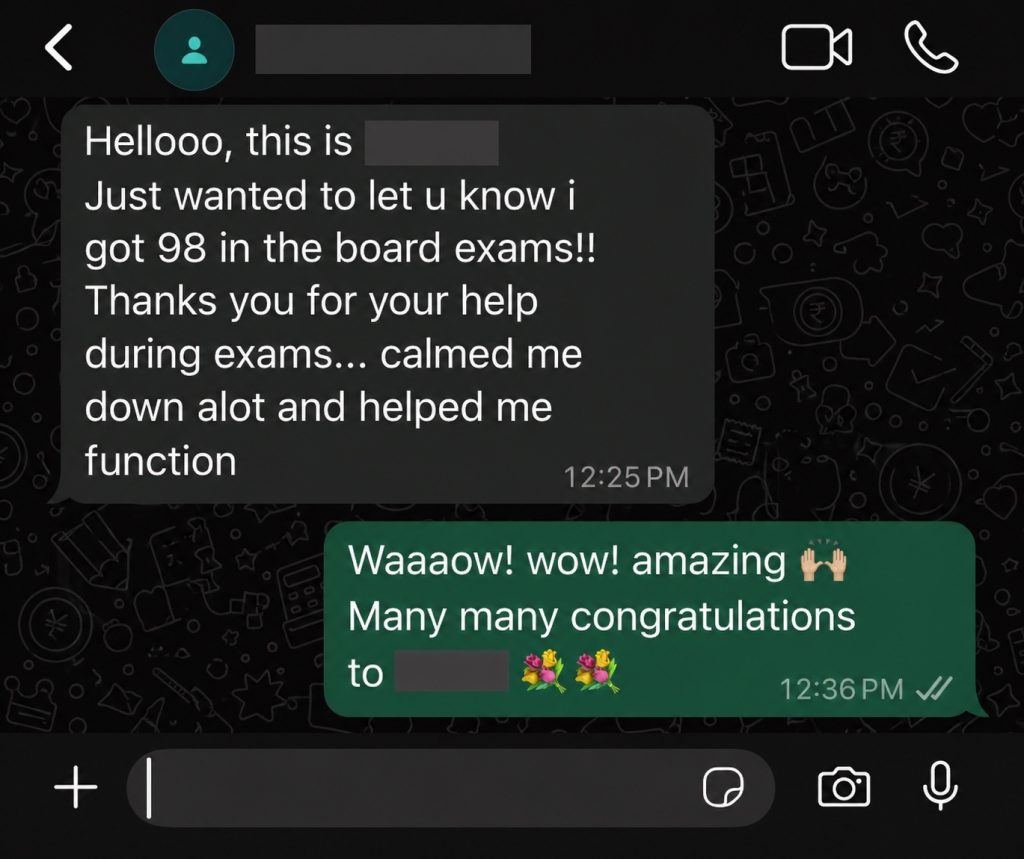
Exam anxiety is not always visible from the outside. But when a student feels calmer, steadier, and able to function during intense academic pressure, the difference can be life-changing. One of my student patient sent me this message. Messages like this remind me that good psychological help is often less about drama and more about helping a person regain their footing.
What therapy does not mean
Therapy is not a magic shortcut to top marks.
It does not guarantee a score. It does not remove all pressure. It does not make exams suddenly pleasant.
What it can do is help a student become less captive to the cycle that keeps sabotaging them.
That can mean:
- less panic before exams
- better sleep during high-pressure periods
- more focused study sessions
- less mental spiralling
- more realistic self-talk
- better recovery after a difficult paper
- less dependence on last-minute reassurance
- more confidence in one’s actual preparation
In plain language: therapy can help a student function more like themselves under pressure.
And that is no small thing.
In clinical work, exam anxiety rarely appears as just “stress before a test.” More often, it shows up as a repeating loop of pressure, self-doubt, poor sleep, mental overactivity, and reduced functioning under pressure. A student may be intelligent and well-prepared, yet still struggle to access what they know when fear takes over. This becomes clinically important because the problem is not only anxiety itself, but the pattern that keeps recreating anxiety at the very moment performance matters most.
When to consider professional help
It may be worth considering therapy when exam pressure is leading to:
- repeated panic, blanking out, or intense dread
- poor sleep for days or weeks around exams
- severe overthinking that affects studying
- crying spells, shutdown, or irritability under academic pressure
- strong self-doubt despite adequate preparation
- procrastination that feels more emotional than practical
- the sense that fear is now affecting performance more than the syllabus is
This is especially important if the problem keeps repeating across exams, presentations, interviews, or other performance situations. Repetition usually means there is a deeper loop worth understanding, not just a one-off bad patch.
Drawing from my work as an RCI-Licensed Clinical Psychologist, I often find that students do not only want reassurance. They want to understand why they freeze, overthink, panic, procrastinate, or lose confidence despite caring deeply about their studies. Good therapy can help make that pattern clearer, reduce shame around it, and support better emotional regulation, steadier study rhythm, and more reliable functioning during high-pressure academic periods. This article is educational in nature and does not replace therapy or an individualized clinical assessment.
What change may realistically look like
The goal is not to become superhumanly calm.
The more realistic goal is something sturdier:
You sit down to study and your mind is less noisy. You can return to the page more quickly after stress. You sleep better before an exam. You do not turn every setback into a personal catastrophe. You can feel anxious and still function. You perform more from preparation than from panic.
That is often what meaningful progress looks like.
Not the absence of all anxiety.
The return of steadiness.
“Exam anxiety is often not a lack of ability. It is the mind losing steadiness exactly where steadiness is most needed.” — Tejas Shah
A gentle closing thought
Sometimes students assume they just need to “be stronger.” Often that is the wrong frame.
The more useful frame is this: your anxiety may not be random, and it may not be weakness. It may be a pattern that has become too costly. Once that pattern becomes clearer, it usually becomes easier to work with.
If this speaks to what you have been going through, a first consultation can help clarify whether therapy may be useful for exam anxiety, overthinking, and performance pressure.
FAQs
Is exam anxiety normal, or does it mean something is seriously wrong?
Some anxiety before exams is normal. It becomes a real problem when it starts affecting sleep, concentration, confidence, routine, or the ability to perform at your actual level.
Can therapy help even if I already know I overthink?
Yes. Insight is helpful, but insight alone does not always interrupt the pattern. Therapy can help you understand what keeps the overthinking cycle going and how to respond differently when it starts.
Can therapy help with blanking out in exams or presentations?
Often, yes. Blanking out is frequently linked to pressure, fear, and mental flooding rather than lack of intelligence. Therapy may help by reducing the loop of panic that interferes with thinking under pressure.
How long does therapy for exam anxiety usually take?
That depends on the person, the severity of the anxiety, and whether this is a short-term performance issue or part of a longer-standing pattern of overthinking, self-doubt, or perfectionism. Some people benefit from focused short-term work; others need deeper work.
Tejas Shah is an RCI-Licensed Clinical Psychologist and Therapist at Healing Studio. He works with anxiety, overthinking, self-doubt, emotional regulation difficulties, academic stress, and repeated inner patterns that begin affecting daily life, studies, work, and relationships. His approach aims not only at symptom relief, but at helping people understand what keeps the difficulty going so they can function with greater clarity, steadiness, and self-trust. If exam stress, performance pressure, or anxiety around studies is affecting your life, a first consultation can help clarify what kind of support may be useful.